
Could a game of “doctor” or “playing house” be the secret classroom for empathy your child needs?
Pretend play lets kids step into others’ shoes and act out feelings. It’s a safe space to try different responses. This play is more than fun; it shapes how kids understand others and solve problems.
Studies show kids as young as three start to see things from another’s view. These skills grow as they get older. This makes pretend play a key focus for parents and teachers in the U.S.
Role-playing activities at home or in preschool help kids practice kindness and cooperation. They build better friendships through these activities.
Key Takeaways
- Pretend play is a powerful way to teach perspective-taking and empathy early on.
- Children begin to understand others’ feelings by age three and refine those skills over time.
- Everyday role-play and story-based activities help children practice emotional responses.
- Parents and caregivers can model empathy and ask perspective-taking questions during play.
- For practical tips and age-appropriate strategies, see resources on building perspective-taking skills in young children at First5Nevada.
The science behind pretend play and social-emotional development
Modern research shows that pretend play boosts social thinking in young children. Studies using brain scans, behavioral tests, and classroom observations confirm this. Pretend play helps kids understand others’ feelings by letting them try out different roles and emotions safely.
Brain development and theory of mind
In preschool, the brain areas for thinking and feeling start to work together better. This helps kids think about different points of view. By age three, some kids can guess what others might believe or feel.
Stages of perspective-taking show how kids grow in understanding others. This growth is linked to better social skills and making kind choices later on. Activities that ask kids to see things from another’s point of view help build these skills.
Language, cognitive flexibility, and emotional understanding
Language helps kids switch between different views. When they talk about feelings or act out a role, they practice this. This practice makes them better at planning and controlling themselves.
Pretend play helps kids understand others because it makes them think like someone else. Reading stories, asking about characters’ motives, and asking your child to describe how characters feel can help. These actions help kids label emotions and think more flexibly.
Evidence from experimental and observational studies
Studies show that exercises that help kids see things from another’s point of view make them more helpful. They also help kids with autism spectrum disorders understand social cues better. Research finds that acting out roles makes kids more emotionally involved than just imagining.
Medical and educational research shows that role-playing increases empathy and understanding of others. Kids who play together use more words about feelings and “we” language. For more ideas and resources, check out strategies for play-based learning.
How pretend play teaches kids empathy
Watching kids act out doctor visits or switch roles shows more than just fun. It’s where they learn about social understanding. Pretend play helps kids understand others by letting them practice feelings and motives safely.
Stepping into another’s shoes through role adoption
Role adoption lets kids mimic others’ actions, words, and feelings. By playing roles like teacher or cashier, they learn about others’ needs. This process, as Selman’s stage model shows, helps kids see things from another’s perspective.
Ask your child why a character acts a certain way. This helps them understand that people have different thoughts and feelings. It builds empathy and social understanding.
Emotional rehearsal in safe contexts
Pretend play is a safe space to practice caring responses. You can talk about sharing or welcoming a new sibling without worry. It’s a chance for kids to learn about kindness and sharing.
They practice saying sorry or asking if someone is okay. This makes them feel more comfortable with real emotions later on.
Cognitive practice for perspective-taking
Pretend play with prompts and role-switching helps kids think about others’ motives and knowledge. This improves their problem-solving and reduces misunderstandings. It’s a way to build important social skills.
Studies show that acting out roles, like being a caregiver, increases empathy more than just imagining. Using pretend play at home or in class gives kids many chances to develop these skills.
Related Guides on Pretend Play, Empathy, and Perspective-Taking
If you want to explore this topic in more detail, these related guides explain how imaginative play helps children understand feelings, recognize other people’s emotions, practice kindness, and build perspective-taking skills through everyday pretend play.
- How Imaginative Play Helps Kids Develop Empathy
- How Pretend Play Teaches Kids to Understand Others
- How Role Play Helps Kids Understand Feelings and Needs
- How Imaginative Play Builds Perspective-Taking Skills in Children
- How Make-Believe Play Teaches Kids Kindness and Caring
- How Pretend Play Builds Social Understanding in Young Children
- How Imaginative Play Teaches Kids to Recognize Other People’s Emotions
- How to Encourage Pretend Play and Empathy at Home
- How Dramatic Play Helps Kids Understand Different Points of View
- How Imaginative Play Makes Social Learning Natural for Kids
Benefits of imaginative play for emotional literacy and empathy
Imaginative play is like a safe space for kids to learn about feelings. They get to name emotions, read body language, and try out different roles. This helps them understand and express feelings better.
Improved emotion labeling and recognition
Games like emotion charades and talking about stories help kids learn new words for feelings. They also get better at reading facial expressions and body language. Asking questions like “How does the doctor feel?” helps kids link words to feelings.
Better social problem-solving and regulation
Pretend play teaches kids about sharing, taking turns, and solving conflicts. It helps them control their impulses and work together better. Asking “How do you think they feel?” helps kids think before acting, improving their problem-solving skills.
Transfer to real-world relationships
Skills learned through play help kids in school, with friends, and with family. Praising kids for understanding others and guiding them to reflect on their actions helps solidify these lessons. Studies show that early practice in empathy through play leads to better social skills later on.
Role-playing activities parents and caregivers can use at home
Short moments can teach big lessons in kindness and understanding. Simple setups fit into your daily life. These activities help kids practice feelings, choices, and helpful actions in familiar settings.
Everyday pretend scenarios
Try a quick “restaurant” scene where your child takes orders and you play a picky customer. Encourage them to offer choices and share the menu. Praise them when they notice another person’s preference.
Play “doctor” with one child as patient and another as caregiver. This practice helps them use comforting phrases and check for signs of hurt.
Use a grocery store game to teach helping strangers and respecting preferences. When a toy goes missing, act out a brief script. This shows how pretend play teaches empathy through actions and words.
Story-based role-play and character swapping
Read a familiar book like Where the Wild Things Are or Charlotte’s Web. Ask your child to act as a different character and retell a scene from that viewpoint. Use prompts like, “Why did they do that?” and “How would you feel?” to deepen thinking.
Swap roles so each child voices another character’s motives. This reinforces empathy by trying on different thoughts and feelings. Keep scenes short and rotate parts so every child practices both speaking and listening.
Emotion charades and mirror play
Use cue slips or flashcards with feelings: surprised, frustrated, proud, shy. Kids act out the card while others guess and ask what caused that feeling. Follow with a quick question: “What could help them feel better?”
Stand with a mirror and model an expression, then ask your child to describe the physical clues and guess the feeling. Switch roles so your child leads the mirror exercise. These exercises show that pretend play teaches kids empathy by linking visible cues to inner states.
Keep activities brief, scaffold with open-ended questions, and praise specific perspective-taking: “You asked about her choice—that was thoughtful.” Rotate roles to balance practice and to make fostering empathy through pretend play part of everyday moments.
| Activity | Goal | Time | Tips |
|---|---|---|---|
| Restaurant role-play | Practice listening and honoring choices | 10–15 minutes | |
| Doctor and patient | Use comforting language and check-ins | 8–12 minutes | |
| Grocery helper | Support helping behavior and preferences | 10 minutes | |
| Story swap | Explore motives and alternative emotions | 5–10 minutes | |
| Emotion charades | Improve emotion labeling and inference | 5–10 minutes | |
| Mirror play | Link facial cues to feelings | 5 minutes |
Classroom strategies: children’s role-playing activities for educators
You can create classroom routines that make pretend play a learning path. Start with clear spaces, themed props, and simple role cards. This helps every child know what to do and makes play safe and fun.
These elements also help you teach language and emotion words. It’s a great way to help kids learn.
Guided dramatic play centers
Set up centers with themes like a grocery, clinic, or family kitchen. Change props and roles often so kids see different views. Teachers should model empathy and guide without taking over.
Give kids open materials and role cues. Ask them to think about what the caregiver would do next. This encourages them to try new things and see things from others’ perspectives.
You can also link this to construction play for even more scenarios.
Structured peer role-switching exercises
Pair kids and give them roles like patient and caregiver. Switch roles halfway so everyone plays both parts. This helps kids understand different views better.
Keep turns short and follow a chart to track roles. Ask kids to share what was different when they swapped roles. This helps them understand empathy better.
Reflective talk and debriefing techniques
After play, have short debriefs with questions like “How did it feel to be the helper?” or “What did you notice about the other person?” Encourage drawings or quick notes for quieter kids.
Praise specific acts, like sharing or waiting, to teach social skills. Use sentence starters like “I noticed…” or “I felt…” to help kids grow their language skills. This shows you value their thoughts.
By combining guided centers, role-switching, and reflective talk, you create a classroom that teaches empathy through play. It shows how role-playing can really help kids understand others better.
How immersive role-play increases engagement and empathy
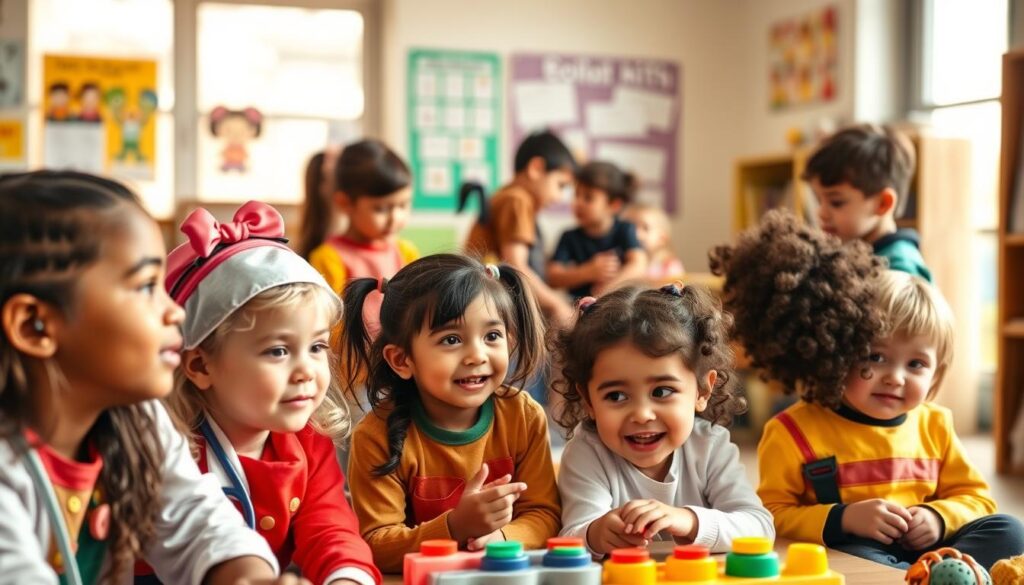
Immersive role-play takes pretend play to a new level. It lets children practice social skills in action. This way, they learn to be more empathetic by taking on roles and interacting with others.
Active enactment vs. imagination alone
Studies show that role-playing is more engaging than just imagining. Children feel more emotions and understand others better when they act out roles. Caregiver roles, in particular, spark deep involvement because they involve real actions and communication.
Measures of engagement and language markers
Experts can tell when children are fully engaged through language. They look for changes in how children talk and how they connect with others. These signs show if pretend play is helping kids become more empathetic.
Practical tips to make role-play immersive and safe
Keep playtime short and use simple words to manage feelings. Use real props and tasks to make scenes feel real. Always set clear safety rules and let kids choose not to play if they’re uncomfortable.
Talk about feelings right after intense play. Ask kids to share what they felt and why. Use pictures or other tools to help if needed. This way, kids learn empathy while staying safe and happy.
the Playful Kids approach shows how games can boost emotional smarts and social skills. It offers tips for using these ideas at home or in school.
Teaching empathy through make-believe scenarios: scripts and prompts
Short, realistic scripts and open prompts can make pretend play a great way to learn about social skills. These tools help you teach kids how to use empathic language. They also guide children to explain their feelings and the reasons behind their actions. This makes pretend play a natural and educational part of your daily routine.
Short scripts to model empathic language
Try simple lines during pretend play: “You seem upset. Do you want to tell me what happened?”
Use reflective statements to name feelings: “I can imagine that made you feel sad; I’m here to help.”
For conflict scenes, try: “I noticed you took the toy. How do you think your friend felt? What can we do now?”
Prompts that encourage explanation of feelings and motives
Ask open questions that invite perspective taking: “Why do you think they did that?”
Follow with feeling-focused prompts: “How would you feel if that happened to you?”
Use motive and prediction prompts to build reasoning: “What could make them feel better? What might they try next?”
Adapting scenarios to age and language level
For toddlers, keep language simple and use gestures. Use labels like happy, sad, mad, and short role exchanges.
For preschool and early elementary children, introduce multi-step scenes and basic why/how prompts. Encourage short role swaps to practice turns and feelings.
For older children, use journaling or extended story swaps. Ask them to write or tell a scene from another character’s viewpoint and analyze motives and outcomes.
Practical tips for effective prompts
Keep prompts supportive and neutral. Match complexity to language ability and attention span.
Offer sentence starters when needed: “I think they felt ___ because ___.”
Reinforce attempts at perspective taking. Point out when a child notices another’s need during pretend play.
| Age Group | Script Example | Prompt Type | Goal |
|---|---|---|---|
| Toddlers (1–3) | “You look sad. Want a hug?” | Emotion labeling | Build basic feeling vocabulary |
| Preschool (3–5) | “Why did the doll cry? What can we do?” | Why/how questions | Encourage simple perspective taking |
| Early elementary (6–8) | “How would you feel if that happened to you?” | Prediction and motive | Develop reasoning about motives |
| Older children (9–12) | “Write the scene from the other person’s view.” | Extended narrative | Refine complex perspective taking |
Promoting empathy skills through pretend games for children with diverse needs
Adapting pretend play for kids with different learning styles makes empathy easier. Start with simple, short routines to avoid confusion. Use role cards, picture scripts, and emotion icons to help kids follow and express feelings.
Structured and visual supports
Break down scenarios into three to five steps for kids to know what’s next. Visual schedules and social stories help set expectations. Use prompts to practice helping and naming emotions.
ABA-informed techniques that respect neurodiversity
Teach short social scripts in discrete trials, then add them to play. Keep the child’s choices central and avoid repetition. Praise them immediately for showing empathy, like asking if a friend is okay.
Peer-mediated and scaffolded approaches
Train peers to use empathic language and take turns. Start with adult-led play, then fade prompts for kids to play alone. This helps them use skills in new situations.
For tips and examples, check out this guide on teaching empathy: key strategies to teach children empathy. Use these ideas to make role-playing activities supportive and predictable.
Always respect kids’ comfort and consent in exercises. Give them meaningful roles, not just tasks. Studies show that respectful, tailored practice can improve empathy in young children, including those on the autism spectrum.
How role-switching and caregiver-focused roles enhance perspective-taking
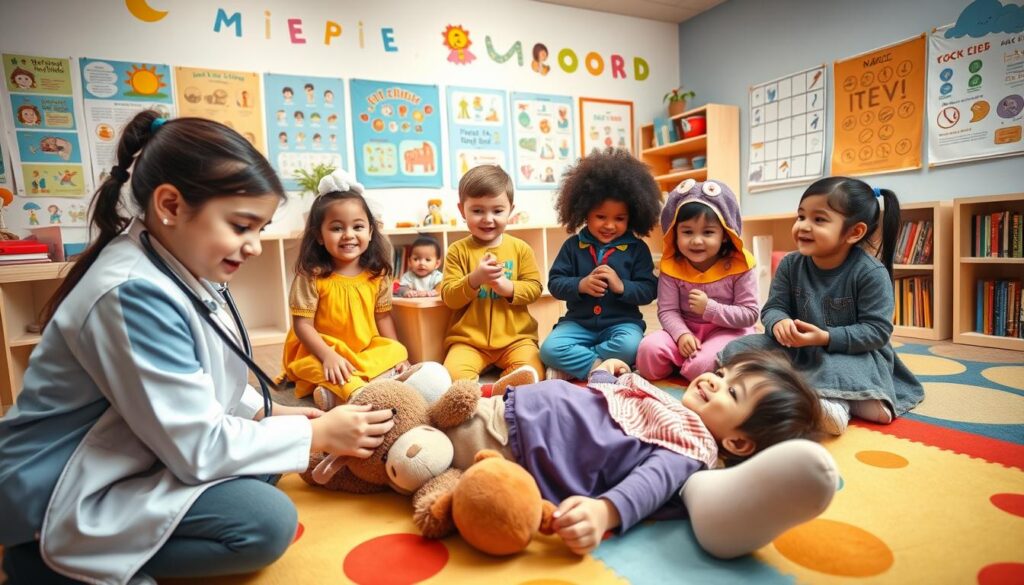
Playing caregiver roles makes you focus more on needs, comfort, and safety. When you help a child in scenes like feeding, soothing, or solving problems, they learn to express emotions and plan. This shows how role-switching helps by making kids act for others, not just imagine them.
Why caregiver roles can produce stronger engagement
Caregiver roles require responsibility and talking. You’ll see kids putting more effort into their play when they care for a doll or friend. This is why experts say role-playing boosts empathy in kids.
Benefits of alternating roles for balanced learning
Switching roles lets kids practice giving and receiving care. This balance helps them understand others better and see things from their point of view. It’s a key way to build empathy through pretend play.
Activities to practice caregiver reasoning and compassionate action
- Care Clinic: Have a child act as a caregiver to check who needs help. Ask them to explain why they chose certain actions.
- Helper Swap: One child acts frustrated, and the other responds with kindness and solutions. Then, switch roles and discuss the choices.
- Reflective Debrief: After play, ask questions like “What did you notice about their feelings?” and “What helped them?” Encourage specific answers.
Use simple items like toy phones, blankets, or kitchen sets to start caregiving scenes. Keep turns short and switch roles often. This way, every child gets to see things from both sides, improving empathy through pretend play.
Assessing progress: signs your child is developing empathy through play
Watch for signs that pretend play boosts social growth. Simple observations over weeks can show change. This helps guide your next steps in empathy development.
Your child might start comforting others without being asked. This could be giving a toy to a crying friend or checking on a friend. Sharing and fair turn-taking also show social growth.
Look for deeper role-play where your child plans actions for others. They might explain their motives while acting out a scene.
Language markers and reflective talk
Listen for phrases like “I’m sorry you’re upset” or “Are you OK?” These show emotional awareness. An expanding emotional vocabulary is important. You might hear statements like “I think they felt left out because…”
These shifts show growing perspective-taking. They move from self-focused to other-oriented explanations. This is typical when pretend play teaches empathy.
When to seek additional support
If your child has trouble recognizing others’ feelings for months, shows rigid play, or avoids imaginative play, seek help. Talk to a pediatrician, preschool special educator, or child psychologist. Early intervention and social skills programs can help.
Practical guidance for parents: fostering pretend play daily
Make pretend play a regular part of your routine to support social growth and emotional learning. Short, device-free blocks of time work best. Keep props simple: costumes, stuffed animals, a play kitchen or a few wooden figures invite stories without overwhelming your child.
Creating time, space, and materials for imaginative play
Designate a safe, flexible corner of your home where furniture and toys can be moved easily. Rotate materials every few weeks to spark new narratives and keep interest high. You do not need expensive sets; a scarf can be a cape, a box becomes a house, and a spoon can be a phone.
Offer predictable play windows, such as after snack or before dinner, so your child learns to expect free-play time. When you observe play, step in lightly. Your presence supports exploration without taking control.
Modeling emotion talk and asking perspective questions
Use everyday moments to label feelings for your child and characters in books. Say things like, “She looks sad; what might help?” Pause during storytime to ask, “How do you think he felt when that happened?” These prompts teach that thoughts and feelings differ across people.
Praise specific perspective-taking: “You gave the bear a blanket when it was cold — that was thoughtful.” Short, clear feedback helps children link pretend actions to real empathic choices.
Balancing structure and child-led play
Mix free, child-led sessions with brief guided role-play to target particular skills. For example, follow five minutes of open play with a two-minute prompt: “Can you show me how the doctor helps when someone is scared?” This keeps creativity while focusing practice.
Start with light scaffolding, such as sentence starters or a simple script. Gradually fade supports as your child gains confidence. Keep debriefs brief: ask what happened, how characters felt, and one thing that helped.
Keep the mood playful, be specific when praising effort, and use short reflections after play to solidify learning. These habits make fostering empathy through pretend play part of your daily family life and show how pretend play teaches kids empathy through small, consistent steps.
Conclusion
Pretend play helps kids learn empathy by letting them see things from others’ points of view. Studies show that acting out roles, practicing emotions, and thinking deeply about feelings all help. This is why play is so important for kids—it’s a safe way to learn to care and understand others.
Make learning fun by using simple routines. Try switching roles, focusing on the caregiver, and talking about feelings after play. When you talk about emotions and ask “How would they feel?” questions, you’re helping kids learn empathy. Make sure all kids can join in by using different prompts and visual aids.
Early practice in seeing things from others’ perspectives can lead to many benefits. It helps with emotional smarts, better friendships, and solving conflicts. Look for signs that your child is getting better at empathy and understanding. If you’re worried, talk to a doctor or child psychologist. Even short pretend play sessions can help a lot.