
You watch a group of children stack wooden blocks and soon they have a tiny town. Within minutes they solve problems, share ideas, and fix what falls. That simple scene shows how hands-on moments help a child learn through doing.
Research and classic theory back this up. Jean Piaget showed that kids learn by testing how pieces fit together. Studies also find that when given free choices in early years, children often pick constructive play more than half the time.
By encouraging play early, you set the stage for creativity, critical thinking, and teamwork. Constructive play helps children build skills they will use in school and life. This guide will show you how to support that growth and why these early experiences matter.
Key Takeaways
- Hands-on building lets children learn by doing.
- Kids naturally choose constructive activities in early years settings.
- Piaget’s work supports exploration as a learning method.
- Constructive play strengthens thinking, creativity, and social skills.
- Supporting play early creates a strong foundation for future learning.
Understanding the Fundamentals of Construction Play
When kids handle blocks, sand, or wood, they begin to probe how the world fits together. This hands-on testing helps you see how children learn by matching ideas with physical results.
The Role of Exploration in Early Learning
Jean Piaget argued that children form knowledge by experimenting with objects and observing outcomes. You can support that process by offering open-ended materials.
“Constructive play is valuable for its own sake.”
- Give blocks, cardboard, sand, and wood so children try balance and symmetry.
- Open resources let one child interpret an idea in a unique way, boosting creativity.
- As children build, they learn how different materials behave and how objects fit.
Tip: For more practical guidance on encouraging constructive approaches, see constructive play basics.
Key Developmental Benefits of Construction Play
Hands-on building moments give children a clear way to test ideas and learn cause and effect.
Cognitive and Problem Solving Skills
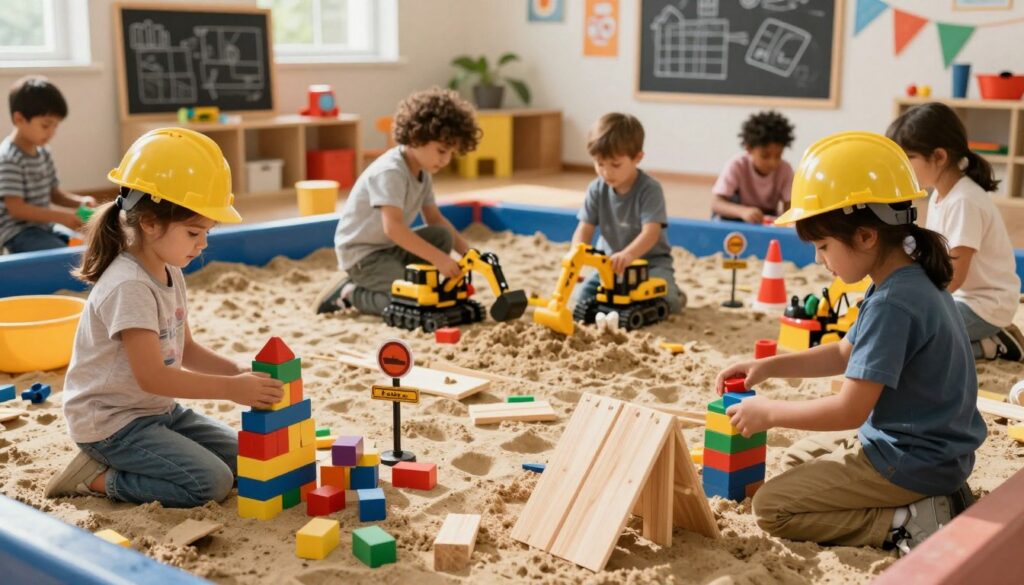
When children arrange blocks and parts, they practice planning, balance, and spatial thinking. You’ll see them try a solution, notice a failure, then adjust until it works.
This trial-and-error approach builds persistence and logical reasoning—core skills for later STEM learning.
Fine Motor Development
Handling small pieces strengthens hand muscles and coordination. These motions support future writing and self-care tasks.
Fine motor skills grow as kids pick up, stack, and align objects with growing precision.
Social and Emotional Growth
Group building encourages cooperation, sharing materials, and solving disagreements. As kids complete their creations, they gain pride and better emotion control.
- Research highlights eight key benefits construction play brings to child development.
- Children build social skills and confidence through shared projects.
“Children learn by doing, and hands-on building gives them space to explore.”
Essential Materials for Building and Creating
Gathering a mix of wood, cardboard, LEGO, play dough, and recycled boxes gives you a simple toolkit for construction play and creative work.
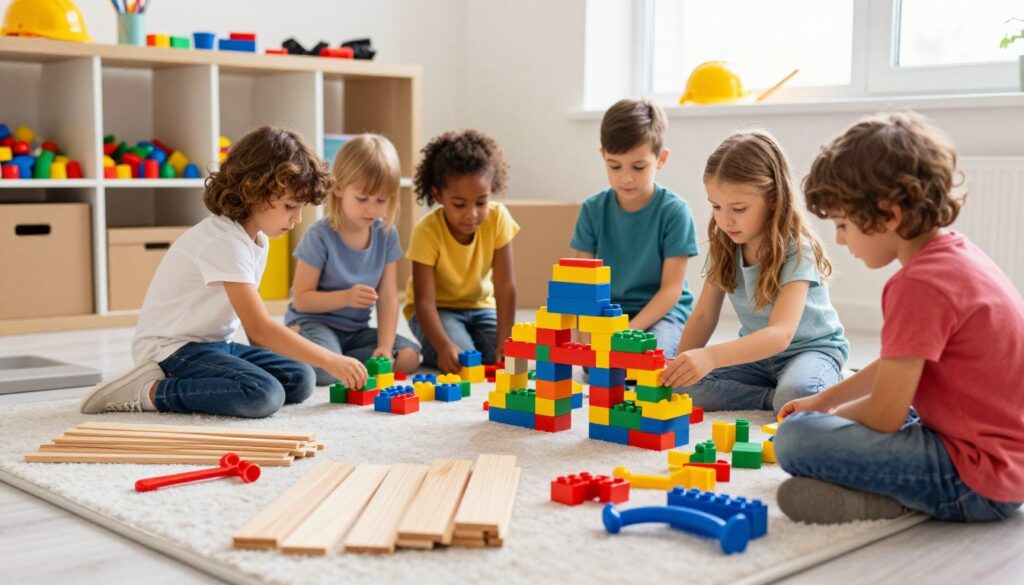
Provide a variety of materials so children can choose how to solve problems. Natural materials like wood and sand add texture. Structured sets such as blocks and LEGO offer predictable connections.
- Use sand and buckets outdoors — building sandcastles teaches volume, density, and buoyancy while being a lot of fun.
- Offer scissors, tape, and cardboard so kids can cut and join parts into rockets or houses.
- Add puzzles and small pieces to help fine motor control and shape recognition.
The best experience combines loose resources and kits. When children build with varied objects, they refine motor skills, grow creativity, and learn through hands-on trial and error.
“Providing diverse materials lets each child invent and learn in their own way.”
Strategies to Encourage Engagement in Early Childhood
Start by sitting beside a child and handling the same materials; your example sparks new ideas. A brief, curious model often invites others to join. Keep your words simple and your moves small so children can copy and try.
Modeling for Children
Get down to their level and use the same blocks and tools. When you model a short task, you show one way to test an idea.
This gentle lead helps less confident learners try new roles and join group building.
Scaffolding Language and Communication
Ask open-ended questions like, “What might happen if we add this piece?” Then add new words: size, balance, curved, secure.
Label materials with signs and describe the process as children work. That vocabulary boosts thinking and social skills.
- Follow children’s impulses; their ideas guide richer projects.
- Show interest in creations to validate effort and support learning for life.
“Small moves and simple words expand curiosity and collaboration.”
Integrating Risky Play and Real-World Tools
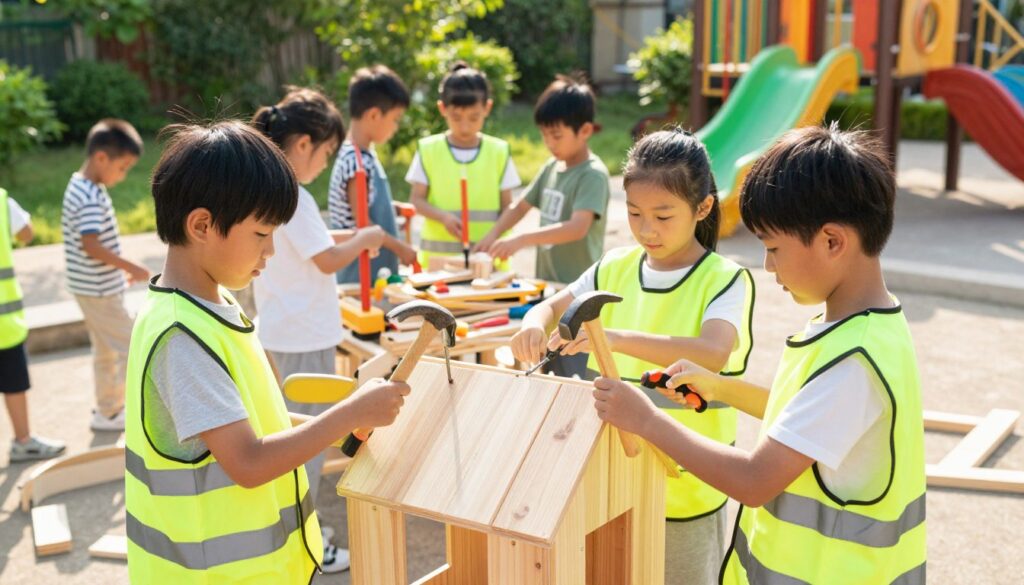
When children experiment with simple real tools, they learn safety, patience, and mechanical ideas. You can start small and build a safe routine that grows with their confidence.
Start with glue and basic hand tools. Wood glue and supervised cutting help fine motor skills and teach the process of joining pieces. These early steps prepare kids for more complex tools later.
Supervised risky tasks—like measured use of drills or saws—teach judgment and emotional control when a creation falls apart. Managing frustration builds resilience and practical problem solving.
- Begin with wood and cardboard projects outside—add sandcastles or simple frames to vary the environment.
- Introduce one tool at a time, model use, then let children try with supervision.
- Celebrate effort and discuss safety rules to keep exploration fun and focused.
| Stage | Materials | Learning Focus |
|---|---|---|
| Starter | Glue, cardboard, blocks | Fine motor, patience, basic joins |
| Intermediate | Wood pieces, hand tools | Tool technique, confidence, problem solving |
| Advanced | Supervised power tools, complex builds | Mechanics, engineering curiosity, resilience |
“Children gain lasting skills when they safely handle real tools and varied materials.”
The Spencer Clarke Group, founded in 2017 and recognised in 2024, highlights the need for a safe environment when children build with real tools. Let guided risk be part of your approach to meaningful, hands-on learning.
Conclusion
, You help shape a vital part of early years learning when you give time and materials to a child.
Support for construction play builds real skills and boosts learning for young children.
Encouraging building and simple projects grows creativity, problem solving, and social ability as children make their own creations.
These benefits are strongest when you set a safe, curious space and invite kids to play early and often. Learn more about the wider power of play.
Keep offering choices, notice effort, and celebrate small wins to unlock lasting development and confidence.