I remember the first time my child built a tiny bridge across the living room floor. With wooden and plastic pieces scattered like a small town, my child tested how far a block could span before it tipped. That simple activity opened a window into how children learn through hands-on construction and imaginative building.
Block play gives kids a way to explore ideas, materials, and space without pressure.
When I set up a dedicated block area, I noticed more focused experimentation. Children use cardboard or wood to try new ways of stacking and creating. This practice supports early childhood learning and essential skills for future development.
Organized spaces encourage longer, richer activity and help a child refine problem-solving, motor control, and social planning. From bridges to towers, using blocks lets imagination guide practical discovery.
Key Takeaways
- Block play supports early childhood learning and development.
- A dedicated block area boosts focused exploration and creativity.
- Using blocks helps children build motor, spatial, and social skills.
- Different materials, like plastic or wood, inspire varied construction ideas.
- Simple floor activities, like building bridges, promote problem-solving.
Understanding the Developmental Power of Block Play
Watching a small engineer at work, I see math and reasoning grow with each stacked piece.
Cognitive and Math Benefits
Block play gives children a hands-on way to explore number, symmetry, and estimation. The National Association for the Education of Young Children notes this activity supports problem-solving and reasoning. Charlie Chewter from PACEY highlights how simple experiments with size and balance teach early math concepts.
I use open-ended questions to guide my child to count pieces and notice patterns. Asking about the number of blocks helps focus attention and goal-setting during building.
Physical and Spatial Awareness
Comparing shapes and sizes helps children build spatial awareness and hand-eye coordination. My child tests structures to solve balance problems and learn cause and effect.
| Benefit | Example | Skill Developed |
|---|---|---|
| Counting and estimation | Counting blocks for a bridge | Number sense |
| Symmetry and patterns | Repeating color or shape sequences | Pattern recognition |
| Balance and stability | Testing tall towers | Spatial awareness |
| Problem-solving | Fixing a leaning structure | Reasoning and attention |
For deeper research on early childhood outcomes, see this early childhood development study. Providing chances to experiment with different sizes and shapes creates meaningful learning opportunities and supports long-term development.
Creating the Ideal Space for Construction
I carve out a quiet corner so my child can build without being bumped or interrupted.
Choose a low-traffic area on the floor, away from doors, as the Mississippi State University Extension Service recommends. I place a soft mat in the corner to mark the block area and keep foot traffic clear.
I give my child plenty of blocks and varied materials. Extra pieces let imagination grow and support longer construction projects.
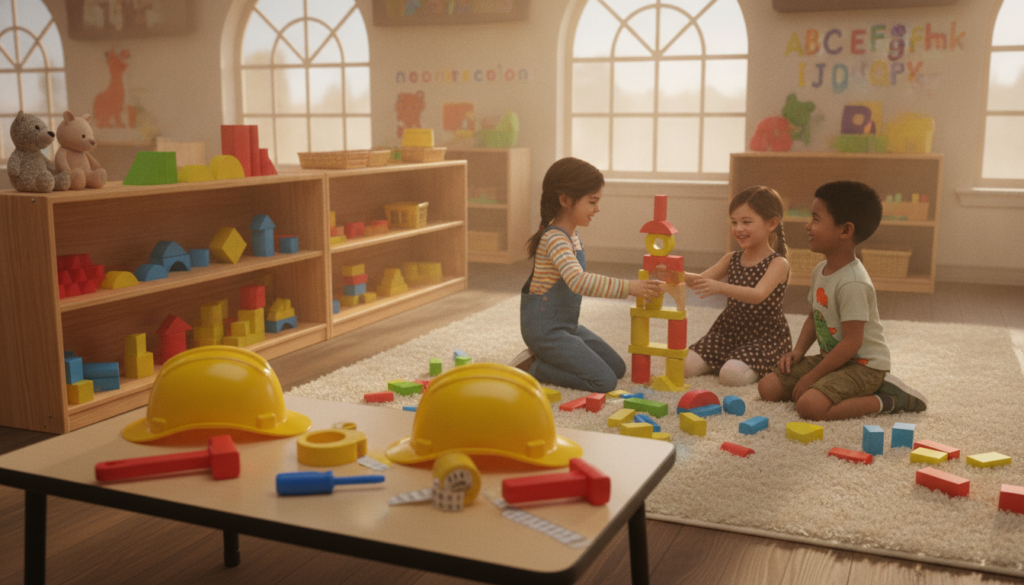
I keep bins with tops accessible so my child can start or return to work easily. Organized containers for each type of block help children find pieces and stay focused.
- Post photos of real buildings to spark new ideas.
- Allow returning to unfinished builds to encourage development.
- Divide areas for different block types to boost building skills.
A tidy, dedicated space supports sustained learning and creative construction. Small design choices make the area inviting and help a child take ownership of their play.
Essential Materials and Types of Blocks
I mix store-bought and homemade pieces to give my child a wider range of sizes and textures.
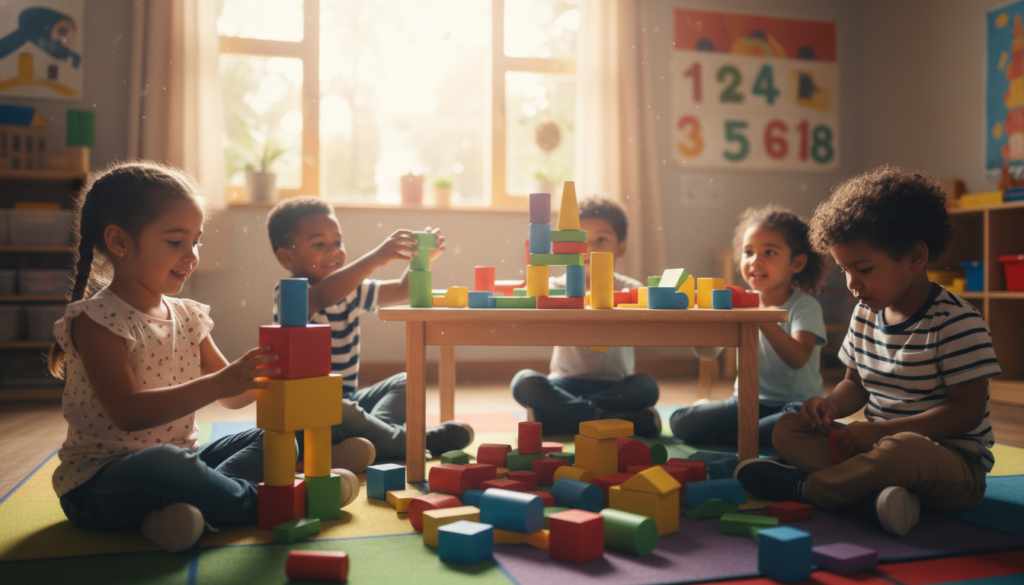
Good materials make building more inviting. I use wooden blocks, plastic building blocks, and soft, cloth-covered sponges so my children feel different textures as they create.
DIY Homemade Block Ideas
Simple recycled boxes make excellent homemade blocks. I stuff cereal, oatmeal, pasta, and shoe boxes with newspaper to keep them stiff and durable.
The Mississippi State University Extension Service recommends tape, construction paper, and scissors to finish pieces. I wrap boxes in construction paper for color and durability.
- Paper bag blocks: stuff lunch bags with newspaper and fold the top.
- Milk-carton and shoe-box towers: rinse, dry, and reinforce with tape.
- Measuring tools: I use a tape measure to help my child compare sizes while they stack blocks during daily play.
Offering varied types and materials gives children the right tools for every activity. Mixing homemade pieces with plastic sets expands creative ways to build and learn in the block area.
Supporting Growth Through Different Developmental Stages
I match materials to each age so toddlers and infants can explore safely and confidently.
For infants, I choose soft, washable pieces that can be banged, dropped, and cuddled. This keeps the block area safe and invites sensory learning for early childhood development.
For toddlers, I introduce harder wood blocks when they can stack and match. I stay close during these early steps and help a child reach the top of taller towers to encourage coordination and balance.
I keep the space open and uncluttered so children can move freely. I observe often and swap materials to match each stage. Knocking towers down remains an important activity for learning cause and effect.
| Stage | Recommended Materials | Adult Role |
|---|---|---|
| Infant | Soft, washable pieces | Supervise, offer cuddle-safe toys |
| Toddler | Wooden blocks, simple shapes | Stay close, demonstrate stacking |
| Preschool | Varied-sized blocks, measuring tools | Encourage longer builds, ask questions |
| Ongoing | Mixed materials to match skill | Observe and rotate materials |
Consistent support helps long-term development. For practical tips and the wider benefits of block play, I turn to trusted resources and my own observations to guide materials and space choices.
Engaging Preschoolers with Creative Building Activities
Small challenges—like making a bridge that holds a toy car—spark sustained curiosity. I use simple prompts to turn loose building into a focused activity that practices reasoning and fine motor skills.
Using Open-Ended Questions
I ask questions such as, “What are you building with your blocks?” This invites my child to explain ideas, count pieces, and plan sizes.
Counting blocks helps practice number concepts and keeps attention on the task.
Incorporating Dramatic Play
The Mississippi State University Extension Service suggests adding small people, animals, and trucks to the area.
I add plastic figures and tools like measuring tapes and toy hard hats to make construction feel real. Children use these props to create stories and practice cooperation.
Building Patterns and Structures
I challenge my child to build color patterns or to use only rectangular types to make towers and bridges on the floor.
Sorting animals into cages or building a garage from mixed materials reinforces categorization and spatial awareness.
- Take turns to build a castle or zoo together to boost social skills.
- Use measuring tools to compare sizes and practice simple math.
- Encourage imagination by turning constructions into real-life places.
Fostering Social and Emotional Skills
I watch children trade ideas and tools and see friendships form around a shared construction.
Block play offers rich chances for social growth. Todd Erickson notes it helps children build focus and resilience in a busy world. When kids take turns and share materials in the block area, they learn negotiation and cooperation.
Working together on a bridge or tall tower teaches perspective taking. My child gains confidence as they balance pieces and explain plans to a friend.
We also talk about simple math and balance as part of the activity. Discussing why a structure leans or stands steady builds concepts and awareness on the floor.
Using plastic figures to act out scenes helps children explore feelings and roles. The emotional satisfaction after finishing a project is powerful.
- Encourage taking turns and sharing tools.
- Give enough space so multiple children can work without disturbing structures.
- Celebrate ideas and the small wins that boost development and friendship.
Conclusion
I often see a quiet focus settle over the room when a new structure starts to take shape.
Block play gives children hands-on early childhood learning that builds real skills. By offering a dedicated area and a mix of blocks, I set the stage for math, balance, and thoughtful construction.
Encourage curiosity: support your child’s ideas, celebrate small wins, and let them test and rebuild. The social and emotional gains match the cognitive benefits, and both matter for a rich childhood.
To learn more about our approach, visit about The Playful Kids. Thank you for joining me in valuing simple moments that shape a child’s future.