I’ve curated 10 fun block building activities that help children gain skills while they enjoy creative construction.
I remember a rainy afternoon when my niece stacked wooden blocks into a tiny city. She named each tower and explained who lived there. Watching her, I saw how imagination turns simple pieces into stories.
In this guide, I share flexible ideas for home or classroom use. Each activity is simple, engaging, and designed to support early childhood learning through block play and hands-on problem solving.
As parents and educators, we can boost development by offering the right materials at the right time. Spend quality time with your child, ask open questions, and notice how blocks become tools for thinking.
Key Takeaways
- Ten easy activities support motor skills, language, and imagination.
- Materials are flexible for both home and preschool settings.
- Engaging with your child deepens learning and curiosity.
- Observe how children use blocks to solve problems.
- These ideas make learning playful and purposeful.
The Developmental Power of Block Play
I often watch a child arrange wooden pieces and think of them as little scientists. Through that focused time, children test ideas about balance, weight, and space. Koralek (2015) found that consistent interaction with blocks helps kids solve complex problems and boosts spatial awareness in early childhood.
Cognitive Benefits
Blocks invite experimentation. When a child builds bridges or tall towers, they apply measurement and balance—basic math concepts that underpin later learning.
Children use structures to model the world and to try out hypotheses about gravity and stability. This hands-on testing strengthens reasoning and concept formation.
Physical Development
Working with blocks refines fine motor skills and hand-eye coordination. Precise placement trains small muscles and fosters confidence.
As children handle pieces, they learn to plan and adjust. That coordination supports classroom tasks like writing and cutting, linking play to wider development.
Setting Up an Engaging Block Area
I set up a corner that invites children to build, move, and test their ideas.
Design the space so traffic won’t interrupt construction. Choose a roomy spot away from quiet areas. That clears space for movement and noisy play.
I follow the Creative Curriculum guidance: for 20 children, provide 2–3 shelves and a full unit set of 390 pieces. With 25 shapes, those blocks create endless opportunities for complex design.
Shelves teach organization and help each child find materials quickly. I find that the time spent arranging shelves and sorting shapes improves the quality of play and the learning that follows.
- Give clear access to varied blocks so children progress through the seven stages of block play.
- Keep the block area large enough for free movement and safe construction.
- Locate storage where kids can return materials easily to build responsibility.
| Feature | Recommendation | Benefit |
|---|---|---|
| Shelves | 2–3 for 20 children | Organization and independent access to materials |
| Block set | 390 pieces, ~25 shapes | Complex construction and extended engagement |
| Location | Away from quiet zones | Reduces disruption and supports energetic play |
A well-designed block area becomes a cornerstone of early childhood learning. It supports development, builds skills, and gives children real opportunities to explore ideas.
Essential Materials for Creative Construction
I like to show families how ordinary household items can become creative construction materials.
Good materials make building inviting. Caroline Pratt designed wooden unit blocks in the 1930s to spark imagination and problem-solving in children. You can mirror that spirit at home.
Homemade Block Ideas
Start with sturdy boxes—cereal, pasta, or oatmeal types. Stuff them with newspaper and tape the edges for durability.
- Use plastic containers and small cartons to add different sizes and shapes.
- Recycle materials so children learn resourcefulness while you save money.
- Mix traditional wood pieces with homemade options to expand creative ways to connect and balance pieces.
- Create a dedicated area where kids have easy access to materials and space to experiment.
- Turn prep time into bonding time by stuffing boxes together; that shared time builds both materials and memories.
For inspiration on how these items support learning, see what children learn from block play.
Varied materials give children access to the tools they need to express unique building ideas and grow fine motor skills, spatial thinking, and creativity.
Fun Block Play Activities for Infants
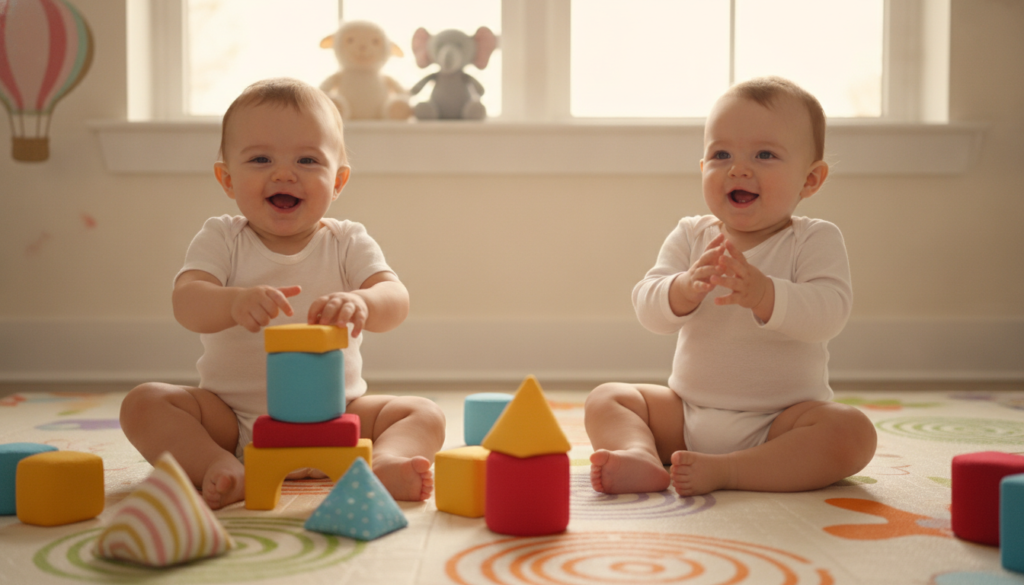
I often set out a soft pile of shapes and watch an infant explore each one with curiosity. Soft, washable blocks let babies bang, mouth, and cuddle safely while they learn about texture and weight.
I recommend introducing infants to soft, washable blocks that allow them to stack blocks and knock them down. Building a small tower with your baby supports early motor skills and spatial awareness.
Try dropping a cardboard piece from shoulder height to make a gentle crash. That sound grabs attention and invites repetition, which helps learning.
Make a mobile of lightweight pieces in different sizes and colors above the play area for visual stimulation. You can also fill a container with small shapes to encourage grasping and reaching.
- Offer items made of varied materials so children learn through touch and sight.
- Create a safe space where stacking and toppling are allowed; your time together matters most.
- Choose age-appropriate, plastic-free options when possible to reduce choking risk.
“The time you spend playing in a safe space builds the foundation of future learning.”
For more ideas and organized activities, see block activities for young children.
Engaging Toddlers with Building Challenges
A small change—a tape road or a toy hammer—can turn routine stacking into a thrilling task. I set up clear space and simple goals so toddlers move and think while they build. These short challenges boost attention, balance, and counting in playful ways.
Stacking and Balancing
Encourage toddlers to stack blocks into towers. I show them how to even out a stack so it won’t topple and count the number of pieces as we go.
Stacking strengthens fine motor skills and introduces basic balance and measurement.
Imaginative Role Play
I turn the block area into a tiny construction site with plastic hammers and measuring tapes. Asking open-ended questions like, “What are you building?” sparks stories and new ideas.
Movement-Based Games
Use masking tape on the floor for roads and add tunnels or bridges to crawl through. I also include gross-motor tasks from a set of 30 activities so children combine strength and problem solving.
“The time you spend guiding short, active challenges helps toddlers grow both skills and confidence.”
Advanced Block Play Ideas for Preschoolers
A simple constraint—use only rectangles—can spark complex engineering from small hands.
Challenge preschoolers to build castles, bridges, or homes for family members using specific shapes. Limiting materials turns free building into a focused task that tests reasoning and design skills.
Ask a child to sort blocks by sizes or shapes before construction. That sort-and-build step strengthens math thinking and classification.
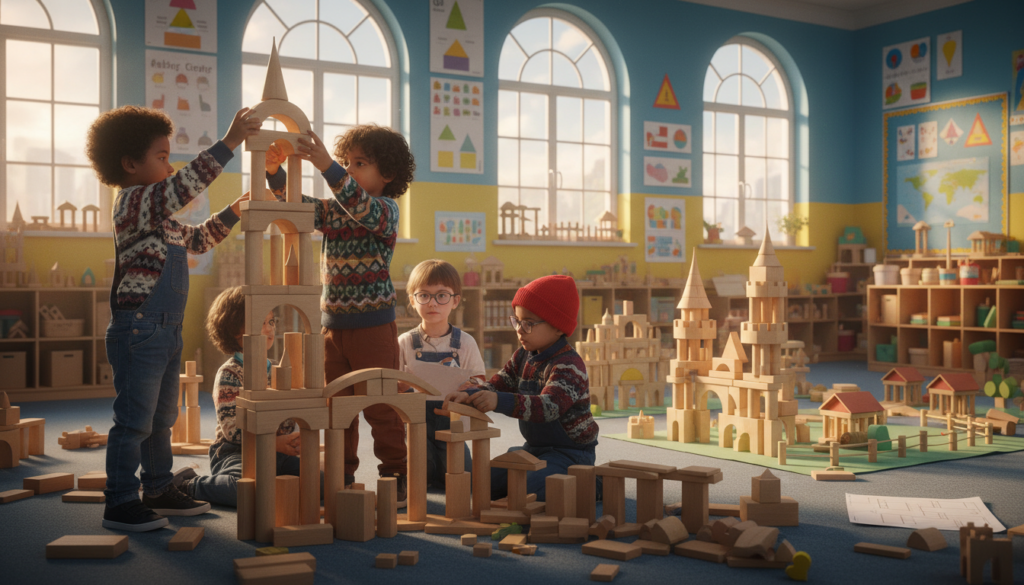
Add props like plastic animals or small figures to encourage storytelling and imagination. I also ask open-ended questions about their plan so children reflect on choices and improve techniques.
- Try a balance game: build a low wall and place plastic eggs on top without them falling.
- Recreate a building from a walk in the neighborhood to fuel new ideas.
- Assign themed projects—like the Three Little Pigs houses—to introduce problem solving.
Provide a dedicated area so structures can stay up. Extended time supports deeper construction, collaboration, and skill development.
“Constraints often invite the most creative solutions.”
Incorporating Math and Science Concepts
I often watch how children compare two towers and learn measurement without a formal lesson.
Block play gives real opportunities for kids to explore gravity, stability, weight, and balance through hands-on testing. When a child builds a bridge, they learn how shapes and supports affect the top of the structure.
Introduce simple vocabulary like “weight” and “balance” as your child builds. Counting the number of blocks in a tower teaches one-to-one correspondence and early addition.
Provide measuring tapes in the block area so children can compare height and length. Small experiments—two towers, different bases—turn construction into science.
“Every time a child builds, they are engaging in design and problem-solving that strengthens cognitive development.”
- I believe block play offers natural ways to learn measurement, length, and width.
- Children use blocks to test gravity and stability as they adjust materials and shapes.
- Watching patterns and symmetry emerge helps math awareness and spatial skills.
| Concept | Child Activity | Learning Outcome |
|---|---|---|
| Measurement | Compare tower heights with a tape | Understanding length and comparison |
| Stability | Test different bases for bridges | Awareness of balance and weight |
| Patterns | Repeat color or shape sequences | Early algebraic thinking and symmetry |
For practical ideas to set up your block area, see block area tips. Small, guided experiments make math and science feel like a natural part of building.
Observing and Supporting Your Child
A few minutes of focused watching often reveals the strategies a child uses to solve design problems. I sit near the block area and note how my child chooses shapes and balances pieces. Quiet observation helps me understand their approach to construction.
Show genuine attention. Ask open-ended questions so your child explains the idea behind their design. Questions like “How did you make that stay on top?” invite thinking without taking control.
I recommend photographing structures on the floor. A picture helps children feel proud and lets you track progress over time. It also starts conversations about height, balance, and math in everyday moments.
- Spend time watching different types of construction to learn your child’s process.
- Offer varied materials to spark new ideas and boost creativity.
- Support experimentation — celebrate attempts even when structures fall.
“Your attention and simple questions build confidence and deepen learning.”
As parents, our role is to provide space, materials, and encouragement. The time you give your child in the area matters more than fixing designs. Stay curious, ask gentle questions, and enjoy watching development unfold.
Conclusion
Short building sessions often reveal a child’s emerging strategies for planning and measurement. I value the quiet focus and the small moments of discovery. These brief periods of time help a young mind test ideas and gain confidence.
Focus on the process rather than a final model. That approach supports early childhood development and boosts practical math thinking and problem solving. It also turns ordinary moments into meaningful learning time.
I hope this guide gives you tools and the confidence to support your child’s development. For more resources, contact the Mississippi State University Extension Service at 662-325-2262. Parents, keep exploring new ways to make block play a regular, joyful part of your daily routine.