
I still remember the first time I opened a new set with my youngest. The pieces rattled like a tiny promise, and my little ones sat wide-eyed as they began to explore how parts click together.
From that first year, I saw how playtime built focus and sparked curiosity. As a family, we turned simple afternoons into short, creative lessons. The story of those small bricks goes back to 1932 in Billund, Denmark, and it still shapes how kids learn today.
My kids can spend hours crafting complex models, and I watch patience and problem-solving grow. When I bring a new box into the room, the excitement shows how hands-on play makes learning feel like fun.
For more ideas on nurturing play and growth, I often visit help your child grow through play for activities and tips that fit our family routine.
Key Takeaways
- Introduce sets early to encourage cognitive growth.
- Family playtime builds patience and focus.
- Hands-on activities make learning feel like fun.
- The toy’s history shows its lasting educational value.
- Short, regular sessions help little ones develop skills.
Why I Use LEGO BUILDING for Educational Play
My home routine favors tactile play because it helps kids connect ideas to action. I prioritize LEGO BUILDING as a deliberate tool to support milestones described by child development experts.
The benefits show up during short sessions. In daily playtime my children face spatial puzzles that build reasoning faster than passive screen use.
My family values the hands-on experience these sets provide. I can demonstrate simple physics and geometry while we sort pieces and test structures together.
Over time, our routine became structured so play turns into focused lessons. That structure helps my children develop critical thinking and teamwork.
Beyond the living room, I notice improved communication during collaborative tasks. Our shared projects strengthen problem-solving and give everyone a chance to lead.
Preparing Your Home for Creative Sessions
A small, steady workspace changed how my family approaches every creative session. I choose one corner of the house where we can leave projects out and return easily. This reduces set-up time and keeps focus on the task.
Setting Up a Dedicated Workspace
I always keep the original box and the paper instructions that come with each set. The box holds the manual, and that guide helps my young builders follow steps without guessing.
Organization matters. I sort pieces by color and size so we spend less time searching. That simple rule helps everyone build more in less time.
“A clear surface and clear rules make creativity feel manageable for kids.”
| Area | Why it helps | Quick tip |
|---|---|---|
| Flat table | Supports multi-step assembly | Keep a tray for small parts |
| Storage box | Protects loose parts year after year | Label by set or color |
| Shared space | Encourages teamwork among family | Allow room for two or three builders |
Practical rule: give each child their own space and the instructions to follow. I find this balance makes every session calm and productive.
Engaging Activities to Boost Imagination
I set aside short sessions where imagination gets the main role and simple prompts guide the play. These mini-projects keep focus high and let my little ones explore ideas without pressure.
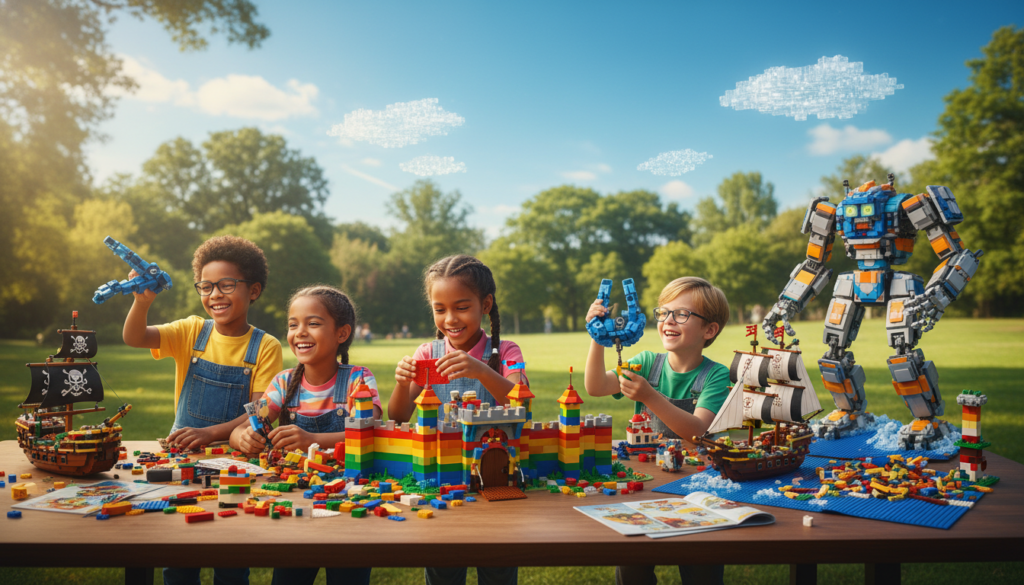
Storytelling with Bricks
I ask my little ones to build together a scene from a favorite book, like a Roald Dahl tale. This turns a single set into a stage and pushes them to plan characters and actions.
When we build together, I prompt questions: who is this character, where are they going, what problem must they solve? That simple routine grows language and narrative skills.
Color Sorting Challenges
During color sorting challenges, I lead the team and my builders sort hundreds of pieces. This exercise teaches organization, pattern recognition, and patience.
I also set a rule: build a model that fits inside one small box. That constraint makes them think about scale and geometry while keeping playtime fun.
| Activity | Skill Focus | Quick Tip |
|---|---|---|
| Story scene | Imagination, language | Use a single set and a short prompt |
| Color sort | Organization, patience | Time each round for friendly competition |
| Box challenge | Spatial thinking | Limit pieces to encourage creativity |
Small, regular sessions help my family bond and keep creativity active. For more on the benefits of creative play, I reference benefits of creative play and find extra ideas at fun activities.
Integrating the LEGO Builder App
I found that a 3D instructions tool transformed confusing steps into clear actions.
The lego builder app gives my kids interactive, zoomable instructions that feel like a tutor in our living room. The app simplifies complex assemblies and breaks each stage into bite-sized moves.
When a step looks tricky, we pinch to zoom and rotate the model. That feature makes matching small parts much easier for my young learners.
Using the builder app also helps me track progress. I keep a simple log of completed projects and note skills my children improved while we worked.
Digital instructions are a modern shortcut for parents who want hands-on learning without the frustration of unclear steps.
“The app turned several “too hard” projects into teamwork wins.”
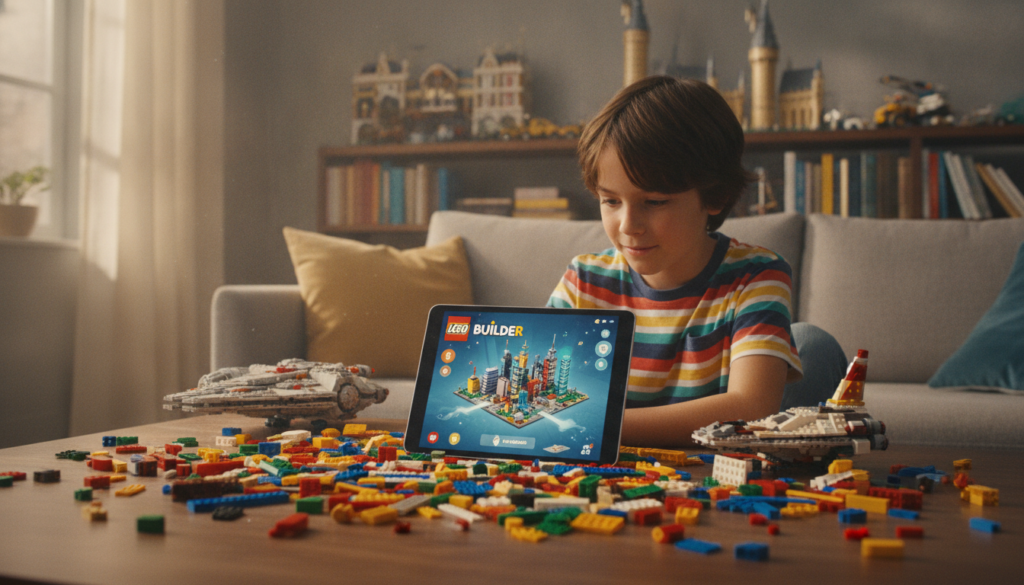
- Zoom and rotate: inspect tiny connections up close.
- Step tracking: record what each child learned.
- Interactive help: reduces adult intervention while boosting confidence.
Developing Essential Skills Through Play
I track small wins when my kids practice finger control with tiny parts; each session shows steady improvement.
Fine motor development happens in short bursts. I ask my little ones to pick, place, and press pieces. That routine sharpens dexterity and hand-eye coordination for children under five.
Fine Motor Development
Daily practice with small pieces improves precision. I break tasks into two- to five-minute drills so attention stays high.
Spatial Awareness Training
I challenge my builders to turn flat instructions into 3D models. Visualizing depth and scale helps them learn geometry and measurement without the pressure of tests.
Problem Solving Techniques
Using the lego builder app and simple step-by-step instructions, I teach kids how to sequence tasks. The app acts like a tutor, guiding them through logical steps and reducing frustration.
“Small, repeated challenges build the confidence to tackle bigger problems.”
| Skill | How I practice | Benefit after one year |
|---|---|---|
| Dexterity | Timed pick-and-place drills | Improved precision and faster handling |
| Spatial sense | 2D-to-3D reconstruction tasks | Better geometry and scale understanding |
| Logical reasoning | Follow app instructions step-by-step | Stronger sequencing and problem solving |
- The benefits are visible within a year of steady, short sessions.
- Clear instructions and the builder app reduce frustration and boost independence.
Encouraging Collaborative Projects
I schedule team build days where each person gets a clear task and we work toward one final result. This structure makes the project feel manageable and gives every child a chance to lead.
I assign roles using the lego builder app. One child follows the instructions, another sorts pieces, and someone else tests subassemblies. That role clarity keeps frustration low and makes the work fair.
Following the instructions as a team becomes a simple conflict resolver. Listening to each other’s ideas is required when a step has two possible approaches.
I also make sure every member has access to the necessary sets so no one stalls the group. Sharing pieces and swapping tasks teaches responsibility and cooperation.
In my experience, large collaborative projects show kids that a complex set is easier to finish when everyone contributes.
For rainy-day team ideas, I often link to indoor activity suggestions that pair well with group sessions and keep energy positive.
Conclusion
A simple prompt often turns playtime into a quick, meaningful learning moment at home.
I hope this guide helps you create a fun, educational experience your kids will enjoy. Short sessions feed imagination and make new skills feel like part of daily life. Keeping projects small helps everyone stay focused and proud of progress.
I recommend the lego builder app and similar builder app tools as a practical way to support each step. The app reduces frustration and lets young builders follow clear instructions with less help.
Whether you choose to build together or try solo challenges, this is a simple way to bring lasting learning and joyful experience into your home. Start small, stay curious, and make play the path to skill and confidence.