Did you know that about 90% of brain development happens before age five? This early stage makes building games a key tool for developing Logical Thinking and Cognitive Development.
When your toddler stacks blocks, sorts shapes, or plays with LEGO®, they’re doing more than just playing. These simple activities are essential Brain Games. They introduce cause and effect, early math, and sequencing. Through play, they move from concrete actions to abstract thinking.
Construction play also supports Learning Through Play. It gives you chances to ask open-ended questions and offer small challenges. Guided play, where you help with prompts or new materials, helps children revise their ideas. It builds stronger problem-solving habits.
Beyond thinking skills, building activities improve fine motor control, persistence, and a sense of achievement. For practical tips and evidence-based benefits, see this concise guide to the advantages of block and sandbox play at building play benefits.
In short, choosing the right construction activities now gives your child a head start in logic, creativity, and Problem-Solving. These skills support future learning in math and science.
Understanding Building Games and Their Importance
Introducing simple construction activities to your toddler opens up a world of learning. Building Games help young children understand cause-and-effect, test their ideas, and improve their fine motor skills. These play moments are key to Learning Through Play and support Early Childhood Play naturally.
What Are Building Games?
Building Games include activities where kids stack, join, or arrange materials. Think of wooden blocks, magnetic tiles, LEGO®, sandcastles, puzzles, and even recycled boxes. You can offer free play or short challenges to guide a child’s planning and adaptation.
These activities also overlap with Educational Games and Brain Games when you add simple rules or prompts. For example, asking a child to make a tower that won’t fall turns stacking into a problem-solving task. This teaches basic engineering ideas and nurtures early logical thought.
The Role of Play in Early Development
Play-based experiences make complex ideas easier to understand. Through puzzles, pretend scenarios, and building tasks, toddlers test theories about the world and revise their beliefs. Daily conversation and open-ended questions during play strengthen language and reasoning.
Guided play offers a balance between child-led exploration and adult support. By naming materials, asking “what if” questions, or suggesting small experiments, you help a child interpret results and refine their thinking. This type of interaction enhances Educational Games and makes Brain Games more meaningful.
Construction play also builds patience, creativity, social skills, and a sense of accomplishment. These gains boost cognitive growth and make Learning Through Play an effective approach in Early Childhood Play settings.
Cognitive Skills Fostered Through Construction Play
Construction play is a great way for your child to learn early reasoning and habits of mind. Short tasks help you model cause-and-effect and ask predictive questions. These moments support Logical Thinking and Cognitive Development in a fun way.
Logical Thinking
When you ask “What do you think will happen if we remove this block?” your child learns to form a hypothesis. They start to explain their choices. Guided play helps them move from simple guesses to evidence-based ideas about stability and balance.
Planning a small LEGO® build or a block tower trains systematic thinking. This sets the stage for later STEM learning.
Spatial Awareness
Stacking, rotating, and fitting pieces together teaches size, shape, and position. Hands-on work helps children imagine objects in space. Simple experiments can highlight center of mass versus geometric center.
These experiments improve spatial reasoning through playful practice.
Problem-Solving Abilities
Puzzles, open-ended projects, and playful failures show children that one problem has many solutions. When a structure collapses, your child learns to reassess and try again. This builds persistence and flexible strategy use.
Scaffolding during inquiry helps them connect observations to better approaches next time.
Use short activities and consistent reflection to make these skills stick. For practical classroom and home examples, see a set of preschool strategies at Practical Preschool Problem-Solving. These approaches treat Brain Games as low-stakes practice for sequencing, pattern recognition, and executive skills.
The Connection Between Intelligence and Building Activities
Building activities show how a child learns. Play with blocks, bricks, and simple machines links hands-on exploration to mental growth. Watching a toddler stack, sort, or balance shows both immediate problem-solving and long-term knowledge.
Construction play taps several kinds of intelligence at once. Your child uses logical reasoning and analytic skills that later support success in math and science. Fluid Intelligence helps when toddlers test new ideas and adapt strategies during free play.
Crystallized Intelligence grows as children fold new experiences into existing knowledge. Prior beliefs guide how they update ideas about weight, balance, and cause-and-effect. You can see Bayesian-style revision: a child changes a building plan after observing what falls and what stands.
Hands-on construction also supports spatial, interpersonal, and intrapersonal aspects of intelligence. Spatial skills improve as children judge distance and orientation. Collaborative play builds social reasoning. Working through frustration improves persistence and emotion regulation.
Benefits of hands-on learning
Hands-On Learning makes abstract ideas concrete. When a child stacks blocks, sorts shapes, or pours sand, they learn cause-and-effect directly. Those actions form the foundation for later abstract thinking.
Guided materials and purposeful tasks work better than unguided exploration alone. If you introduce simple challenges, you give scaffolds that highlight key features and link new tasks to what your child already knows. This approach boosts learning from Educational Games and open play alike.
Fine motor practice and immediate feedback are practical perks. Building strengthens small muscles while showing instant results. That tangible feedback makes concepts like balance and stability accessible and meaningful for young learners.
Practical takeaways: choose play that encourages variation, offer gentle scaffolding, and pair free exploration with short, targeted tasks. This mix supports both Fluid Intelligence and Crystallized Intelligence as your child explores the world through Educational Games and Hands-On Learning.
Choosing the Right Building Toys for Your Toddler
Choosing the right building toys helps your child learn from simple stacking to basic engineering. Look for toys that match your child’s current abilities but also challenge them a bit. This way, they stay interested and keep learning.
Age-Appropriate Options
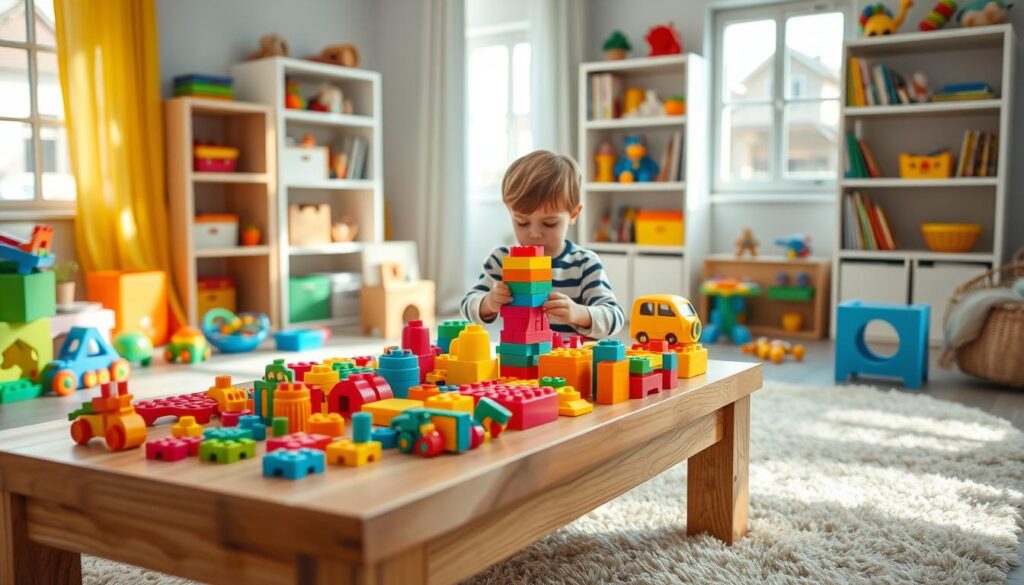
For 2–3 year olds, go for big, chunky wooden blocks and soft foam blocks. Also, simple stacking rings and large-piece puzzles are great. These toys help toddlers learn about cause-and-effect and basic sorting without getting too frustrated.
For 3–5 year olds, introduce smaller blocks and interlocking bricks like LEGO® Duplo. Also, Magnetic Tiles, tangrams, and simple pattern tasks are good. These toys help with sequencing, pattern recognition, and symbolic play, and encourage planning.
For 5 year olds and up, offer more complex LEGO® sets and advanced tangram puzzles. Also, basic coding toys and beginner construction kits are good. These toys prepare kids for logic puzzles and strategy games that need multi-step planning.
Recommended Brands
- LEGO® Duplo and LEGO® Classic offer versatile, age-graded brick play for toddlers and preschoolers.
- Magna-Tiles and Magformers provide magnetic tile construction that supports spatial reasoning.
- Melissa & Doug wooden block sets encourage durable, open-ended play for early building skills.
- Tegu magnetic wooden blocks combine fine motor practice with magnetic exploration.
- Learning Resources and Thames & Kosmos starter kits introduce simple engineering and cause-and-effect experiments for older preschoolers.
When picking sets, look for materials that help your child learn and explore. Choose toys that let them test and adjust their ideas. Balance Building Toys with Educational Games and Strategy Games as your child grows.
Encouraging Creative Play in Your Child
Make a special place for your child to play and build with confidence. A clean, small area is perfect for independent play. Use low shelves and labeled bins to help toddlers find and return materials.
Offer sensory-rich activities to keep play exciting and educational. Include a sand tray, water tub, and small toys. Change the materials often to match your child’s interests. Young kids like simple tasks, while older ones enjoy more complex challenges.
Setting Up a Constructive Environment
Combine loose parts with structured sets for creative and focused play. Provide pictures or simple models for your child to try. Keep scissors and glue safe but accessible.
Use natural materials like wood and fabric for different challenges. Short play sessions help with fine motor skills and thinking. This routine is key for steady progress.
Suggestions for Guided Play
Guided Play means helping while letting your child lead. Sit close and play with the same materials. Start with a few blocks or a photo prompt.
- Ask prompts like, “What do you think will happen if you move this block?”
- Offer a failed example, then rebuild to show how balance or weight changes outcomes.
- Encourage justification by asking, “Why did the tower fall?”
Find the right balance between helping and letting your child explore. Be ready to add words when you see a chance to link play to learning. This helps kids think and try again.
For more ideas, check out construction play resources. They show how building supports thinking. Use Educational Games and Building Games to make play more fun and educational.
How Social Interaction Enhances Building Skills
Watching kids build together is amazing. They learn to share ideas, test plans, and think again. This helps them connect what they do with words and thoughts.
Collaborative Play
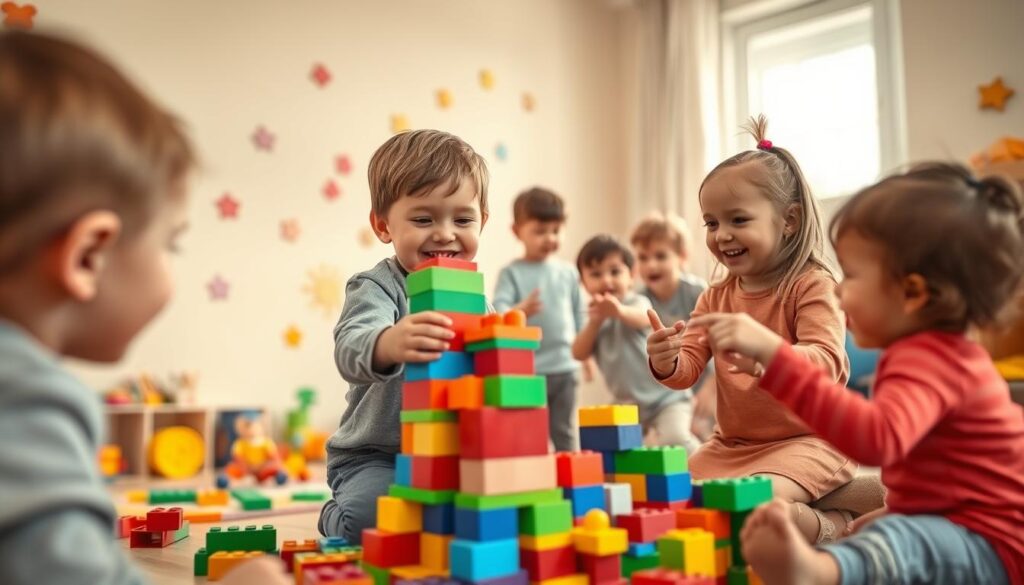
Collaborative Play makes kids work together. They decide who does what and when. They talk about their designs and share ideas for towers or bridges.
As they see others try new things, they get feedback right away. They learn to accept different ideas and change their plans. This helps them think symbolically and solve problems like balancing and weight.
Learning Through Sharing and Teamwork
Sharing and working together helps kids solve problems. They learn to plan and try different solutions. This skill is useful in school too.
By asking kids to explain their roles and ideas, you help them grow. This makes them better at solving problems and working with others.
Try using Building Games and Strategy Games for different challenges. Changing the rules can lead to new ideas and teamwork. It keeps everyone interested and helps them learn together.
Observing Developmental Milestones in Your Child
Watching your child play with blocks or simple kits shows a lot about their thinking and problem-solving skills. Keep the atmosphere calm and focused. This way, you can notice small but important steps. Use photos and brief notes to track their progress easily and meaningfully.
What to Look For
For ages 2–3, look for stacking of simple towers and single-trait sorting by color or size. Expect imitation of adult constructions and basic cause-and-effect phrases like “it fell because.” These actions mark early stages of Cognitive Development.
Between ages 3–5, watch for improved pattern completion and basic planning in building. Children begin to explain reasons, test balance and stability, and sustain play longer. These behaviors point toward stronger Logical Thinking.
As children reach about 5–6 years, you may see early grasp of weight distribution and multi-trait sorting. They perform more systematic tests and show organized classification. Building Games begin to reflect higher-order reasoning.
Tracking Progress Through Play
Keep simple records: photos of constructions, short captions about height, symmetry, and planning steps. Over weeks and months, these snapshots reveal trends in complexity and persistence.
After play sessions, jot quick observational notes. Ask whether your child tested alternatives, asked “why,” or invited peers to collaborate. These moments indicate growth in logical reasoning and social problem solving.
- Use playful prompts: ask your child to predict if a model will stand or fall.
- Compare prediction with outcome and encourage them to explain the result.
- Repeat similar tasks over time to detect conceptual shifts in reasoning.
Apply gentle, game-like assessments instead of formal tests. This keeps play enjoyable while supporting Tracking Progress and deeper Cognitive Development through Building Games and hands-on discovery.
Incorporating Building Games into Daily Routines
Begin with a simple plan that matches your family’s schedule. Short, regular play times make it easy to add Building Games to your day. Make sure each day offers something new and fun.
Fun Activities to Try at Home
- Timed stacking challenges: set a 2–5 minute timer for tower builds or pattern continuation using alternating colors. This boosts planning and focus.
- Mini experiments: test float versus sink with toy boats, melt ice blocks with salt, or balance asymmetrical models to explore stability and cause-and-effect.
- Treasure hunts: create simple maps or sequential clues that require following steps and reasoning to reach a small prize.
- Recycled-material builds: use cardboard, bottle caps, and cloth to craft bridges or vehicles. Let your child test, redesign, and improve their models.
- Copy-this-photo tasks: give a picture of a structure and ask your child to recreate it with blocks. This sharpens spatial awareness and attention to detail.
Balancing Screen Time and Hands-On Play
Limit passive Screen Time and give more time for Hands-On Play, which is key for kids aged 2–5. Use Educational Games like interactive math apps wisely. Follow app use with a physical task to reinforce learning.
Plan your day with at least two construction periods: a morning free-play and an afternoon guided experiment. Keep device use brief and focused. Then, switch to blocks, recycled builds, or puzzle games to practice what was learned.
Addressing Common Challenges in Building Play
Young children often get frustrated when their towers keep falling. They might give up, repeat the same move, or throw a tantrum. This is because they’re in the preoperational stage. At this age, they struggle with abstract ideas like balance and weight.
Start by making the task simpler. Break it down into smaller steps. Use bigger blocks or show a clear example to follow. This way, each failure becomes a chance to learn and grow.
Model your own attempts. Talk out loud as you try, like “That fell, so I’ll move the big piece to the bottom.” This shows your child how to keep trying and view failure as a learning opportunity.
Ask open-ended questions that focus on strategy, not just the end result. Say, “What could we change next?” or “What do you notice about the base?” These questions help your child think critically and build resilience.
- Break tasks into clear steps to reduce overwhelm.
- Offer visual models to support imitation and understanding.
- Celebrate small changes and improvements to encourage persistence.
Take photos of your child’s early and later attempts. Seeing the progress can boost their confidence. It shows them that hard work leads to success, helping them solve problems in many building games.
Research Insights on Building Games and Learning
Research shows that hands-on play boosts early reasoning. Jean Piaget’s work links movement to abstract thought. Studies also link building activities to later math and science skills.
Studies with 183 five- to six-year-olds found interesting results. At first, most kids didn’t explain balance using Mass theory. But after playful activities, more kids used Mass theory. Their intelligence levels predicted who learned best, showing the importance of cognitive readiness.
Experts agree that building activities improve many areas. They help with problem solving and STEM readiness. Educators see these activities as key for learning.
Guided play is a focus for researchers like Kathy Hirsh-Pasek. They suggest balancing child freedom with adult guidance. This helps kids explore and learn without losing interest.
Research by van de Pol and Klahr shows the value of combined supports. Using materials and verbal cues leads to better learning than free play. Clear demonstrations and connections to what kids already know help them understand better.
Experts recommend using structured materials and brief prompts. This approach keeps building fun and focused on learning. It ensures play remains joyful and centered on the child’s needs.
Long-Term Benefits of Early Engagement with Building Games
Introducing construction play early in your child’s life sets the stage for future success. It boosts their spatial thinking, fine motor skills, and determination. These skills are key for math, engineering, and the arts later on. For more ideas, check out this guide on building games for children.
Lifelong Skills Gained Through Play
Building games teach kids to think critically and solve problems. They learn to test ideas and adjust their plans. This sharpens their logical thinking and ability to interpret evidence.
These skills also help with teamwork, managing emotions, and clear communication. They improve performance in school and real-life situations.
Preparing for Future Learning Experiences
Playful, hands-on activities help kids develop important thinking habits. They learn to question, explain, and compare. These habits are essential for moving from simple to complex tasks like coding.
Keep providing challenging builds and guided questions. This helps bridge play and academic learning.
Regular play with construction activities builds strong skills in strategy and planning. It prepares your child for future learning and enhances their cognitive abilities.