
Can a short board game really teach your child planning, turn-taking, and better focus — and also be super fun? There are many strategy games for kids ages 6 to 9 that make learning these skills enjoyable.
You’re looking for games that are both fun and educational. Strategy games for kids ages 6 to 9 are perfect. They have simple rules, quick games, and fun themes. Games like Sushi Go and Dixit show how easy it is to learn skills through fun stories.
Find games that are both challenging and easy to understand. The Wirecutter has a list of family favorites. These games are quick to play and let adults join in, helping kids learn new things.
Fun learning games are great for homeschool or after-school activities. They help kids focus on counting, planning, and social skills. And they can do it all in just 15 to 30 minutes.
Key Takeaways
- Choose quick, clear games to teach planning and turn-taking.
- Look for titles that adults can join to scaffold learning.
- Imaginative themes help children practice language and social skills.
- Short playtime keeps engagement high for ages 6–9.
- Refer to trusted roundups like the Wirecutter review for tested family picks: board games for kids.
Why strategy and social games matter for kids’ development
Choosing fun activities for your child helps build important skills. Games like Karuba and Kingdomino improve planning, memory, and thinking on your feet. Kids learn to predict outcomes and adjust their plans as needed.
Playing games helps kids develop their executive function. Games like Mastermind and Laser Maze teach kids to recognize patterns and solve problems. These games are short and fun, making learning easy and enjoyable.
Benefits for executive function and problem solving
Games teach kids to set goals, test strategies, and learn from mistakes. This process boosts planning and self-control. Games like Prime Climb make math fun and easy to understand.
Social-emotional gains from cooperative and pretend play
Cooperative games like Pandemic teach teamwork and communication. Playing together helps kids learn to take turns and manage their emotions. Games like Dixit and Telestrations improve storytelling and listening skills.
Screen-free learning, memory, and attention improvements
Hands-on games improve fine and gross motor skills and memory. Mixing physical games with short digital activities sharpens planning and pattern recognition. Apps should be used sparingly to keep play hands-on.
Learn more about how building and construction play enhance these benefits at theplayfulkids guide to building games. It shows how to mix hands-on and virtual play for better focus and creativity.
How to choose age-appropriate games for kids ages 6 to 9
You want games that match your child’s skills and attention span. Age ranges on boxes are just guidelines. Some eight-year-olds can play family-style board games on their own. Others need help with simple strategies.
Try short play sessions for new games to see if your child likes them. This helps decide if they want to play longer.
Reading the age range versus your child’s readiness
Don’t just look at the age range. Check if the game is too big or too hard to read. If it says 10+, you might need to simplify the rules or play cooperatively with younger kids.
Watch demo clips on Instagram or YouTube before buying. This helps you see if the game is right for your child’s vocabulary and setup.
Balancing complexity, playtime length, and attention span
Choose games that are easy to set up and have short rounds. Games like Sushi Go and Kingdomino are great for busy evenings. They take about 15–20 minutes to play.
Save longer games for older kids or split them into sessions. This helps avoid getting too tired.
Looking for games that teach specific skills: counting, turn-taking, strategy
Find games that match what you want your child to learn. For math, try I Sea 10! or Sums in Space. For language, Zingo or Story Cubes are good. For thinking and planning, Mastermind or Kanoodle are great.
Make sure any small parts are safe if you have younger siblings at home.
| Choice Factor | What to look for | Example games |
|---|---|---|
| Attention span | Short rounds, clear turns, quick scoring | Sushi Go, Kingdomino, The Fuzzies |
| Learning goal | Mechanics that practice the target skill | I Sea 10!, Zingo, Mastermind |
| Reading level | Minimal text or picture-based cues | Story Cubes, Qwirkle, Scrabble Junior |
| Family fit | Adaptable rules, cooperative options, scalable difficulty | Kingdomino, Pandemic Junior, Sushi Go |
| Safety and parts | Large components for younger children, avoid many tiny pieces | HABA games, Zingo, Story Cubes |
| Preview options | Watch demo videos and reviews to save trial-and-error buys | Instagram reels, publisher how-to clips, BoardGameGeek videos |
Related Guides on Strategy and Rule-Based Games for Kids Ages 6 to 9
If your child is ready for more challenge, these related guides can help you choose screen-free, educational, social, and strategy-based games that build focus, patience, rule-following, choices, and graceful losing.
- Best Rule-Based Games for Kids Ages 6 to 9: Strategy, Patience, and Fun
- Best Simple Strategy Games for Elementary Kids Ages 6 to 9
- Best Board and Card Games for 6, 7, 8, and 9 Year Olds
- Best Games for Elementary Kids That Build Rules, Choices, and Social Skills
- Best Educational Games for Kids Ages 6 to 9 That Do Not Feel Like Homework
- Best Family Strategy Games for Kids Ready for More Challenge
- Best Competitive Games for Kids Who Need Practice Losing Gracefully
- Best Card, Dice, and Board Games for Elementary Kids Ages 6 to 9
- Best Screen-Free Games for 6 to 9 Year Olds That Build Focus
- How to Transition Kids From Simple Rules to Strategy Games
strategy games for kids ages 6 to 9
Choose games with short, catchy titles for kids with short attention spans. Quick games teach planning and reward choices without long waits. They’re great for introducing turn-based thinking and are excellent additions to your collection of educational games.
Best quick strategy games for short attention spans
Sushi Go is a fast card game that lasts 15–20 minutes. It teaches set collection and timing in a fun way. Kingdomino is similar, lasting about the same time, and introduces domino-style tile choices that improve simple arithmetic and placement skills.
Family-style strategy games that grow with your child
Look for games that get more complex as your child grows. Karuba offers spatial planning on individual boards and becomes more strategic as kids get older. Azul and Splendor add pattern recognition and resource planning for older kids, making them great educational games.
Games that introduce planning, spatial reasoning, and set collection
Set collection is key in Sushi Go and Splendor, where balancing short-term gains with long-term combos is important. Spatial reasoning is featured in Karuba, Azul, and Hive, where piece placement and anticipation are critical. Sequence for Kids and simpler versions of Catan teach sequencing, trading basics, and group planning in a way kids can understand.
| Game | Primary Skill | Approx. Playtime | Best Age Range |
|---|---|---|---|
| Sushi Go | Set collection, timing | 15–20 minutes | 5+ (ideal 6–9) |
| Kingdomino | Tile placement, domino logic | 15–20 minutes | 7+ (adaptable for 6–9) |
| Karuba | Spatial planning, independent boards | 30–40 minutes | 8+ (scales down for 6–7) |
| Azul | Pattern recognition, tile placement | 30–45 minutes | 8–12 |
| Splendor | Resource collection, long-term planning | 30 minutes | 10+, adaptable for guided play |
| Sequence for Kids | Sequencing, planning | 15–25 minutes | 4–8 |
Try short demos at home to see if the game is right for your child. Watch videos on Instagram and at playgroups to see how other families play. This helps you find the perfect fun learning game for your child.
Top recommended board games that develop social skills and teamwork
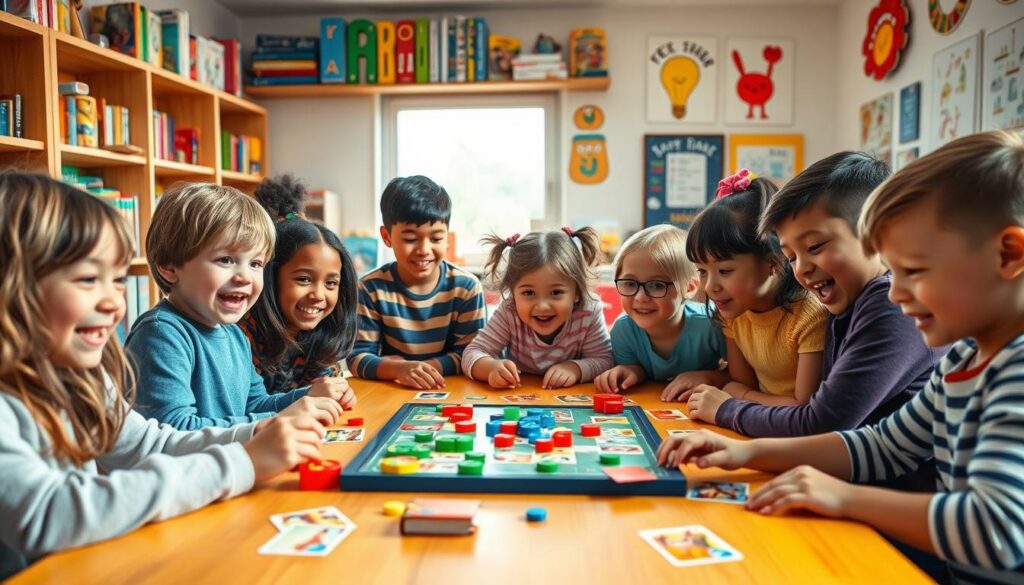
Choose games that teach cooperation, listening, and gentle conflict resolution. Use cooperative titles to model shared goals and calm decision-making. These games are great for play at home, in small groups, or during classroom transitions.
Cooperative games that reduce competitive frustration
Pick games where players win or lose together. Pandemic and Exit: The Game ask teams to solve puzzles and manage resources. Wildcraft! and Fish n’ Flip are simpler choices that show young players how to support one another.
Cooperative play lowers anxiety about winning and encourages shared planning. You will see children practice turn-taking and negotiating without a single winner dominating the session.
Story-driven and pretend-play games that build conversation skills
Dixit, Rory’s Story Cubes, and Create A Story Cards prompt expressive storytelling. Telestrations blends drawing with guessing to spark laughter while strengthening vocabulary and sequencing skills.
These interactive games for elementary school students invite open-ended responses. Your child will practice describing scenes, listening to peers, and expanding ideas during group turns.
Turn-taking and rule-following games for classroom and home use
Dexterity titles like The Fuzzies and family party games such as Happy Salmon teach quick turns and patience. Hedbanz and similar guessing games make rule-following fun and build social cues.
Use short rounds to match attention spans. You can scaffold play by simplifying rules at first, then adding complexity as kids master the basics.
| Game | Primary Social Skill | Age Fit | Playtime | Why it helps |
|---|---|---|---|---|
| Pandemic | Collaborative planning | 8+ | 45–60 min | Requires shared strategy and role communication |
| Exit: The Game | Problem solving together | 8+ | 60+ min | Puzzle-based teamwork with timed pressure |
| Wildcraft! | Shared goals, empathy | 5–9 | 15–30 min | Child-friendly cooperative mechanics and nature themes |
| Dixit | Expressive language | 6+ | 30–45 min | Story prompts that reward creative description |
| Telestrations | Listening and turn-taking | 6+ | 20–30 min | Mixes drawing and guessing to boost conversation |
| The Fuzzies | Patience and dexterity | 5–9 | 10–20 min | Low-stakes turns that teach self-control |
| Happy Salmon | Fast social interaction | 6+ | 5–10 min | Simple actions that build group energy and cooperation |
| Hedbanz | Questioning and perspective-taking | 7+ | 15–25 min | Encourages asking clear questions and interpreting clues |
When you pick titles, balance cooperative depth with short, engaging rounds. Use story-driven and pretend-play choices to boost conversation skills. Rotate interactive games for elementary school students with dexterity and guessing games to keep sessions fresh.
Mixing cooperative and party-style play gives your group a range of social learning. These engaging games for young kids create practice in listening, turn-taking, and teamwork while keeping fun at the center of play.
Recommended strategy board games with age guidance and playtime
Looking for games that teach planning and social skills? These games are quick, fun, and suitable for kids aged 6 to 9. They are great for educational purposes and fit well with other games in the same age range.
Sushi Go — fast pick-and-pass card strategy (ages 5+, good for 6–9)
Sushi Go is a 20-minute game for 2–4 players. It’s easy to learn and plays well with kids. Points are counted at the end, which might need adult help for younger ones. It’s perfect for families who enjoy short games and learning through fun.
Karuba — tile placement and independent planning (recommended 8+, adaptable)
Karuba takes 30–40 minutes for 2–4 players. Kids build their own board, improving spatial skills and planning. It’s quiet and focuses on strategy, making it great for kids who like calm games. It’s a good step towards more complex games.
Kingdomino and Qwirkle — domino/tile logic for younger strategists
Kingdomino is a 15–20 minute game for 2–4 players. It teaches spatial planning and is easy to learn. Qwirkle focuses on patterns and matching with wooden tiles. Both games are fun, short, and great for young strategists.
For more games, consider Azul for patterns, Splendor for resource planning, and Sequence for Kids for sequencing. Check out unboxing clips and reviews on social media to see game quality and length. For more kid-friendly game suggestions, visit Meeple Mountain.
| Game | Age Guidance | Players | Playtime | Core Skill |
|---|---|---|---|---|
| Sushi Go | 5+ | 2–4 | ~20 min | Set collection, planning |
| Karuba | 8+ (adaptable) | 2–4 | 30–40 min | Tile placement, spatial planning |
| Kingdomino | 8+ | 2–4 | 15–20 min | Drafting, spatial constraints |
| Qwirkle | 6+ | 2–4 | 20–30 min | Pattern recognition, matching |
Recommended social and party games to boost interaction and storytelling
You’re looking for games that make everyone laugh, improve talking skills, and keep the energy up. Choose games that fit your group’s size and how loud you like things. Switch to quieter games for storytelling when it’s time to calm down.

Dixit is great for sparking creativity. It’s for groups of three to six players and lasts about thirty minutes. Players give clues tied to artful cards, which boosts vocabulary and storytelling without too much reading. Pair it with Story Cubes and Create A Story Cards to keep the practice going.
For quick laughs, try dexterity games. The Fuzzies has short rounds that mix fine motor skills with social play. Games like Happy Salmon and Throw Throw Burrito add movement. Hedbanz and Telestrations focus on quick guessing and drawing. These games add variety to your collection.
Start with simple social deduction games. Chameleon-style games teach deduction and persuasion with adult guidance. Keep clues simple, limit talk, and discuss the choices to learn about different views.
Use a mix of games to keep things interesting. Rotate a few favorites to see social skills grow through play.
| Game | Age | Players | Session Length | Skill Focus |
|---|---|---|---|---|
| Dixit | 6+ | 3–6 | ~30 min | Storytelling, vocabulary, creative clues |
| The Fuzzies | 6+ | 2+ | ~15 min | Dexterity, turn-taking, light competition |
| Telestrations | 6+ | 4–8 | ~20–30 min | Drawing, communication, laughter-driven interaction |
| Happy Salmon | 6+ | 4–8+ | ~10 min | Matching, speed, physical activity |
| Throw Throw Burrito | 7+ | 3–6+ | ~15–20 min | Card play, dodge/active play, social fun |
| Hedbanz | 6+ | 2–6 | ~15 min | Questioning, inference, vocabulary |
| Exploding Kittens | 7+ | 2–5 | ~15 min | Quick decision-making, matching, luck management |
| Chameleon-style (adapted) | 8–9 (with adult) | 4–8 | ~10–20 min | Deduction, persuasion, social reasoning |
| Story Cubes | 6+ | 1+ | ~10–15 min | Improv storytelling, sequencing, imagination |
Evidence-based social skills activities that pair well with games
You can make board and party games even better by adding short, evidence-based activities. These activities help with cooperation, emotion recognition, and conversation skills. Use these routines before or after a game to make learning fun and easy to repeat.
Emotion charades and expression mimicking
Emotion charades help kids understand and name feelings. Ask a child to act out emotions like joy or frustration. Then, have others guess what they feel.
Games like Dixit and Telestrations naturally support this. Use these moments to ask, “What might this character feel?” This boosts empathy and self-regulation.
Roll the Ball, Simon Says, and turn-taking drills
Short drills like Roll the Ball or Simon Says mirror cooperative puzzle games. Try a 3-minute relay or a Simon Says sequence. These exercises improve impulse control and group play rules.
Use timers or tokens to make turn-taking clear. Regular practice helps kids be patient and share in games.
Improvisational stories and topic games
Improv story games improve perspective-taking and conversation. Use Story Cubes or Create A Story Cards for quick prompts. Each child adds one sentence, keeping it short for younger players.
These exercises pair well with games that ask for reasoning or description. Narrating your thinking aloud models vocabulary and problem-solving language. Kids can imitate this during play.
You act as coach and language partner. Model, narrate, and then step back. Make materials accessible and rotate choices to encourage independent and collaborative projects. For more ideas on construction play and group projects that boost social skills, see construction play resources.
| Activity | Target Skill | Time |
|---|---|---|
| Emotion Charades | Emotion recognition, empathy | 5–10 minutes |
| Roll the Ball relay | Cooperation, turn-taking | 3–7 minutes |
| Simon Says with emotional cues | Impulse control, listening | 3–5 minutes |
| Improv story chain | Perspective-taking, conversation | 5–10 minutes |
| Timed cooperative puzzles | Shared problem-solving, role distribution | 10–20 minutes |
Use frequent, short sessions for better results. This builds confidence and links these activities to educational games. Keep language simple and invite imitation to transfer skills into games.
How to adapt games to different developmental levels and support needs
You can make strategy games for kids ages 6 to 9 and engaging games for young kids work for a wide range of abilities by changing small things. Start by setting clear, short goals and simplifying rules so play stays fun and achievable.
Modifying rules for younger or less experienced players
Lower scoring thresholds and remove complex mechanics to shorten game length. For titles like Sushi Go, Kingdomino, or Karuba, let adults keep score while children focus on choices. You can create a “play-with” rule where an adult suggests moves until a child gains confidence.
Cooperative options and scaffolding for children with social or attentional challenges
Choose cooperative variants such as simplified Pandemic-style play or games that reward teamwork over competition. Break tasks into steps and set 10–15 minute goals. Sit beside the child to model turns and praise teamwork to reduce anxiety and promote social learning.
Using token systems, visual supports, and shorter rounds to sustain engagement
Offer token rewards for focused turns and clearer reminders for rules. Printable cheat-sheets, labeled tiles, and example boards make abstract rules concrete. Replace one long session with multiple short rounds so attention stays steady and frustration stays low.
When you adapt games for children with different support needs, keep flexibility in mind. Test small changes, watch how the child responds, and adjust pacing and supports. This approach turns many strategy games for kids ages 6 to 9 into engaging games for young kids of varied developmental levels.
Tips for running successful family game sessions
Begin by setting simple expectations to keep play fun and stress-free. Explain that the goal is to spend time together, not to win. Use clear rules and show an example before starting.
Teach kids to lose gracefully with small consequences and positive examples. Give tokens or rewards for effort. Praise them for good sportsmanship, like waiting or congratulating winners.
Make sessions smooth with predictable rituals. Start with a quick game like Happy Salmon or a five-minute dexterity game. Rotate a theme each week for a fun lesson in math, vocabulary, or planning.
Choose games that fit your group’s length and complexity. Mix short games like Sushi Go with longer strategy games for kids 6 to 9. For longer games, plan multi-session play and use simple rules if a player leaves.
Use partnerships and simple rules for mixed-age groups. Pair younger kids with older siblings for teamwork. Choose cooperative games for shared success. Use visual aids for turns and counting to help emerging readers and players with attention issues.
Preview rules with demo videos or Instagram clips before family night. Watching a playthrough helps you pace instruction and spot challenges. Keep a cheat sheet for tricky rules to teach quickly.
Rotate “fun learning games” to keep things interesting and support specific goals. For math practice, pick games with scoring. For social skills, choose games that encourage conversation and teamwork.
When needed, switch to a five-minute dexterity or storytelling game. This change of pace helps focus without ending the session. Over time, your family game nights will become routine, building patience and a love for strategy.
Where to find and test games: buying, borrowing, and group play options
Before buying, try out many games. Libraries, homeschool groups, and community game nights are great places to start. They let you see how games work in action.
Watch how a game is set up and played. See if it keeps a 6–9-year-old interested. This helps you decide if it’s right for your child.
Consider borrowing games from friends or joining a playgroup. This way, your child can play the game several times. It’s also a good way to see if a game is good for teamwork and can be played over and over.
Shopping online? Look for reviews and demo videos. They can teach you about the game’s mechanics before you buy. This is helpful, as some games have complex rules.
When looking for games, choose sellers with good return policies. Make sure the game is suitable for your child’s age. Some games are small and easy to store, while others are bigger and need more space.
Look for games that can be played many times. Games with different strategies and setups are great. For example, games like Karuba and Kingdomino offer new experiences each time you play.
Watch YouTube unboxings and Instagram play clips. They show how games work with different ages. These videos give you a real idea of how the game is played.
Plan how you will store and set up the game. Choose games with easy storage and quick setup. This makes it more likely that your child will play the game again and again.
Conclusion
Choosing the right strategy games for kids ages 6 to 9 can make playtime both fun and educational. Games like Sushi Go, Dixit, and Karuba are great. They teach planning, vocabulary, and more.
Start with shorter games for younger kids. Use simple rules. For older kids, try longer games that last over several sessions.
Think of educational games as tools to help your child grow. Rotate games to focus on different skills. Cooperative games can help reduce stress.
Research shows that interactive games improve thinking and social skills. Add simple activities like charades or storytelling to make learning fun.
Before buying games, watch demos or try them out at library game nights. This helps you find games that match your child’s interests and learning goals.
Make playtime predictable and fun. This way, each game becomes a step in your child’s growth.