
Physical play for kids is any movement children actually enjoy: running, climbing, chasing, dancing around the living room before dinner. It’s also the most realistic way for most families to meet daily activity recommendations, because it doesn’t depend on a gym, a schedule, or a coach.
This guide is written for parents, teachers, childcare providers, and camp staff who want usable ideas rather than another reminder that children should move more. You’ll find what the U.S. guidelines actually ask for at each age, indoor and outdoor games that work in small spaces, ways to keep active play going at home and at school, and the safety details that matter most.
Key Takeaways
- Physical play supports bone, muscle, and heart health from infancy through the teen years, and the habits tend to carry forward.
- Children and teens ages 6–17 need 60 minutes or more of moderate-to-vigorous activity daily, including muscle- and bone-strengthening activity at least three days a week.
- Preschoolers should be active throughout the day rather than in one scheduled block.
- Ordinary movement counts: walking to school, playground climbing, and dance breaks all add to the daily total.
- Family routines and school programs matter more than equipment when it comes to making movement stick.
Why Physical Play for Kids Matters for Growth and Development
Movement does several jobs at once in a growing child. It builds tissue, it wires motor skills, and it gives children a low-stakes place to practice waiting, negotiating, and losing.
Physical Health Benefits Backed by Guidelines
The Physical Activity Guidelines for Americans, 2nd edition set the U.S. baseline. Children and adolescents ages 6 through 17 should get at least 60 minutes of moderate-to-vigorous physical activity every day. Within that hour, vigorous activity, muscle-strengthening activity, and bone-strengthening activity should each appear on at least three days a week. Preschool-aged children ages 3 through 5 aren’t given a minute target; the guidance is that they should be active throughout the day, with adults encouraging a variety of active play.
That distinction matters in practice. For a nine-year-old, you can think in terms of an hour. For a four-year-old, you’re really managing the shape of the day: how often they get up, how long the sitting stretches run, whether the afternoon includes somewhere to run.
Motor Development and Skill Acquisition
Fundamental movement skills, such as running, jumping, throwing, catching, balancing on one foot, aren’t automatic. Children acquire them through repetition, and the repetition happens during play far more than during instruction. A child who has spent two summers throwing a ball against a garage door has practiced thousands of times without anyone calling it training.
The same is true of bone. Most of the skeleton’s mineral content is laid down during childhood and adolescence, with peak bone mass typically reached in the late teens to mid-twenties. Weight-bearing play during those years is doing something that can’t easily be made up later.
Mental, Cognitive, and Social Advantages
Regular physical activity is associated with better sleep, improved mood, and lower risk of anxiety and depression symptoms in children and adolescents. It may also support attention and classroom behavior, though the size of that effect varies a great deal between studies and between children.
The social side is easier to observe directly. Group play gives children reasons to explain a rule, adjust it, argue about it, and start again. A game of tag with mixed ages will produce more negotiation in ten minutes than most structured activities do in an hour.
Explore the Main Benefits of Physical Play in Depth
Each of these benefits deserves more room than a pillar article can give it. The guides below go deeper on one benefit at a time.
- Screens are usually the main competitor for a child’s free time, and swapping them out works better when you have specific alternatives ready. See the guide to screen-free physical activities for kids.
- If you’re watching a toddler or preschooler who seems less coordinated than their peers, start with how physical play builds gross motor skills in young children.
You’ll find every guide in this section, plus the games themselves, in our physical games for kids collection.
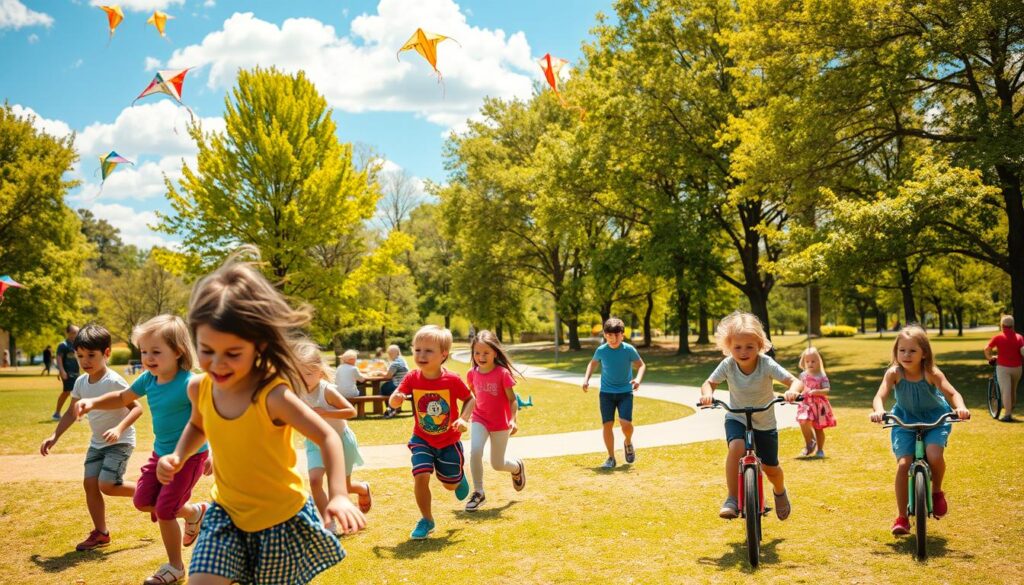
How Much Activity Kids Need by Age
Targets change as children grow, and so does the kind of play that gets them there. What follows is a working reference for home, daycare, and preschool routines.
Babies and Toddlers: Building the Foundation
U.S. guidelines don’t set a minute-based target for children under 3. The practical goal for babies is plenty of supervised floor time, including tummy time spread across the day, which gives them the chance to reach, roll, push up, and eventually crawl. The World Health Organization suggests at least 180 minutes of activity of any intensity across the day for ages 1 to 2, spread out rather than blocked together.
For toddlers, that number is less useful than the shape of the day. Tunnels to crawl through, low cushions to climb over, a wagon to push, a basket to carry across the room: these are the activities that fill the time. Long stretches strapped into a stroller, high chair, or car seat are the main thing to limit.
Preschoolers and Early School-Age Children
Children ages 3 to 5 should be active throughout the day. The WHO adds a useful benchmark for ages 3 and 4: at least 60 minutes of that time should be moderate to vigorous, the kind of play where a child is breathing harder and their face is flushed.
Obstacle courses, playground climbing, chase games, and simple ball play all qualify. So does a walk to the park if the child is allowed to walk rather than ride.
Once children start school, the mix shifts. Keep the running games, but start adding activities that load the muscles and bones: hopscotch, monkey bars, skipping rope, short bike rides, tumbling on a mat.
Older Children and Adolescents
Ages 6 through 17 need 60 minutes or more each day, mostly aerobic, with vigorous activity, muscle-strengthening, and bone-strengthening on at least three days a week. Team sports, swimming, hiking, and cycling cover most of this without anyone tracking minutes.
Adolescents can handle more structured training, including supervised strength work with proper technique. If a teen wants to start weight training, that’s the point to involve a qualified coach or a pediatric provider rather than a workout video.
| Age | Daily target | Key play types | Simple examples |
|---|---|---|---|
| Under 1 year | Frequent supervised floor time, including tummy time, across waking hours | Floor play, reaching, rolling | Tummy time on a mat, reaching for toys, rolling to a target |
| 1–2 years | No U.S. target; WHO suggests ~180 minutes at any intensity, spread out | Light and energetic play, gross motor play | Push-and-pull toys, low climbs, crawling tunnels, carrying tasks |
| 3–5 years | Active throughout the day; WHO adds 60+ minutes moderate-to-vigorous for ages 3–4 | Outdoor play, aerobic and bone-loading play | Obstacle courses, running games, playground climbing |
| 6–17 years | 60+ minutes daily | Aerobic, muscle-strengthening, bone-strengthening | Team sports, swimming, hiking, skipping rope, supervised strength work |
Treat every age range here as a starting point rather than a rule. Children arrive at the same skills on different timelines.
High-Impact Play: Bones, Muscles, and Heart
The three-days-a-week part of the guidelines is the piece families most often miss, mostly because it sounds like it requires equipment. It doesn’t.
Bone-Strengthening Through Play
Bone responds to impact. Jumping, hopping, skipping, running, and climbing all send force through the skeleton and may help build bone density during the years when it matters most. Hopscotch, jump rope, playground climbing, and a homemade course of taped lines to leap between all count.
One caution worth naming: the American Academy of Pediatrics recommends against recreational home trampoline use because of the injury rate, particularly when more than one child jumps at a time. If a family already has one, the standard risk reduction is one jumper at a time, adult supervision, no flips or somersaults, and intact safety padding.
Muscle-Strengthening Activities for Kids
For most children, strength comes from climbing, hanging, pushing, pulling, and carrying, not from formal training. Monkey bars, wheelbarrow walks, animal walks, tug-of-war with a rope on grass, and hauling a loaded laundry basket up the stairs all load muscles in a way children find fun rather than tedious.
Three short sessions a week is enough. It doesn’t need to be a session at all; it can just be what’s available on the playground.
Aerobic Play to Boost Heart and Lungs
Anything that keeps children breathing hard for stretches at a time works: tag, cycling, swimming, relay races, soccer in the yard. Young children rarely sustain aerobic effort in long blocks; they sprint, stop, negotiate, sprint again. That interval pattern is normal and it counts.
Outdoor Activities for Children: Ideas That Get Them Moving
Outdoor play tends to produce more movement per minute than indoor play, mostly because there’s more room and fewer things to break.
Classic Playground and Park Activities
Swings, climbing frames, and slides build strength and confidence in ways that are hard to reproduce indoors. Add running relays, tag, or hide-and-seek and you have aerobic play without any equipment at all.
Simple ball games on grass work for mixed ages, since catching, kicking, and throwing can be scaled up or down for each child in the group.
Active Outdoor Games and Sports
Short games of soccer, kickball, or basketball mix endurance with turn-taking. Hopscotch, skipping rope, and obstacle courses fit almost any space, including a driveway.
Team sports give structure and a sense of belonging. Informal games do something different: they let children set the rules, which is often where the real learning happens.
Weather-Friendly Outdoor Adaptations
Plan around the weather rather than canceling. Layers and shorter outings handle cold days. On hot days, choose shaded routes, go early or late, and build in water breaks. Rain often just means a covered area and boots.
Rotating activities keeps interest up, and it also spreads the load across different muscles and skills.
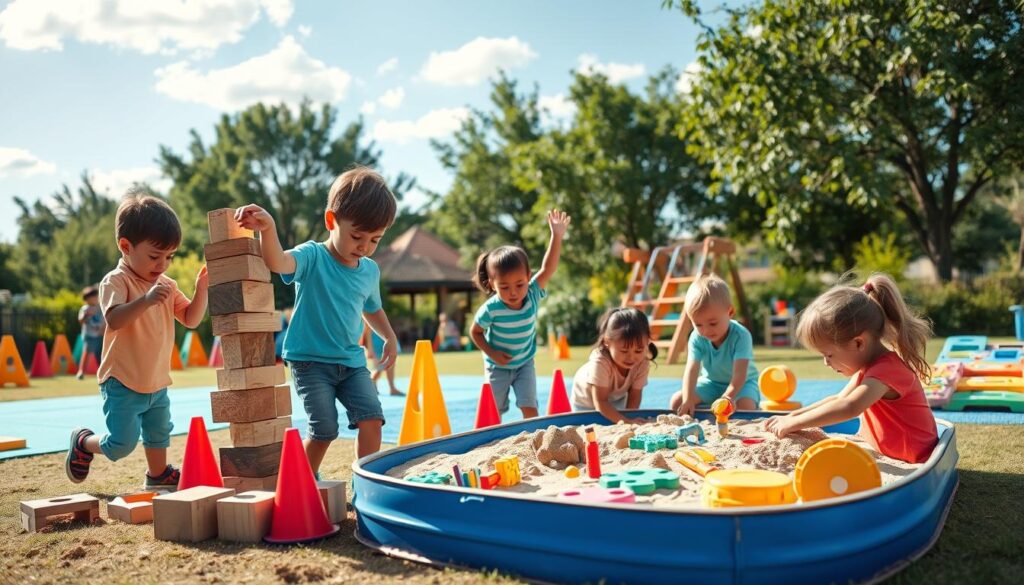
Indoor Physical Games and Screen-Free Alternatives
When outdoor play isn’t an option, the goal is short bursts that fit a small footprint.
Movement Games for Kids You Can Do Inside
Build an obstacle course out of couch cushions, painter’s tape, and a laundry basket used as a hoop. Add a hallway relay with a timer. Freeze Dance and balloon volleyball both burn a surprising amount of energy in a living room.
Cardboard boxes become forts, tunnels, or puppet theaters, all of which involve more crawling and lifting than sitting. Bubble wrap on the floor turns jumping into a game on its own.
Active Play for Children With Limited Outdoor Access
Indoor climbing equipment (such as a wooden climbing triangle, a small ladder frame, a soft gymnastics mat) gives children something to climb when there’s no playground within walking distance. Pop-up tents, a mini slide, and an indoor ride-on toy work in the same way.
Family movement sessions in a hallway, sport drills in a basement, and even bath time with cups and pouring toys add to the total. Rough-housing is fine with clear rules and an adult in the room.
Reducing Screen Time With Playful Routines
Screen time is easier to displace than to remove. A morning dance track, an afternoon obstacle break, and a pre-dinner scavenger hunt occupy the same slots screens usually fill. An audio storyteller or a story podcast can drive movement games — freeze when the narrator pauses, act out the animals — without a screen involved.
For under-5s, frequent short bursts beat one long session. Messy play, supervised floor play, and safe indoor riding all count. And modeling matters: children who see adults moving are more likely to choose movement themselves. See our full list of screen-free activities for kids for more options.
| Activity | Space needed | Age range | Benefits |
|---|---|---|---|
| Obstacle course (cushions, tape) | Living room or hallway | 2–10 years | Balance, coordination, aerobic bursts |
| Indoor climbing triangle or ladder frame | Corner of a playroom, with a mat | 1–8 years, supervised | Climbing skills, confidence, gross motor |
| Balloon volleyball / keep-it-up | Any open room | 2+ years | Hand-eye coordination, cooperative play |
| Fort or puppet theater (cardboard or cushions) | Floor space, couch cushions | 2–9 years | Imagination, movement, role play |
| Timed relays and stopwatch games | Hallway or room | 3+ years | Speed, motivation, goal-setting |
| Dance party / Freeze Dance | Living room | All ages | Aerobic fitness, rhythm, mood boost |
| Audio story with movement cues | Any room | 2–10 years | Imaginative play, less screen reliance |
Play-Based Learning That Builds Skills and Confidence
Play that teaches works best in short, varied sessions with simple props and clear rules. The point isn’t to turn play into a lesson — it’s to notice that a lot of learning is already happening and give it room.
Kinetic Learning Through Movement
Hands-on, movement-rich learning turns abstract ideas into something physical. Practice math facts with a beanbag toss, spell words by hopping between taped letters, or sort shapes at the far end of a relay. Classroom stations and outdoor games both work.
Many school programs already build this in, which is one reason activity breaks and academic performance often get discussed together.
Coordination and Balance Games
Games that sharpen timing and spatial awareness are simple to set up: catching rounds, partner mirroring, stepping through a ladder of taped rungs. Balance work needs even less: a line of tape on the floor, a low beam, standing on one foot while brushing teeth.
These are also good diagnostic moments for adults, in the informal sense. You’ll see quickly which children plan their movements ahead and which ones improvise.
Activities That Build Body Confidence and Emotional Regulation
Confidence grows out of achievable challenges, not praise. Start with short tasks, give specific feedback about what the child actually did, and let them set their own next goal. Group challenges let children lead and support each other, which does more for self-esteem than winning does.
Calmer movement belongs in the mix too. Child-friendly yoga, guided breathing during a cooldown, and rhythmic games can help children settle, and may support better sleep and a smoother transition back to focused work.
Sample 30-minute session: 5 minutes warm-up, 10 minutes of a movement-based learning activity, 5 minutes of coordination games, 5 minutes of balance work, 5 minutes of cooldown. Shorten the rounds for younger children, add supports for children who need them, and offer a lower-sensory option for children who find noisy group games overwhelming.
For hands-on play that develops motor planning in a different way, our guidance on construction play covers building activities that complement physical play.
Active Play Ideas by Space and Equipment
Match the activity to your space, your equipment, and who’s joining in. Everyday movement (such as walking, climbing stairs, carrying things) contributes to daily totals alongside deliberate play, which is useful to remember when the day gets away from you. School gyms, community centers, and parks fill the gap when home space is tight.
Small-Space and Apartment-Friendly Activities
With limited square footage, pick low-equipment options. Indoor obstacle courses using couch cushions, tape-marked balance lines, and short hop or sprint challenges all fit in a living room. Dance breaks, balloon volleys, and simple yoga flows work in even less space.
For toddlers and preschoolers, scooter time in a hallway, block-stacking races, and follow-the-leader games add up over a day. They also suit short attention spans, which matters more than the activity itself.
Backyard and Community Space Ideas
A backyard opens up relay races, nature scavenger hunts, and obstacle courses built from cones, rope, and whatever’s in the garage. Ball games, kickball, and modified tag encourage running and coordination without much setup.
In community spaces, look for climbing structures (which are excellent for bone-loading play) and open fields for running games. Garden chores count too: hauling a watering can and digging are real work.
Inclusive and Adaptive Play Options
Design activities so every child can join. Shorten distances, change the scoring, use larger or lighter balls, or switch a competitive game to a cooperative one. Ramps, sensory stations, and bigger targets make a real difference to participation.
Adaptive equipment (such as modified balls, supportive seating, hand pedals) is often available through community centers and schools, which also run accessible programming. For children with specific mobility or communication support needs, a physical therapist or pediatric provider can suggest adaptations that fit the individual child.
| Space | Sample activity | Key benefit |
|---|---|---|
| Apartment living room | Minute-long dance bursts, cushion obstacle lanes | Cardio boost, balance practice |
| Hallway or stairwell | Scooter rides, step-up challenges | Leg strength, coordination |
| Backyard | Relay races, nature scavenger hunts | Aerobic fitness, problem solving |
| Community park | Climbing, team ball games | Bone and muscle strengthening, social skills |
| Adaptive setup | Ramp races, sensory stations, modified ball play | Equal access, motor skill inclusion |
Rotating between these across a week keeps children engaged longer than repeating a favorite until it wears out.
How to Encourage and Sustain Active Play at Home and School
The families who manage this consistently usually aren’t doing anything elaborate. They’ve just attached movement to things that already happen every day.
Creating Routines That Prioritize Daily Activity
Predictable slots work better than good intentions. A walk after dinner, a dance break between homework and bath, ten minutes in the yard before screens come on — the specific activity matters less than the fact that it happens at the same point each day.
Mix free play with short guided sessions. The Move Your Way® campaign from ODPHP has planning tools for building age-appropriate blocks of activity into a week.
Motivation Strategies and Making Play Enjoyable
Keep it low-pressure. Let children choose, rotate the options before boredom sets in, and praise effort in specific terms — “you kept going after you missed twice” lands better than “good job.”
Music, themes, and friendly challenges spark interest. Basic equipment helps: balls, jump ropes, scarves, chalk. And joining in yourself does more than any of it.
Working With Schools and Caregivers
Ask teachers and childcare staff what already happens (such as activity breaks, PE quality, after-school options) and align home routines with it rather than duplicating. Small changes at transitions help: walking part of the pickup route, fifteen minutes on the playground before heading home.
When a child needs adaptations, involve the pediatrician or therapist early so the same approach is used at home and at school. Our collection of playful activities that build gross motor skills works for both settings.
| Goal | Simple at-home action | School or caregiver role |
|---|---|---|
| Daily activity habits | Short active transitions: dance breaks, walks after meals | Scheduled activity breaks, active homework options |
| Variety and skill building | Rotate balls, hoops, scarves; try obstacle challenges | Diverse PE units, inclusive recess equipment |
| Motivation and engagement | Let children choose games and lead family challenges | Positive reinforcement, student-led activities |
| Access and safety | Age-appropriate gear, safe play spaces | Trained supervision, safe playground surfaces |
| Inclusion and adaptation | Modify distance, equipment size, or rules | Coordinate with therapists, adapted PE options |
Safety, Supervision, and Preventing Injury During Play
Most play injuries come from a mismatch between the challenge and the child’s current skill, not from the activity itself.
Matching Risk to the Child
Toddlers belong on low climbing structures with an adult close enough to reach them. School-age children can handle more height and more speed, with an adult watching and available. Teenagers starting strength training need qualified supervision and correct technique before they add load.
Good supervision means positioning yourself where you can actually intervene, and explaining the risk out loud rather than only saying “be careful.” Build in rest breaks; fatigue is when technique falls apart.
Equipment, Surface, and Environment
Check equipment before each use for cracks, loose bolts, and worn straps. Helmets for anything with wheels, closed shoes with grip for running games, and impact-absorbing surfacing under playground climbing equipment (such as wood chips, rubber, or sand rather than packed dirt or concrete).
Size matters: a bike that’s too large or a helmet that slides back on the forehead creates the hazard it’s meant to prevent. Indoors, clear the fall zone around any climbing or jumping activity and put a mat down.
Building Up to Bigger Challenges
Skills should progress in stages. A child learns to hang before they swing across, to jump down from low before high, to balance on a wide line before a narrow beam. Let them repeat the easy version until it’s boring: that’s the signal they’re ready for more.
Small failures are part of this. A child who slips off a low beam and climbs back on is learning something a child who is never allowed on the beam won’t learn. The adult’s job is keeping the consequences small, not removing them.
When to Adapt Activities or Seek Help
Talk to a pediatrician if a child isn’t reaching motor milestones, avoids movement they used to enjoy, reports pain during activity, or is getting hurt repeatedly. A pediatric physical therapist can assess coordination concerns and suggest targeted activities.
For strength training in adolescents, get guidance from a certified coach before the first session rather than after the first injury.
Conclusion
Physical play for kids works best when it’s ordinary: built into the walk to school, the twenty minutes before dinner, the Saturday morning at the park. School-age children need about an hour a day; younger children need movement spread across the whole day rather than concentrated in one block.
Aim for variety across the week: something aerobic most days, something that loads the muscles and bones a few times a week, and enough outdoor time to break up long stretches of sitting. Adapt freely: the version of a game that a particular child will actually play is worth more than the version in the guide.
If you want to go deeper on one benefit at a time, start with the guides in our physical games for kids collection.
Reviewed by F.S., early childhood educator.
FAQ
What’s the difference between moderate and vigorous activity for a child?
During moderate activity, a child breathes faster but can still hold a conversation (such as during brisk walking, easy cycling, or active play on a playground). During vigorous activity, talking becomes difficult and they’re clearly working: running games, chasing, swimming laps. Both count toward the daily hour, and the guidelines ask for vigorous activity on at least three days a week.
Does everyday movement count, or does it have to be a planned activity?
It counts. Walking to school, carrying groceries, climbing stairs, and helping in the yard all contribute to daily totals. For younger children especially, most of the activity total comes from ordinary movement rather than anything scheduled, which is why limiting long stretches of sitting matters as much as adding activities.
Is ten minutes here and there as good as one long session?
For children, short frequent bursts are the normal pattern and they add up the same way. Preschoolers in particular rarely sustain long stretches of vigorous effort: they sprint, stop, and go again. What matters is the total across the day and the variety of movement, not whether it happened in one block.
What if my child dislikes organized sports?
Plenty of children who avoid teams will happily ride a bike, climb, swim, dance, or spend an hour at a playground. Offer noncompetitive options, let them choose, and focus on personal progress rather than comparison. Martial-arts-style classes and climbing gyms suit some children who dislike ball sports specifically because progress is individual.
When should I raise a concern with a pediatrician?
Bring it up if a child is late reaching motor milestones, seems noticeably less coordinated than peers over a sustained period, reports pain during or after activity, or is getting injured often. These are worth a conversation rather than a wait-and-see approach, and a pediatric physical therapist can assess coordination in more detail if needed.