Could a cardboard box, a stick, and a few stuffed animals teach your child problem-solving and empathy better than a screen?
Every day, you see kids turning simple things into whole worlds. Imaginative play lets them create stories, try out roles, and solve problems safely. Teachers in Olney, MD and Potomac, MD say kids who play pretend do better in language, thinking, and confidence.
Simple games like storytelling and puppet shows from socks or bags spark imagination. Building forts from blankets also helps. Using real materials like boxes and tools makes play more meaningful. When you let your child tell the story and ask questions, it boosts their vocabulary, social skills, and feelings.
Key Takeaways
- Imaginative play for kids supports language, problem-solving, and empathy.
- Make-believe play encourages complex speech and narrative thinking.
- Everyday materials and loose parts often beat specialized toys for creativity.
- Puppet shows and storytelling strengthen emotional expression and confidence.
- Letting your child lead play and asking open questions enhances development.
What is imaginative play for kids and why it matters
Imaginative play lets kids turn the everyday into something magical. You’ll see stories, puppet shows, and art that spark creativity. This kind of play helps kids with language and solving problems.
Definition and forms of pretend play
Pretend play is when kids act out stories or use objects in new ways. It includes storytelling, using objects as symbols, and creating roles. Schools have areas for pretend play, like cooking or running a store, to help kids practice social skills.
How make-believe, role play, and symbolic play differ and overlap
Make-believe play is about creating fictional scenes and characters. Role play is about taking on roles and following rules. Symbolic play is when kids use objects in new ways, like a box as a car.
These types of play often mix together. A single play session might include storytelling, roles, and using objects in new ways. This makes play more engaging and fun.
Why pretend play matters for early childhood development
Young kids use more complex sentences during pretend play than in everyday talk. This shows how important pretend play is. It’s a safe space for kids to try new words and emotions.
Dramatic play also helps kids practice important skills like taking turns and negotiating. It builds their ability to think and plan.
| Aspect | What it looks like | Developmental benefit |
|---|---|---|
| Make-believe play | Imaginary stories with characters and settings | Boosts narrative skills and creative thinking |
| Role play for kids | Assuming jobs or identities, like doctor or shopkeeper | Strengthens social rules, empathy, and cooperation |
| Symbolic play in early childhood | Using one object to represent another, such as a block as a phone | Encourages abstract thought and language expansion |
| Transformable-object play | Loose parts and realistic materials turned into props | Enhances problem-solving and fine motor skills |
| Dramatic play areas | Kitchen, store, clinic setups in preschool | Supports social interaction and routine vocabulary |
Explore the Main Benefits of Imaginative Play for Kids
Imaginative play can support many areas of child development, from language and vocabulary to empathy, emotional intelligence, creativity, cooperation, and abstract thinking. These related guides go deeper into each important benefit.
- How Imaginative Play Builds Language and Vocabulary in Young Children
- How Pretend Play Teaches Kids Empathy and Perspective-Taking
- How Imaginative Play Builds Emotional Intelligence in Children
- How Pretend Play Boosts Creativity and Storytelling Skills in Kids
- How Imaginative Play Helps Kids Process Emotions and Real-Life Events
- How Role Play Teaches Kids Social Skills and Cooperation
- How Symbolic Play Builds Abstract Thinking in Young Children
Benefits of imaginative play for cognitive development
When kids create stories and worlds, they work on planning, memory, and making choices. This kind of play boosts their executive functioning. It helps them keep scenes in mind, switch roles, and manage game steps.
These skills are important for schoolwork that needs focus and organization.
Play that uses objects as symbols helps kids’ language grow. Through symbolic play, they label items, tell stories, and try out new ways of speaking. You’ll see their vocabulary and sentence complexity improve when they act out different scenarios.
Pretend play also teaches simple math and logic. Kids learn to sort, count, and measure when they play. This is how they start to understand numbers.
Imaginative play that involves STEM thinking lets kids test cause and effect. They design ramps, experiment with balance, and explore motion. These activities help them think critically and solve problems.
Using real tools and materials in play deepens learning. It encourages kids to play longer and solve problems in more ways. This links to their cognitive development and everyday skills.
You can help this growth by giving open-ended prompts and a space full of possibilities. A local playspace or a play corner at home can help kids improve their storytelling and executive functioning. It also boosts their language skills and early STEM abilities.
For more on how imaginative games help the brain grow and teach emotional learning, check out The Playful Kids experts.
Social and emotional benefits of pretend play
Pretend play is a safe space for kids to explore feelings and rules. It’s where they practice emotions and how to interact with others. This section highlights how pretend play boosts empathy, self-control, and teamwork skills.
How role-playing games for kids build empathy and perspective-taking
When kids play roles like teacher or doctor, they learn to see things from another’s view. This practice helps them grow in empathy and understanding of others’ feelings.
Puppet play is a great example. A child can give a puppet a worried voice and then comfort it. These moments teach kids to recognize and manage emotions without pressure.
Studies and experts agree on the benefits of pretend play. For a quick look at the research, check out this overview of pretend play.
Pretend play and emotional regulation: practicing feelings safely
Pretend play lets kids manage feelings like upset, fear, and frustration in a safe way. You can help them try different reactions and see what works best for them.
These safe practices help kids deal with strong emotions better. Over time, they learn to handle transitions and conflicts more smoothly.
Collaboration, negotiation, and turn-taking in group play
Group play requires assigning roles, making rules, and taking turns. These skills help kids learn to share, listen, and compromise.
Using loose parts and realistic props makes group play more engaging. Kids can trade roles and solve disputes. You can support their growth by asking open-ended questions and letting them lead the story.
| Skill | What it looks like in play | How you can support it |
|---|---|---|
| Pretend play social skills | Taking turns as cashier and customer; sharing props | Offer simple prompts: “Who goes next?” and model polite turns |
| Role-playing games for kids | Acting out real-world roles with peers | Provide loose parts and costumes; step back while observing |
| Pretend play and empathy | Comforting an upset peer or puppet; describing feelings | Ask reflective questions: “How do you think they feel?” |
| Emotional benefits of pretend play | Practicing calming strategies during a dramatic scene | Label emotions and offer vocabulary during moments of upset |
| Pretend play social development | Negotiating rules, leading joint storytelling, forming friendships | Create mixed-age play groups and provide free-play blocks of time |
Creative benefits: fostering creativity in kids through play
Play lets kids try out new ideas and roles without risk. They might turn a blanket into a tent or use a wooden spool as a steering wheel. These actions boost their confidence and encourage them to think differently.
Using open-ended materials for play encourages kids to experiment. Items like cardboard boxes, fabric scraps, and craft supplies help them invent and tell stories. Teachers at places like Reggio Emilia-inspired classrooms see how kids express themselves and explore different solutions through art and play.
Open-ended materials for play include natural finds, recycled objects, and everyday tools. Loose parts play lets a single kit become many different objects over time. Kids show original thinking when they rearrange materials to solve pretend problems.
Free invention in play builds self-belief. When kids invent games or build imaginary worlds, they practice planning and adapting. They learn to make up rules and roles, teaching them to persist and be flexible.
Imaginative play and creativity help solve real-world problems. Kids learn to negotiate, compromise, and test ideas under pressure. These skills help them later with school projects or social disagreements.
Start simple creative play with a pile of loose parts, kitchen tools, or a dramatic-play box. Let your child lead, and offer prompts that encourage exploration, not answers.
| Material | How it sparks creativity | Example play uses |
|---|---|---|
| Cardboard boxes | Flexible, large-scale construction; supports role play | Forts, vehicles, puppet stages |
| Fabric scraps | Textural variety; drama and costume play | Capes, tents, textured sensory bins |
| Natural loose parts (stones, shells) | Open-ended sorting, patterning, symbolic uses | Treasure collections, counting games, landscape building |
| Household items (spoons, bowls) | Authentic, realistic props that support caring roles | Play kitchens, clinics, repair shops |
| Building sets (blocks, planks) | Engineering thinking, iteration, cooperative design | Bridges, towers, obstacle courses |
Pretend play and language development
Imaginative play is a key area for language growth. When kids act out daily routines or create new worlds, they practice words and sentences. This section explores how dramatic play boosts vocabulary and storytelling enhances narrative skills. It also discusses how adults can use conversation to strengthen communication during play.
Dramatic play and vocabulary growth
In preschool classrooms or at home, kids take on roles that expand their vocabulary. Playing house, clinic, or store helps them label objects and describe actions. Using real materials like metal pots and wooden tools encourages them to name items and use verbs, speeding up vocabulary growth.
Studies show kids in dramatic play areas use more complex phrases than in regular talk. To enhance dramatic play language skills, offer open-ended props and model vocabulary in context.
Pretend play storytelling and narrative skills
Storytelling games help kids practice story structure. By creating plots and solving problems, they learn to organize events and link causes to effects. These activities improve listening, sequencing, and retelling stories.
Encourage storytelling by asking questions, setting scenes, and asking for details. This engagement helps kids move from single words to connected sentences and more complex storylines.
Conversation scaffolding: how adults can expand language during play
Adults play a big role in language growth by joining in without taking over. Ask open-ended questions and show interest. Repeat key words and add new terms to extend what the child says. These actions are key to conversation scaffolding during play.
Simple prompts and gentle modeling boost both dramatic play language skills and storytelling. By listening, expanding phrases, and introducing relevant vocabulary, you create many learning moments. These moments lead to steady gains in language development.
Imaginative play at home: practical indoor play activities for children
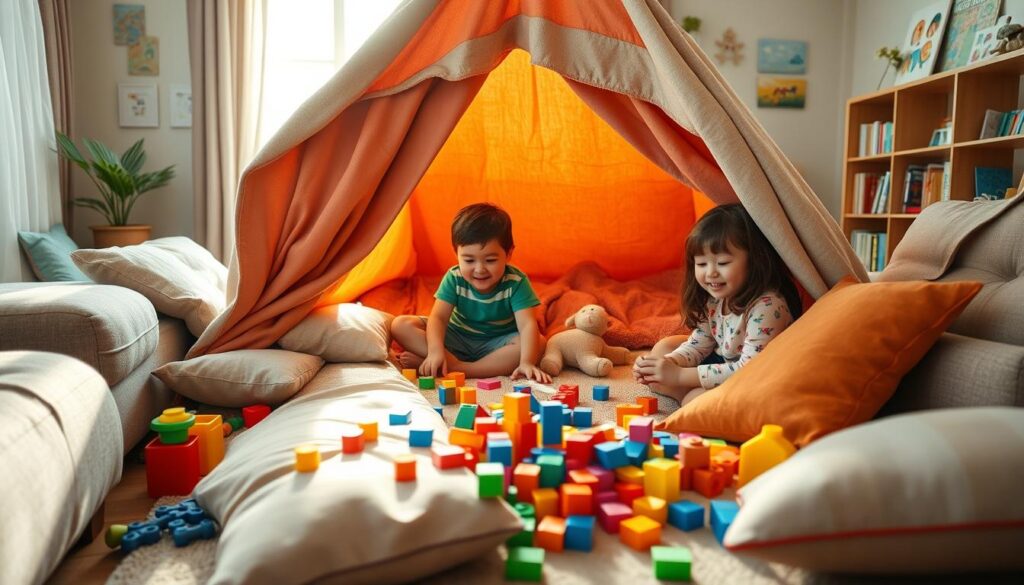
You can make a corner of your living room into a play area easily. Just use a soft blanket, a lamp, and some baskets with loose parts. These things turn everyday spots into places for stories, role play, and quiet creativity.
Low-cost imaginative play ideas
Forts made from sheets and chairs are great for drama. Cardboard boxes become rockets, theaters, or houses, encouraging big thinking. A small bin with fabric scraps, measuring cups, and empty spice jars can start many scenes without costing much.
Real-life props for play
Children love real, heavy materials. Use child-sized ceramic plates and wooden spoons instead of plastic ones. A small broom, a toy medical kit, and baskets for pretend shopping make play more real and useful.
Indoor play activities for children
- Make a mini market with grocery bags, price tags, and canned goods for counting and talking.
- Set up a pretend clinic with stuffed animals, a notepad, and a towel for bandages.
- Use a cardboard box and craft stick puppets made from socks and buttons for a puppet theater.
Daily routines reused as pretend-play scenarios
Turn morning chores into play scripts. Let your child run a mock kitchen while you guide them. Play “store” after shopping by sorting receipts and practicing exchanges. Camping in the living room teaches sequence and vocabulary while roasting paper marshmallows.
Support your child by asking open-ended questions like “What happens next?” or “Who will help in your shop?” Let them lead and add to their language when asked. These choices make play at home a constant source of learning and happiness.
Creative play ideas and themed activities by age
Choose simple, flexible themes that match your child’s energy and attention. Start with everyday objects and let imagination transform them into props. Rotate materials often to keep play fresh and to scaffold new language and problem-solving skills.
Pretend play activities for toddlers: simple symbolic games
Offer a small selection of safe, realistic items such as wooden bowls, fabric scraps, and stuffed animals. Let your toddler use a block as a phone or a scarf as a cape to practice symbolic thought.
Try short, repeatable routines: a tea party with two cups, a pretend grocery run with a basket, or caring for a doll. These pretend play activities for toddlers build vocabulary and early narrative skills.
Imaginative games for preschoolers: role play and world building
Set up role-play stations like a store, clinic, or fire station using cardboard and bins. Provide loose parts so kids can redesign spaces and invent rules.
Encourage collaborative projects where preschoolers build small towns with blocks and figurines. These imaginative games for preschoolers boost planning, negotiation, and storytelling.
Older kids: extended narratives, cooperative dramatic play, and maker challenges
Offer longer scenarios such as a camping expedition or a science mission. Add tools like building sets and Rigamajig-style pieces so older kids can construct scenery and props.
Prompt cooperative dramatic play for children by suggesting roles, then step back. Imaginative play for older kids grows when you pair narrative goals with maker challenges that demand teamwork.
Use themed play activities by age to guide materials and prompts. For toddlers, favor repetition and clear props. For preschoolers, mix role play with building tasks. For older kids, combine dramatic play for children with maker elements to deepen complexity and sustain interest.
| Age Group | Quick Setup | Core Benefits | Example Theme |
|---|---|---|---|
| Toddlers (1–3) | 2–4 realistic props, soft toys, fabric | Symbolic thinking, vocabulary, routine | Tea party with stuffed animals |
| Preschoolers (3–5) | Cardboard stations, blocks, role badges | Planning, perspective-taking, storytelling | Grocery store and block town |
| School-age (6–10) | Building sets, maker tools, scenario cards | Collaboration, extended narratives, design skills | Park ranger expedition with constructed basecamp |
Educational toys for pretend play and how to choose them
When picking toys for pretend play, look for ones that can be used in many ways. Choose items that encourage storytelling, problem-solving, and playing different roles. This makes play more engaging and helps your child practice important skills like language, planning, and teamwork.
Features to look for in toys that encourage imaginative play
Choose toys made from durable, touchable materials that feel real. Wood blocks, fabric scraps, metal pots, and solid dolls provide a sensory experience that sparks longer play.
Look for toys with simple parts that offer endless possibilities. Sets that let kids change and reuse parts teach them to adapt and grow their stories.
Open-ended toys vs. role-play sets
Open-ended toys let kids invent and change the rules. Blocks and loose parts become anything when paired with fabric and baskets.
Role-play sets, like a toy kitchen or doctor kit, offer a ready-made scenario. They help kids start playing quickly and learn routines. Mix both types to balance creativity and structure.
Integrating maker tools (Rigamajig, building sets) with dramatic play
Combine construction systems like Rigamajig and maker kits with costumes and props. Building a fort or a spaceship links engineering with storytelling.
Choose tools that are easy to use, suitable for different ages, and durable. These features support teamwork and let kids keep trying new ideas.
Below is a quick comparison to guide your choosing toys for imaginative play. It highlights strengths you can match to your child’s interests and developmental goals.
| Type | Best for | Key benefits | What to look for |
|---|---|---|---|
| Open-ended materials (blocks, loose parts) | Story-building, problem-solving | Flexible use, sparks creativity, supports motor skills | Durable, tactile, varied shapes and sizes |
| Role-play sets (kitchen, doctor) | Routine learning, social scripts | Quick scene-setting, vocabulary growth, cooperative play | Realistic details, sturdy pieces, safe small parts |
| Maker tools (Rigamajig and maker tools, building kits) | Design challenges, collaborative builds | Engineering thinking, storytelling through construction | Simple fasteners, adjustable components, cross-age appeal |
| Real-life props and loose parts | Tactile realism, sensory play | Authentic feel, encourages creative substitutions | Household-safe items, different weights and textures |
| Art supplies and fabrics | Scene creation, character design | Visual storytelling, fine motor practice | Washable materials, non-toxic paints, open-ended formats |
Use the table to weigh open-ended toys vs role-play sets when you shop. Mix in Rigamajig and maker tools to deepen narratives and boost collaborative exploration.
How to encourage pretend play and support your child’s leadership
Let your child lead the play and watch their confidence soar. Start with a few prompts and then step back. This method boosts creativity in kids as they create stories, make rules, and solve problems on their own.

Letting kids take the reins
Begin with a simple prompt or prop and let your child take it from there. When they name characters and decide the story’s direction, you’re supporting their creative play. Keep your input minimal and respect their made-up rules.
Using dress-up, props, and costumes
Collect loose parts, fabric scraps, hats, and everyday items for dramatic play. These items help kids feel more real in their roles. Store them in labeled baskets so they can pick what they want to use.
Coaching with open-ended questions
Ask questions like, “Who are you today?” or “Where will you go next?” These questions help kids tell their own stories without feeling controlled. Use descriptive follow-ups to encourage more details and support their imaginative play.
| Strategy | What you do | Child benefit |
|---|---|---|
| Prompt then pause | Start a scene with one sentence and wait for the child to continue | Builds leadership and narrative skills |
| Loose parts and real props | Provide fabric, baskets, and child-safe tools for open use | Encourages creative problem solving and role adoption |
| Dress-up rotation | Rotate costumes and keep them accessible in labeled bins | Sustains interest in dress-up for role play and symbolic thinking |
| Open-ended coaching | Use questions like “Who is that?” and “What happens next?” | Expands language and helps with coaching play with questions |
| Minimal intervention | Intervene only to keep play safe or to model a behavior | Supports autonomy and long-term engagement in child-led imaginative play |
Make pretend play a regular part of your day with small routines. Offer choices, show interest, and ask open-ended questions. These actions support your child’s creativity, leadership, and language skills.
Inclusive and safe strategies for fostering imaginative play
You can create play spaces that welcome everyone while keeping it fun and safe. Start with activities that let each child decide how to participate. Things like puppet shows, blocks, and simple art supplies are great for everyone.
Adapting play for different abilities and sensory needs
Give kids choices in texture, volume, and pace to keep them comfortable. Offer soft fabrics, weighted items, and quiet areas for those who need them. Break tasks into small steps and use pictures or a simple schedule to help with routines.
Use items that are familiar and sized right for kids, like IKEA’s low shelves and Melissa & Doug tools. Remember, it’s about play, not making everything perfect.
Setting safe boundaries while allowing real materials
Real items like bowls, wooden spoons, and kid-sized gardening tools add to the fun but need rules. Show kids how to handle things carefully and keep dangerous items out of reach. Make sure everyone knows the rules and show them how to play safely.
Introduce new tools in a way that lets you teach kids how to use them safely. Choose items that are safe for kids and make sure big structures are stable to avoid tipping.
Encouraging cooperative play among siblings and peers
Let kids take the lead in their stories and give everyone a role that fits their abilities. Use open-ended questions like “What should our market sell?” to get everyone talking and learning new words.
Practice teamwork by setting clear goals, like building a fort or putting on a puppet show. Praise kids for sharing ideas and helping each other to encourage teamwork.
Keep a play area stocked with wooden blocks, cardboard boxes, magnetic sets, and dress-up clothes. This mix encourages creativity and helps kids adapt to different play styles. For more ideas, check out building games for children.
| Need | Simple Adjustments | Safe Materials | Cooperative Prompt |
|---|---|---|---|
| Sensory sensitivity | Offer quiet corner, soft textiles, low lighting | Weighted lap pads, fleece, foam blocks | “Who will place the soft blanket first?” |
| Motor delays | Use larger pieces, stabilizing bases, step tasks | Large wooden blocks, big-piece puzzles, child-size tools | “Can you show the next step while I hold the base?” |
| Nonverbal communication | Include picture cards, gestures, puppets | Picture cue cards, finger puppets, tactile boards | “Point to the puppet who will speak next.” |
| Risky real materials | Supervised sessions, model use, clear storage rules | Child-sized broom, plastic knives for play cooking, wooden spoons | “Let’s show how to carry this safely together.” |
Measuring and observing pretend play development
Watch how your child uses objects, words, and roles to tell stories. Measuring pretend play development means noting changes in play complexity, language, and social give-and-take over weeks and months. Keep short, regular notes so you can spot trends in pretend play development milestones and adjust support as needed.
Signs of imaginative play
Look for simple object substitution in toddlers, such as a block becoming a phone. Preschoolers usually show multi-step narratives, role negotiation, and costume-based scenarios. Strong indicators include storytelling, role-taking, transformation of objects, and building make-believe environments or puppet shows.
What to do if your child seems reluctant to play
If your child is reluctant to play, offer open-ended materials like baskets of loose parts, real-life props, and simple costumes. Join their play with gentle modeling and short guided sessions using familiar items. Take walks to collect natural objects and return to play later; repeated, low-pressure opportunities help many children who seem reluctant to play.
When to consult professionals about play and development concerns
Track language complexity, social engagement, and symbolic play across time. You should consider when to consult professionals if your child shows persistent absence of symbolic play, limited social interaction, or language delays against age expectations. Start with your pediatrician and consider speech-language pathologists or early childhood specialists for further evaluation.
Community programs such as library story times and local play groups let you observe and encourage play before seeking formal assessment. Use those settings to compare play behaviors against typical pretend play development milestones while you monitor progress.
Conclusion
Imaginative play is great for kids in many ways. It helps with language, problem-solving, and fine motor skills. It also boosts social skills and confidence.
Simple activities like storytelling and making forts are good for kids. They help with planning and emotional expression. These activities are similar to what preschoolers do every day.
To encourage imaginative play, give kids loose parts and real materials. Let them find new uses and roles. You can also teach them about safe tool use and set clear storage rules.
Construction and maker activities are also good for learning. They help kids develop problem-solving skills. For more ideas and safety tips, check out construction play resources from experts like the Spencer Clarke Group.
What you do as a caregiver is important. Ask open-ended questions and let kids lead. Short, regular play sessions are better than long ones.
These approaches improve language, executive skills, and empathy. If your child seems hesitant or has concerns, get professional help early. This ensures they get the most out of pretend play.
Make creative play a regular part of your child’s life. Small, guided moments of freedom are key. They help kids become confident, curious, and able to solve problems and work with others.