
Can a simple game of chase or a couch-cushion obstacle make your child steadier, stronger, and more confident than any drill?
Physical play is key for young children. It helps them move better and do everyday things on their own. You don’t need a gym to help—just play at home or the playground.
Researchers use the Test of Gross Motor Development–Third Edition (TGMD-3) to check how well children move. For kids aged 3–10, the TGMD-3 looks at how they run, jump, and throw. It shows if a child is doing well or needs more practice.
Studies also use devices like the ActiGraph wGT3X-BT to measure how active kids are. They look at light physical activity (LPA) and moderate-to-vigorous physical activity (MVPA). This helps understand how much active time kids get.
This article talks about the benefits of physical play for kids. It covers how play helps with coordination, balance, and strength. You’ll find ways to support your child’s motor growth through play, indoors and outdoors.
Key Takeaways
- Gross motor skills include locomotor and object-control skills central to daily life and play.
- TGMD-3 is the standard tool for assessing motor competence in ages 3–10, with clear scoring for locomotor and object-control items.
- Accelerometers like the ActiGraph wGT3-X-BT are used in research to measure LPA and MVPA over multiple days.
- Benefits of physical play for children span physical strength, balance, coordination, and social-cognitive development.
- You can promote the development of gross motor skills in children through playful, consistent activities at home, school, or outdoors.
- For activity ideas that boost gross motor skills, see this practical guide on playful movement and games: physical play ideas to boost gross motor.
Why physical play matters for gross motor development
Young children learn by doing. Active play helps them develop important motor skills. It strengthens muscles, improves balance, and boosts social skills.
Studies show play is key for motor skills. Kids aged 3–10 get better at moving and handling objects as they grow. These skills help them behave better and make friends.
Research evidence linking play and motor milestones
Object-control skills help kids join games and teams. This leads to better social skills and cooperation. Locomotor skills let kids reach others and stay involved in play.
Early motor skills are linked to later success. Kids with strong motor skills do better in school and have fewer problems. They also tend to stay active and make friends.
Long-term health and developmental outcomes
Motor skills are important beyond play. Active play makes bones stronger and improves heart health. It also helps with thinking and feeling better.
Learn more about physical development at physical development stages in children. It shows how play matches up with skill growth.
Focus on play to help kids grow strong and confident. Regular activity leads to lasting improvements in strength, balance, and social skills.
physical play gross motor skills children
Before planning play, you need a clear definition. Physical play for kids means active, movement-based activities. These activities help build big muscle actions like running and throwing.
It covers kids from birth to early school age (about 10 years). It includes both structured activities like ball skills and free play like running.
Defining the primary keyword and scope
When we talk about physical play for kids, we mean whole-body development. It improves trunk stability and leg power. It also helps with arm control and coordination.
Tools like the TGMD-3 assess these skills for kids aged 3–10. This helps track progress as kids reach early milestones.
Use both guided and free play to balance skill practice with creativity. Structured drills focus on specific abilities. Unstructured play offers varied experiences and problem-solving that enhance motor coordination.
How this type of play differs from fine motor or sedentary activities
Fine motor tasks focus on small-muscle precision, like writing and buttoning. These skills are important but different from gross motor demands. Gross motor activities build balance and strength, supporting mobility and sports skills.
Sedentary or screen-based time lacks the intensity and variety needed for motor learning. Research shows that moderate-to-vigorous physical activity (MVPA) is best for motor skill practice. MVPA offers challenges like load, speed, and balance that sedentary time can’t provide.
Make room in daily routines for both types of play. Pair fine motor tasks with active play to support overall development. This maximizes the benefits of physical play for kids.
| Activity Type | Primary Gross Skill | Developmental Benefit |
|---|---|---|
| Running, hopping, skipping | Locomotion | Cardio fitness, spatial awareness, bone loading |
| Throwing, catching, kicking | Object control | Hand-eye coordination, timing, social play |
| Climbing, monkey bars | Upper-body strength | Grip strength, core activation, motor planning |
| Balance beam, beam walking | Balance and proprioception | Postural control, confidence on uneven surfaces |
| Unstructured free play | Mixed gross skills | Creativity, decision-making, motor coordination |
For more ideas and evidence, visit benefits of physical play. See how you can adapt these ideas to your routines.
Related Guides on Gross Motor Play and Physical Development
If you want to explore this topic in more detail, these related guides explain how active play, running, jumping, climbing, and full-body movement help children build gross motor skills, strength, agility, coordination, and healthy physical development.
- How Active Play Builds Gross Motor Skills in Young Children
- How Running, Jumping, and Climbing Support Child Development
- Best Physical Games for Kids That Build Strength and Movement Skills
- How Active Play Helps Kids Develop Gross Motor Control
- Best Gross Motor Games for Early Childhood Development
- How Movement Games Help Kids Build Strength and Agility
- How Physical Games Support Development in Young Children
- Why Kids Need Active Full-Body Play Every Day
- How Physical Games Support Healthy Growth in Kids Ages 3 to 8
- Gross Motor Play for Kids: What It Is and Why It Matters
How physical play promotes specific gross motor skills
Physical play lets kids practice important movements over and over. By planning activities that challenge speed, balance, and strength, you help them develop gross motor skills. Use different surfaces, changing goals, and fun rules to keep it interesting and useful.
Locomotion skills
Games like tag, hopscotch, and obstacle courses help kids master running, hopping, and jumping. These games break down complex actions into simpler parts. The TGMD-3 assessment looks at specific skills like arm and leg action, stride length, and rhythm.
Playing these games often improves kids’ motor skills and makes them more efficient. For example, obstacle courses help with pacing and foot placement. Tag games that require quick changes in direction improve agility and teach safe landing.
Balance and coordination
Playing on uneven surfaces and climbing helps kids develop balance. Balance is key for catching, throwing, and kicking. Introducing challenges like narrow beams or stepping stones helps kids move from simple to dynamic balance.
Activities that require opposite-arm and opposite-leg timing improve bilateral coordination. Games that mix climbing with reaching or jumping with turning help the nervous system sequence movements. This benefits daily activities and sports skills.
Strength, endurance, and bone health
Activities like running and jumping help bones grow and muscles get stronger. Regular exercise builds cardiovascular endurance and supports a healthy body. Kids who develop gross motor skills early tend to stay active, which is good for fitness and bones.
Start with short sprint relays and add repeated hops. Gradually increase play duration. You can see progress by checking for increased jump height or longer play times. Tools like TGMD-3 offer a way to track progress in gross motor skills.
Make play more challenging by changing tasks, surfaces, and tempos. This keeps kids motivated. Use informal observation or standardized measures to track their progress.
| Skill Domain | Play Examples | Targeted Components | Simple Way to Track Progress |
|---|---|---|---|
| Locomotion | tag, hopscotch, obstacle courses | stride length, rhythm, takeoff/landing, spatial control | count successful skips or timed shuttle runs |
| Balance & Coordination | balance beams, log walks, single-leg hop games | postural control, bilateral timing, stability during reach | measure seconds of single-leg stance or beam traversals |
| Strength, Endurance & Bone Health | repeated jumping, sprint relays, climbing | muscle force, cardiovascular endurance, bone-loading impact | track jump height, relay distance, active play minutes per day |
Age-by-age considerations: infants, toddlers, and preschoolers
Your child’s motor skills grow in stages. Early experiences shape their future movement and social skills. Here are age-based tips to help develop gross motor skills through play.
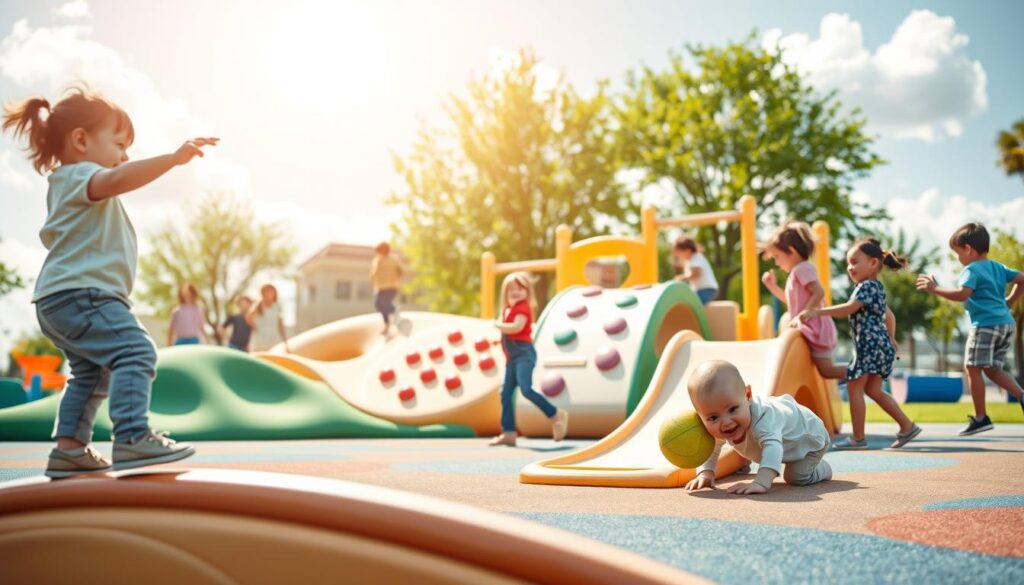
Infants and early motor experiences
In the first year, floor time is key. Tummy time, sitting, reaching, and rolling build strength and coordination. These steps are the foundation for walking and balance later on.
Safe floor play with a caregiver lets infants explore and move. Short, frequent play sessions help with head control, reaching, and staying stable.
Toddlers and the emergence of locomotor variation
Between 1 and 3 years, toddlers start to run, climb, and jump. Giving them space to move and trying different surfaces helps them adapt.
Play like chase games and climbing on low structures improve balance and coordination. These activities also help with social skills and independence.
Preschoolers and complex coordination
At 3 to 5 years, coordination gets better fast. Expect better balance, clearer running, and starting to throw and catch.
Try skipping, ball games, and following rules to mix movement and skill. These activities boost coordination, timing, and social skills, preparing them for group games and school.
Assessment and expectations
Use age-based milestones and tools like TGMD-3 for concerns. Early help from physical therapy or play programs can make a big difference for kids who need it.
Practical tip
Make play varied and mostly outside. Outdoor play boosts balance, movement variety, and social skills. Short, regular play sessions are better than long, rare ones for gross motor development.
Benefits of outdoor play for gross motor skill development
Outdoor play offers kids different surfaces and open space. This helps them balance and coordinate better. Kids run, climb, and jump more outside than inside. These activities boost physical activity, strength, and spatial awareness.
Playing outside also helps with thinking and social skills. Group games teach kids to work together, follow rules, and solve problems. Studies show that kids who play outside are better at cooperating and controlling themselves.
Nature provides more sensory input than most indoor places. Kids learn to balance and understand their bodies better. Weather and obstacles help them be creative and learn to take risks.
It’s important for everyone to have access to outdoor play. Not all neighborhoods have safe parks. Supporting parks, school playgrounds, and nature-based preschools can help.
To make outdoor play more effective, offer short, frequent sessions. Provide different equipment like balls and climbing structures. Adults should help by encouraging kids to try new things safely.
| Focus | Outdoor Advantage | Example Activity |
|---|---|---|
| Balance and coordination | Uneven terrain and natural obstacles prompt postural adjustments | Trail walking, log balancing, obstacle courses |
| Strength and bone health | More running, jumping, climbing increases impact and load-bearing | Climbing frames, hill sprints, hop-and-land games |
| Social-emotional skills | Group outdoor play fosters cooperation and rule negotiation | Team tag, cooperative building, shared playground games |
| Cognitive gains | Problem solving and planning arise from open-ended outdoor challenges | Scavenger hunts, route planning, games with evolving rules |
| Access strategies | Community parks and school scheduling expand reach | Playground time in school day, mobile play programs, park partnerships |
Activities for gross motor skills in kids you can try
Try simple, playful routines that build strength, balance, and coordination. Short sessions work best for busy days. Aim for 10–30 minutes of active play that raises the heart rate and keeps kids engaged. These ideas use everyday items and common playground equipment to make physical play fun and purposeful.
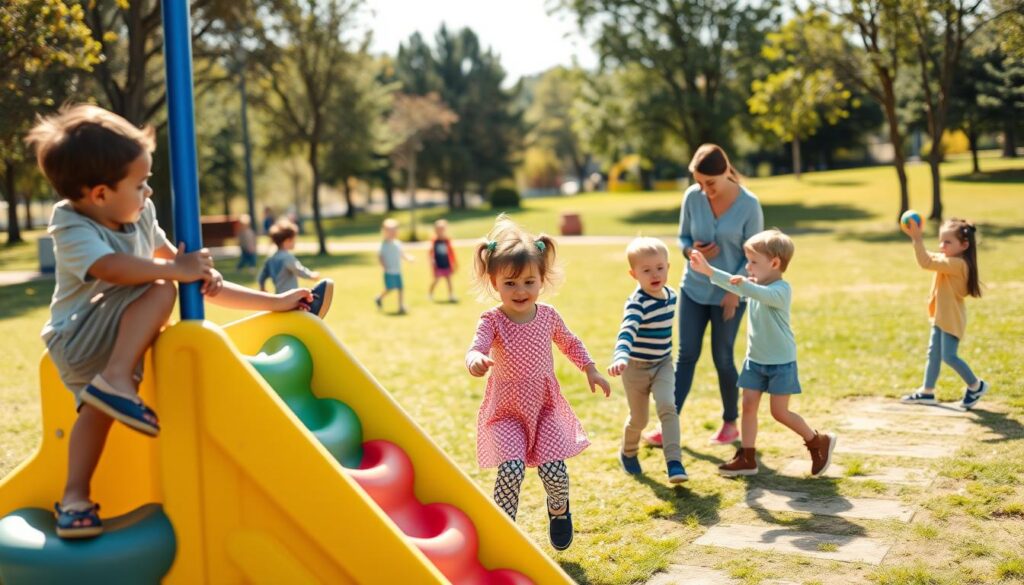
Simple home and playground activities
- Tag and chase: boosts speed, spatial awareness, and anticipatory movement. Vary rules to teach stopping and starting.
- Hopscotch: improves single-leg balance and jumping control. Use chalk outdoors or tape indoors.
- Obstacle courses: combine crawling, jumping, balancing, and throwing. Progress by adding timed runs or smaller gaps.
- Ball games (throw, catch, kick): develop hand-eye coordination and object control. Use age-appropriate balls from brands like Franklin Sports or Voit for safer grip.
- Jump rope: sharpens rhythm and lower-body power. Start with group jumps, then move to single-rope practice.
- Climbing on playground equipment: strengthens upper body and core while teaching safe risk-taking.
- Scooter or tricycle rides: enhance leg power and steering coordination for preschoolers.
Indoor adaptations for rainy days and small spaces
- Tape “balance beam” on the floor: practice heel-to-toe walking and single-leg holds.
- Pillow obstacle course: step, hop, and crawl between soft surfaces for safe landing practice.
- Balloon volleyball: use a balloon for gentle catching practice to slow object speed and improve timing.
- Stepping-stone patterns with floor markers: work on foot placement and sequencing.
- Animal walks (bear crawl, crab walk): build core strength and coordinating opposite limbs.
- Gentle tossing into laundry baskets: refine throwing accuracy and catching by varying distance and target size.
Dosage, progression, and safety
Have kids play daily in short bursts. Gradually raise complexity by shrinking targets, asking for single-leg catches, or timing obstacle runs. Emphasize playful repetition over drill-like practice to keep motivation high and support physical play gross motor skills children.
Choose age-appropriate balls, soft landing surfaces, and close supervision for riskier moves. Research with accelerometers shows moderate-to-vigorous activity minutes matter, so include games that elevate movement and sustain effort. These activities support enhancing motor coordination in children through play while keeping safety central.
Promoting motor coordination in children through play: adult roles and interaction styles
You guide learning more than you lead it. Create a safe space with different materials. Show one example, then let children try on their own.
This balance helps in promoting gross motor skills through play. It also avoids over-directing.
How to scaffold without over-directing
Start by setting up props that are easy to reach. Use simple language and show one example, like a jump or throw.
Ask open-ended questions like “What happens if we move faster?” Praise their effort, not just their success. Let them watch and imitate each other.
Only step in to adjust safety or change the task’s difficulty. Give brief cues and encourage them to play again. This helps in developing gross motor skills.
Supporting children with disabilities or delays
Screen early if you notice missed milestones. Refer to pediatric therapists when needed. Targeted programs, like ball-skill practice, help in object control and social behavior.
Use inclusive strategies like modifying rules and adding visual cues. Offer adapted equipment and break tasks into small goals. Keep practice frequent and fun to boost motivation and independence.
Work with schools and therapists to align goals. Use simple checklists to monitor progress. Observe increases in participation and confidence. For more ideas, visit construction play ideas.
These resources help design playful routines. They support in promoting motor coordination and developing gross motor skills in children.
Best practices for developing gross motor skills in kids in childcare and school settings
Make sure kids have time to move freely every day. Set up outdoor play and gross motor activities regularly. This lets them practice running, jumping, and balancing.
Place climbing structures, balance beams, and balls in different areas. This helps avoid accidents and keeps play going smoothly.
Have clear rules and goals for physical activity. Set daily activity targets and include gross motor skills in school plans. Mix free play with lessons to teach new skills in a fun way.
Keep track of how kids are doing with simple tools like step counters. This shows how they’re improving over time.
Train staff on child development and safe movement. Make sure they know how to help kids grow without getting hurt. Offer training on the TGMD-3 and how to adapt activities for children with different physical, sensory, or developmental support needs.
Use screenings to find any delays early. Share the results with families and suggest ways to help at home. Working together with families is key to helping kids develop their gross motor skills.
Plan environments and rules to support kids’ physical play. With clear plans, goals, and trained staff, kids can grow their motor skills every day.
Incorporating physical activity for children’s motor skills into daily routines
Making movement a part of daily life helps kids build strength and balance. You can add short active bursts to usual tasks. This makes practice feel natural and steady.
Aim for several 10–20 minute sessions throughout the day. This boosts stamina and skill more than one long session.
Simple routine-based strategies for families
Turn the commute into practice. Walk or scoot to preschool when safe. Let your child carry a light bag of groceries to add purposeful strength work.
Use movement breaks between screen time and homework. Quick hop, balance on one foot, or a short obstacle course down the hallway are great.
Make chores active. Ask your child to sweep, sort laundry by tossing socks into a basket, or water plants while stepping up onto a low stool. These tasks count as activities for gross motor skills in kids because they combine control, coordination, and repetition.
Using play to create positive lifelong movement habits
Choose games that are social and fun. This links physical play gross motor skills children with pleasure. Family relay races after dinner, weekend park visits, or parent-child gymnastics classes at community centers build habit and skill together.
Offer choices so your child picks favorite activities and feels ownership.
Set small, clear goals to measure progress. Try targets like jump rope 10 times, balance on one foot for 10 seconds, or catch a ball five times. Track those wins on a simple chart and raise the challenge slowly.
Share goals with teachers so home and school reinforce the same skills.
Encourage autonomy and celebrate mastery. When your child devises a new trick on a scooter or beats a personal record for hops, praise effort and improvement. Early competence increases the chance your child will keep moving into adolescence and adulthood, supporting long-term health and confidence.
Addressing common barriers and practical solutions
When you try to make playtime count for motor development, you face real obstacles. Short school days, heavy homework, tight budgets, and unpredictable weather can keep kids inside. Use focused strategies that fit classrooms, homes, and communities to keep gross motor progress steady.
Limited time and competing academic pressures
Start by seeing movement as part of learning. Research shows active breaks boost attention and memory. Add short kinesthetic lessons for letters, numbers, and vocabulary.
Turn a five-minute transition into a balance or hopping routine that reinforces a lesson. This way, you can fit movement into busy timetables while following best practices for developing gross motor skills in kids.
Safety concerns, weather, and space constraints
Address safety through risk-managed play. Choose age-appropriate equipment, teach safe landing and fall techniques, and place soft surfacing under climbing areas. Supervised, slightly challenging play helps children test limits and build resilience.
When weather or space limits outdoor time, move activities indoors with compact tools like foam mats, balance pads, and hula hoops. Use active classrooms with clear zones for movement and simple rules that keep kids safe while practicing coordination.
You can expand options by partnering with local recreation centers and schools to use gyms on bad-weather days. Advocate for policy changes that prioritize recess and community park improvements to increase access to outdoor settings that support the importance of outdoor play for gross motor skills.
Equity and community partnerships
Prioritize low-cost, high-impact programs. Work with parks and recreation departments, YMCAs, and public libraries to provide free or subsidized classes. School-based interventions reach children who lack safe places to play at home.
Train staff and volunteers in inclusive approaches so programs follow best practices for developing gross motor skills in kids. Focus on simple, replicable activities that families can do at home with minimal equipment.
| Barrier | Practical Solution | Quick Implementation |
|---|---|---|
| Limited classroom time | Integrate movement into lessons; use 5–10 minute active breaks | Teacher-led kinesthetic alphabet or math relays |
| Safety worries | Use age-appropriate gear, supervise, teach safe landings | Soft mats under climbing areas and staff training |
| Bad weather or small spaces | Indoor adaptations, compact equipment, community gym access | Foam balance pads, hopscotch taped on the floor |
| Limited access due to cost | Partnerships with local parks, YMCAs, school programs | After-school play clubs with donated equipment |
| Lack of awareness | Share evidence that motor skills support cognition and school readiness | Short parent workshops and classroom flyers |
Use this blend of tactics to address barriers and build consistent opportunities for movement. Emphasize the importance of outdoor play for gross motor skills while you apply practical, evidence-aligned methods for addressing common barriers gross motor skills in diverse settings.
Conclusion
Physical play is key for kids to develop skills like moving and controlling objects. It also helps with balance and strength. By making sure kids get lots of active time, you help them grow in many ways.
Studies using tools like the TGMD-3 show how important motor skills are. They link to better health and social skills later on.
To keep kids improving, mix up their activities. Make sure they have fun and learn at the same time. Watch how they do and help when needed.
Simple daily routines and outdoor play should be part of family life. This helps kids develop their motor skills in a fun way.
In schools and childcare, follow best practices. This includes daily outdoor time and training for staff. It also means making sure everyone can join in and checking for any delays.
By making physical play a priority, kids get to enjoy better movement and stronger bodies. They also get to make more friends and have richer experiences.