
Could something as simple as letting kids run, climb, and jump be the key to their long-term health and academic success? In today’s screen-heavy world, it’s easy to underestimate what unstructured movement does for a growing child — but the science is clear.
The benefits of physical play go far beyond burning off energy. From building stronger bones to sharpening focus in the classroom, active play is one of the most powerful tools parents and educators have. And the best part? Kids don’t even know they’re “developing” — they’re just having fun.
Whether you’re a parent trying to balance screen time, a teacher wondering why recess matters, or someone setting up a backyard play space, this guide covers everything you need to know about why physical play deserves a top spot in every child’s day.
Key Takeaways
- Physical play enhances brain development and boosts cognitive performance
- Active movement builds stronger bones and develops muscle strength and endurance
- Regular play helps children manage stress, anxiety, and emotions more effectively
- Physical play refines gross and fine motor skills, including balance and coordination
- Group play fosters communication, teamwork, and social confidence
- Establishing active habits early creates a foundation for lifelong health
What Is Physical Play — and Why Does It Matter?
Physical play is any active, movement-based activity that gets the body engaged. It includes everything from high-energy outdoor games to structured sports to a child spinning in circles just to see what happens.
Unlike quiet or sedentary activities, physical play requires children to move, react, and engage with their environment in real time. That’s what makes it so developmentally rich.
Defining Physical Play
At its core, physical play is child-driven movement. It can be organized — like a soccer game — or completely unstructured, like chasing butterflies around the yard. Both are valuable.
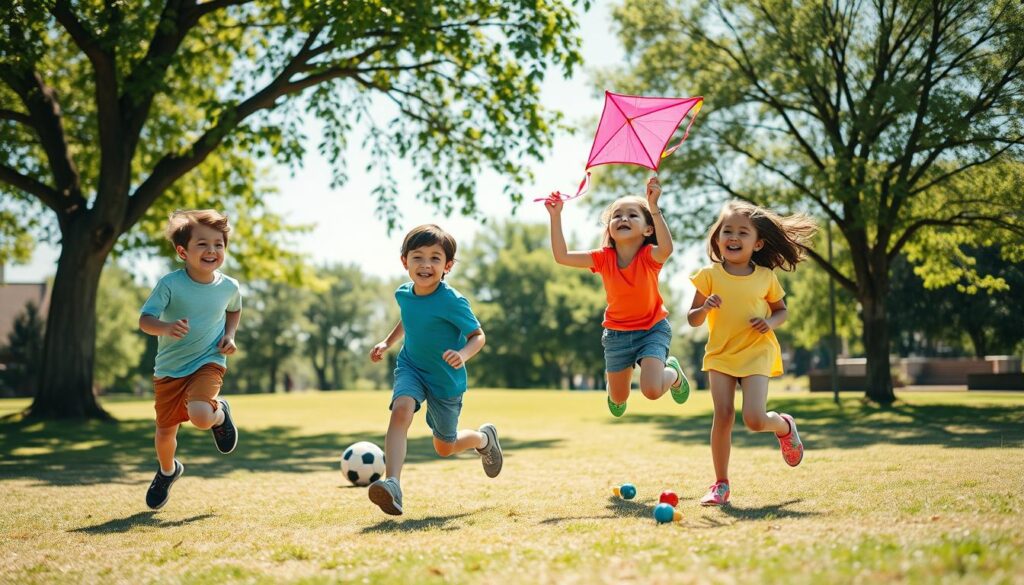
The common thread is body engagement: muscles working, balance being tested, senses firing.
Common Types of Physical Play Activities
Gross Motor (Large Movement) Activities
These engage major muscle groups and build whole-body coordination:
- Running, jumping, and skipping
- Riding bikes or scooters
- Swimming
- Playing tag, football, or relay races
- Navigating obstacle courses and climbing structures
Fine Motor (Small Movement) Activities
These require precision and hand-eye coordination:
- Throwing and catching a ball
- Hula hooping
- Hopscotch
- Balancing and climbing on monkey bars
| Activity Category | Common Examples | Key Benefit |
|---|---|---|
| Gross Motor | Cycling, Running, Swimming | Whole-body coordination |
| Fine Motor | Throwing, Hopscotch, Balancing | Precision and control |
| Free Play | Climbing, Swinging, Tag | Exploration and resilience |
The Role of Physical Play in Child Development
Physical play isn’t just recreation — it’s developmental infrastructure. Every time a child runs, climbs, or balances, they are building neural pathways, strengthening muscles, developing spatial awareness, and learning to navigate the world around them.
It builds cognitive ability, emotional health, and social skills all at the same time — making it one of the highest-return activities in early childhood.
Physical Health Benefits of Physical Play
Regular active movement provides the essential building blocks for a child’s physiological growth. When kids engage in physical play consistently, their bodies become stronger, more coordinated, and more resilient.
Building Strong Bones and Muscles
How Physical Activity Strengthens Bones
Bones grow denser when they experience force through weight-bearing movement. Activities like jumping, running, and dancing help children build bone density during their critical growth years. This early investment acts as a long-term shield against conditions like osteoporosis in later life.
Developing Muscle Strength and Endurance
Physical play builds muscle not through structured gym work, but through repetitive, joyful movement. Climbing, pushing, pulling, and carrying all activate different muscle groups and build endurance over time. As kids grow stronger, play becomes more dynamic — and even more rewarding.
Enhancing Motor Skills and Coordination
Gross and Fine Motor Skill Development
Motor skills are mastered through repetition, and physical play provides that repetition in the most engaging format possible. Running and climbing develop gross motor abilities, while activities like catching a ball or navigating a climbing wall refine fine motor control and hand-eye coordination.
Balance and Body Awareness
Jumping, balancing on a beam, or running on uneven terrain teaches children where their body is in space — a skill called proprioception. This spatial awareness builds physical confidence and is foundational to athletic development.
| Activity Type | Physical Benefit | Skill Developed |
|---|---|---|
| Jumping & Dancing | Bone density | Spatial awareness |
| Monkey Bars | Upper body strength | Grip and control |
| Sliding & Climbing | Core activation | Motor planning |
Improving Flexibility and Range of Motion
Children naturally increase their range of motion through play. Reaching, stretching, rolling, and performing cartwheels keep muscles and joints flexible — without any structured stretching routine. This organic flexibility training reduces the risk of injury as children grow.
Preventing Obesity and Supporting Cardiovascular Health
Unstructured physical play is one of the most effective tools for maintaining a healthy weight in children. It burns calories, boosts metabolism, and keeps the cardiovascular system strong — through activities kids genuinely want to do.
Research consistently links regular active play to lower rates of childhood obesity and a reduced risk of developing chronic conditions like type 2 diabetes and cardiovascular disease in adolescence.
Cognitive and Learning Benefits of Physical Play
Many parents focus on the physical gains of active play — but some of the most impressive benefits of physical play happen inside the brain. Movement doesn’t just build muscles; it builds minds.
Boosting Brain Development and Neural Pathways
Every time a child engages in dynamic movement — spinning, balancing, navigating an obstacle course — their brain activates across multiple regions simultaneously. This cross-brain engagement builds strong neural pathways that directly enhance learning capacity and mental flexibility.
Research in pediatric health consistently shows that children who engage in regular physical activity develop greater cognitive plasticity — meaning their brains are more adaptable and ready to absorb new information.
Enhancing Focus and Attention Span
Physical activity increases blood flow and oxygen to the brain and triggers the release of neurotransmitters like dopamine and serotonin. The result is improved focus, better working memory, and a brain that’s primed to learn.
This is why children who have recess before class — not after — often perform better on attention and concentration tasks. Movement prepares the brain; it doesn’t distract from learning.
Improving Memory and Problem-Solving Skills
Games with rules require children to hold information in working memory, adjust strategies in real time, and coordinate with others simultaneously. Activities like tag, team sports, or navigating a jungle gym challenge the brain to plan, recall, and respond — the exact cognitive skills needed in the classroom.
| Active Movement | Cognitive Skill | Classroom Benefit |
|---|---|---|
| Climbing | Visualization | Geometry readiness |
| Spinning | Neural integration | Information processing |
| Team sports | Strategic planning | Logical reasoning |
Decision-Making and Risk Assessment
Every time a child decides whether to jump from a ledge or test a new handhold on the climbing wall, they are practicing real-world risk assessment. They evaluate distance, strength, and consequence — and make a judgment call.
This kind of decision-making builds executive function: the ability to plan ahead, regulate behavior, and think critically. These skills transfer directly to academic and social challenges.
Spatial Awareness and Mathematical Thinking
Navigating an obstacle course, building a fort, or playing a game with spatial rules all develop three-dimensional thinking. This spatial reasoning is directly linked to mathematical ability — children who engage in more active, spatial play often perform better in geometry and STEM subjects.
Supporting Academic Performance
The evidence is consistent: kids who move more, learn better. Regular physical activity is associated with higher test scores, better classroom behavior, and stronger critical thinking skills across all age groups.
Movement doesn’t compete with education. It fuels it.
Mental and Emotional Wellbeing Benefits of Physical Play
Beyond fitness and cognition, the mental and emotional benefits of physical play are among the most meaningful for a child’s long-term development. Active movement shapes how children feel, cope, and grow as individuals.
Reducing Stress, Anxiety, and Depression
Physical activity triggers the release of endorphins — the brain’s natural mood elevators — while simultaneously reducing cortisol, the stress hormone. For children managing anxiety or low mood, regular active play can have a significant, measurable impact on their daily wellbeing.
Research supports physical activity as one of the most effective, accessible tools for reducing symptoms of anxiety and depression in children — and it requires no prescription.
The Calming Power of Rhythmic Movement
Swinging, rocking, and spinning have a distinctly soothing effect on the nervous system. These rhythmic, repetitive movements help children regulate sensory input and return to a calm baseline after stress or overstimulation — which is why this type of movement is commonly used in therapeutic and occupational settings.
Energy Release and Emotional Balance
Hours of sitting still build up physical and emotional tension in children’s bodies. Physical play provides an essential release valve. Kids who move regularly throughout the day are less prone to emotional outbursts and better equipped to regulate their behavior during quiet activities.
Building Self-Confidence and Resilience
There is something deeply powerful about a child mastering a physical challenge — finally crossing the monkey bars, landing a jump they were afraid of, or winning a team relay. These moments build genuine, earned confidence and a real sense of capability.
Each challenge a child overcomes on the playground teaches them that effort leads to growth. This mindset — built through physical play — becomes their default approach to life’s obstacles.
Improving Sleep Quality
High-energy physical play tires the body in a healthy way, making it easier for children to fall asleep and stay asleep. Better sleep means better mood, sharper concentration, and more stable behavior the next day. The benefits of physical play compound: good sleep makes the next day of active play even more effective.
Developing Emotional Regulation Skills
Physical games regularly present moments of frustration: losing, rule conflicts, physical setbacks. Navigating these moments in a social setting teaches children to manage their impulses, take turns, and recover from disappointment — all crucial emotional regulation skills.
| Activity Type | Emotional Focus | Wellness Result |
|---|---|---|
| Rhythmic swinging | Nervous system regulation | Calm, focused state |
| Climbing challenges | Resilience and competence | Increased self-esteem |
| Group games | Impulse control | Better frustration management |
Social Development Through Physical Play
Active play is one of the most natural social training grounds available to children. It places kids in dynamic, unscripted situations where they must communicate, cooperate, and negotiate — in real time, with real stakes.
Learning Teamwork and Cooperation
Collaborative games require kids to work toward a shared goal, trust their teammates, and contribute meaningfully to the group. These are skills that cannot be fully taught in a classroom — they have to be practiced through lived experience.
Developing Communication and Active Listening
Whether calling out during a game of tag or explaining rules to a new player, physical play demands constant, purposeful communication. Children practice giving clear instructions, reading body language, and listening actively — in an environment that naturally motivates them to get it right.
Building Empathy and Understanding
When a teammate struggles, children learn to adjust. When a peer gets hurt, emotions become visible and real. Physical play creates authentic moments that build social awareness and genuine compassion.
Practicing Conflict Resolution and Negotiation
Disagreements over game rules are a healthy and inevitable part of group play — and that’s a feature, not a flaw. Navigating a dispute teaches children to negotiate fairly, advocate for themselves, and find solutions that work for the whole group.
Strengthening Family and Peer Bonds
Active play creates shared memories, shared effort, and shared laughter — three of the most powerful foundations of human connection. Families who play together, and children who play with peers regularly, build stronger and more trusting relationships over time.
“Play is the primary way children learn how to get along with each other and prepare for adult life.”
| Social Area | Physical Activity Example | Key Benefit |
|---|---|---|
| Cooperation | Relay races | Learning to rely on teammates |
| Communication | Tag or hide-and-seek | Giving clear instructions |
| Empathy | Partner games | Understanding others’ limits |
Additional social skills built through physical play:
- Sharing: Taking turns with equipment and space
- Leadership: Organizing and directing group games
- Sportsmanship: Handling wins and losses with grace
How to Encourage Physical Play: Practical Tips for Parents and Educators
Creating a culture of movement means turning everyday moments into opportunities for active exploration and growth. Here’s how to make it happen — indoors, outdoors, and in between.
How Much Physical Activity Do Children Need?
According to the CDC and the American Academy of Pediatrics:
- Preschoolers (ages 3–5): Should be physically active throughout the day, accumulating at least 3 hours of activity at varied intensities
- School-age children and teens (ages 6–17): Need at least 60 minutes of moderate-to-vigorous physical activity every day
This time should include a mix of aerobic activity, muscle-strengthening movement, and bone-strengthening exercise.
| Age Group | Recommended Daily Activity | Examples |
|---|---|---|
| Ages 3–5 | 3 hours (varied intensity) | Free play, running, dancing, outdoor exploration |
| Ages 6–17 | 60+ minutes (moderate to vigorous) | Sports, cycling, active games, swimming |
Fun Indoor Physical Play Activities
Bad weather? No problem. Indoor spaces offer more potential for active play than most parents realize.
Obstacle Courses Use pillows, chairs, and blankets to create a crawl-and-jump challenge course in your living room. Kids love the creativity and the challenge — and it builds the same motor skills as outdoor play.
Dance Parties Turn up a playlist and let kids move freely. Dancing builds coordination, rhythm, and cardiovascular fitness — and it’s almost impossible not to enjoy.
Yoga for Kids Child-friendly yoga sessions improve flexibility, balance, and focus. They also teach children to regulate their breathing — a powerful emotional regulation skill.
Active Classroom Games Simon Says, Freeze Dance, and Twister require minimal space but maximum engagement. These are great options for teachers looking to weave movement into the school day.
Outdoor Play Ideas Close to Home
You don’t need a fancy playground. Neighborhoods and nature offer endless possibilities for meaningful physical play.
Classic Outdoor Games Timeless games like hide-and-seek, hopscotch, and jump rope deliver high-energy movement and genuine social interaction. They’re easy to learn, need almost no equipment, and never get old.
💡 Looking for the best outdoor toys for active kids? Jump ropes, balance bikes, and backyard obstacle course kits are excellent investments that get kids moving every day. Check our top picks on the blog. (Affiliate placement opportunity: Amazon Associates — outdoor & active play gear)
Scavenger Hunts Combining movement with cognitive engagement, scavenger hunts send kids exploring for colors, objects, or nature finds. They make exercise feel like adventure.
Gardening and Nature Play Digging, planting, and exploring the garden engages small muscle groups and connects children to the natural world. It’s sensory-rich, calming, and more physically demanding than it looks.
Finding Local Resources Check local park and recreation websites, school directories, or programs like Let’s Move! to find trails, community spaces, and outdoor programs near you.
Creating Inclusive Play Environments for All Children
Every child deserves access to physical play — regardless of physical ability or developmental stage.
- Choose equipment with multiple access points: ramps, handrails, and low-entry designs
- Include sensory-rich options like tire swings or textured balance beams
- Provide seated or supported play options alongside more active equipment
- Design spaces that encourage interaction between children of varying abilities
“The benefits of physical play are so crucial that playground designers must ensure children of all abilities have the opportunity to spin, slide, roll, swing, climb, and jump.”
Balancing Screen Time with Active Play
The most effective strategy isn’t banning screens — it’s making physical play more appealing. Schedule active time before screen time as a default, offer varied and exciting outdoor options, and involve children in choosing what activities to do.
When kids have access to good equipment and interesting options, they naturally choose movement. Investing in quality play experiences now builds habits that last a lifetime.
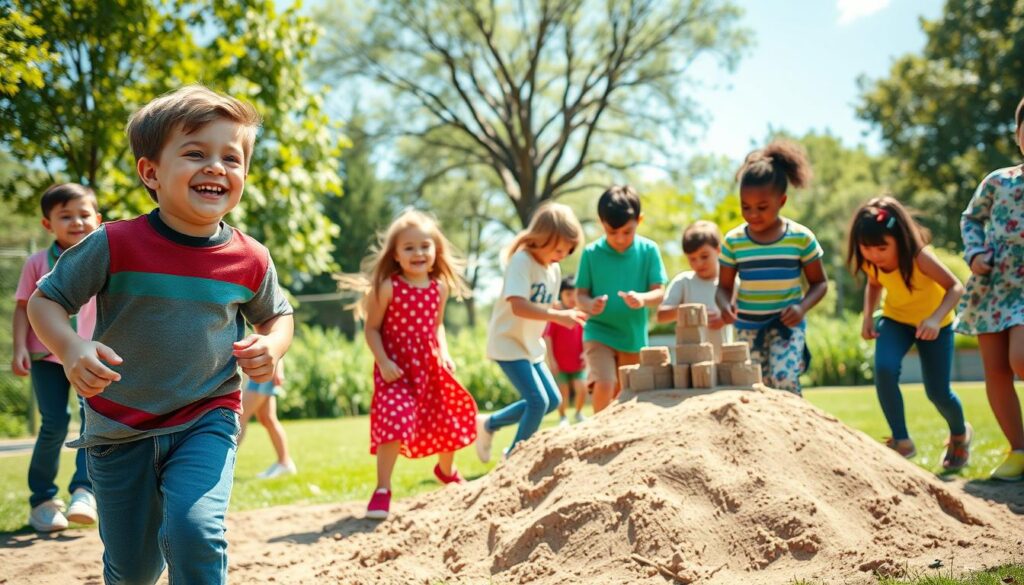
Conclusion
The benefits of physical play are profound, wide-reaching, and backed by decades of research. Active movement shapes every dimension of a child’s development — physical health, cognitive ability, emotional resilience, and social competence.
It doesn’t require expensive gear, a perfectly designed playground, or hours of structured programming. It requires time, intention, and the understanding that play is not a break from learning — it is the learning.
As a parent or educator, your role is to protect the time and space for physical play. Set up the obstacle course. Let them climb the tree. Join the backyard game.
The confidence, focus, resilience, and social skills children build through active play are the ones that carry them through school, relationships, and life.
Start today. Let them play.
FAQ
How much time should children spend on physical play each day?
According to the CDC, children ages 6–17 need at least 60 minutes of moderate-to-vigorous physical activity per day. Preschoolers ages 3–5 should accumulate at least 3 hours of physical activity throughout the day. This time doesn’t need to happen all at once — short bursts of active play throughout the day all count toward the total.
What types of equipment best support physical play at home?
Outdoor toys like balance bikes, jump ropes, climbing domes, and backyard obstacle course kits are excellent for developing gross motor skills. For fine motor development, activities involving throwing, catching, and small-scale movement are ideal. The best equipment encourages open-ended, imaginative play rather than a single scripted activity.
How does physical play help children develop social skills?
Group physical games place children in real-time social situations where they must communicate, cooperate, and resolve conflict without adult intervention. Games like relay races, tag, and team sports naturally develop listening skills, empathy, leadership, and the ability to work toward a shared goal.
Can physical play improve a child’s mental health?
Yes — significantly. Regular physical activity triggers the release of endorphins and lowers cortisol levels, the body’s main stress hormone. Research consistently links active play to reduced symptoms of anxiety and depression in children, as well as improved emotional regulation, better sleep quality, and stronger overall resilience.
What are easy physical play ideas for indoors?
Excellent indoor options include pillow obstacle courses, dance parties, child-friendly yoga, and active games like Simon Says or Freeze Dance. These require minimal space but deliver real physical and cognitive benefits — making them perfect for rainy days or apartment living.