Have you ever wondered why a cardboard box becomes a spaceship in your child’s hands? And how that simple swap helps them learn words faster?
Play is not just fun; it’s where early language skills are built. When your child acts out a doctor visit, cooks an invisible meal, or talks to a stuffed animal, you see imaginative play in action. These moments help them practice new words, try out sentence patterns, and connect words to objects and actions.
Understanding how imaginative play builds language shows why free time, props, and outdoor play are important. Play prompts questions about spiders, rain, or a muddy puddle. These questions encourage language.
The importance of imaginative play in language development is clear when quieter children speak up during play. Or when a routine game helps a child link a new word to a real-life task.
By creating space for dramatic, sociodramatic, and pretend play at home or preschool, you support your child’s communication, empathy, and resilience. Simple actions like naming objects, expanding phrases, and following a child’s lead make play a powerful tool for growth. This growth will help kids in reading and beyond.
What is imaginative play and why it matters for language
Watching a child turn a block into a phone shows how pretend play boosts language. It’s about giving meaning to objects, acting out roles, and making up stories. These actions help kids connect words to actions and symbols, which is key for language growth.
Definition and examples of pretend play
Pretend play uses imagination to mimic real-life scenarios. A child might play house, use a stick as a wand, or have a tea party with stuffed animals. It can start simple but grow into complex stories as vocabulary and creativity expand.
How imaginative play differs from other play types
Play has many forms, like sensory or motor play, and dramatic play. But sociodramatic play, which involves sharing and social interaction, is the most advanced. It’s where kids really develop their language skills through role-playing.
Evidence linking play to early language milestones
Research shows play is linked to language development. Studies by Nicolopoulou and others found that storytelling and sociodramatic play improve literacy and vocabulary. Myck-Wayne’s work shows how play areas help kids practice language and literacy.
Play helps kids understand symbols, like letters and words, which are important for reading. A resource page from Play Matters explains how imaginative play lays the groundwork for reading and literacy: how imaginative play builds a foundation for reading and literacy.
The variety and volume of language in play are key. Kids learn new vocabulary, practice sequencing, and get feedback from others. This helps them develop the language skills needed for reading and success in school.
How imaginative play supports early vocabulary growth
Imaginative play is a natural way to introduce new words. It lets children try out these words in real-life scenarios. For example, when they pretend to run a store or play doctor, you can teach them specific vocabulary.
Role-play scenarios like restaurants and doctor’s offices are great for learning new words. Words like menu and stethoscope become meaningful when used in action. This makes learning vocabulary fun and memorable.
Linking words to objects and routines helps children remember them. Use labels on play props and menus. This strengthens their understanding of print and supports their language development.
Everyday routines are perfect for teaching language. During bath time, you can teach words like wash and rinse. Cooking and dressing up also offer opportunities to teach vocabulary.
Try simple techniques to boost vocabulary. Pair a theme with a short story to pre-teach vocabulary. Create a list of “spotlight words” for different play centers. Invite guests to use real vocabulary during play.
Dramatic play helps children practice sentence structure and dialogue. They learn to ask questions and take turns. You can help them by repeating and adding words to their sentences.
| Technique | What to Say or Do | Language Goal |
|---|---|---|
| Role-play setup (restaurant) | Provide menus, labels, fake money; model “I would like…” | Introduce nouns, polite requests, and transaction vocabulary |
| Routine narration (bath time) | Narrate steps: “We will wash, rinse, then dry.” | Teach sequence verbs and transitional language |
| Printed props (grocery list) | Label items; ask child to find and match words | Link spoken words to print; build sight-word recognition |
| Guest speaker or circle story | Introduce specialty words before play; repeat during activities | Pre-teach domain vocabulary; increase retention through repetition |
| Expansion technique | Repeat child’s phrase and add details: “Car” → “Red car zooms fast.” | Model complex sentences and descriptive language |
Planning play with clear goals boosts language learning. Repeated, meaningful exposure in pretend activities is key. It helps children develop language skills and enjoy the benefits of imaginative play.
Related Guides on Imaginative Play, Language, and Vocabulary
If you want to explore this topic in more detail, these related guides explain how pretend play helps young children build vocabulary, practice real conversations, strengthen communication skills, and develop early listening, speaking, and storytelling abilities.
- How Imaginative Play Builds Language Skills in Young Children
- How Pretend Play Builds Vocabulary in Young Children
- How Make-Believe Play Helps Kids Learn and Use New Words
- How Imaginative Play Supports Speech Development in Kids
- How Pretend Play Helps Kids Practice Real Conversations
- How Talking During Play Boosts Early Language Development in Kids
- How Pretend Play Turns Everyday Words Into Real Learning for Kids
- How Pretend Play Builds Communication Skills in Young Children
- How Dramatic Play Builds Storytelling and Communication Skills in Kids
- How Imaginative Play Builds Listening and Speaking Skills in Children
Imaginative play and symbolic thinking as a foundation for reading
When a child turns a block into a phone or a box into a boat, it’s symbolic thinking. This skill helps them think of one thing as another. It also helps them connect words to objects and letters to sounds.
Using objects to represent other things and what that teaches about symbols
In pretend play, your child learns to represent things. A spoon might become a microphone, and a scarf a cape. This shows them one thing can be another.
This practice helps with abstraction. You can teach new words while playing. This makes words real through actions and objects. It links play and learning words together.
Connections between symbolic play and letter/word representation
Symbolic play prepares kids for print awareness. When they see a toy as a real object, they can see marks on a page as sounds and meanings. Adding simple labels or signs to play helps.
Encourage your child to make signs or pretend to read. This connects spoken stories to written words. It bridges play and early reading skills.
How symbolic play predicts easier transition to literacy tasks
Children who play a lot tend to read better. They learn to sequence, tell stories, and connect symbols to things. This helps them start reading tasks more easily.
In class, make play print-rich. Ask your child to make a storybook or a menu for a play café. These activities show how play and literacy are connected.
| Play activity | Symbolic skill practiced | How you can add print |
|---|---|---|
| Block as phone | Substitution and naming | Label the phone with a pretend number or name |
| Box as boat | Role-taking and narrative sequencing | Ask your child to make a map and label destinations |
| Play kitchen | Object-function mapping and vocabulary expansion | Create simple recipe cards with pictures and words |
| Doll care routines | Temporal order and conversational turns | Have your child write a short care checklist |
| Store or café | Symbolic exchange and number words | Make menus, price tags, and signs for the shop |
Role of social pretend play in communication skills
Social pretend play is a great way for kids to practice talking. They learn to take turns, listen, and build conversations. This makes their language skills better.
Games that involve passing props or speaking as a character help a lot. These activities teach kids about pauses, eye contact, and who should speak next. It’s a fun way to improve their conversation skills.
Turn-taking, listening, and conversational structure
Try setting up simple scenarios like a pretend store or clinic. Kids will practice making requests and answering questions. This helps them learn the basics of conversation.
Playing with peers vs solo play: different language benefits
Playing with others helps kids learn to negotiate and share stories. They use longer sentences and new words. On the other hand, playing alone lets them practice vocabulary and sentence structure.
Using role-play to practise pragmatic language and perspective-taking
Role-play lets kids try different roles like a firefighter or teacher. They learn to make requests and explain things. Asking them to imagine how someone else would ask a question helps them think from another’s perspective.
Adults can play a big role in this by joining in or leading the play. By modeling phrases and asking questions, you help kids learn new words and solve problems. It’s important to create a safe space for this kind of play.
Labeling objects and asking open-ended questions helps kids learn new vocabulary. It also encourages them to think critically. For more ideas on building and problem-solving, check out construction play tips.
Keep play sessions short and focused. This lets kids try out new phrases and roles. It shows how imaginative play helps kids develop their communication skills every day.
How imaginative play develops narrative and storytelling abilities
Imaginative play is like a sandbox for your child to practice storytelling. They learn to arrange a story with a beginning, middle, and end. This play helps them understand how events follow each other and how actions lead to results.
When kids create play scripts, they link actions to their outcomes. Asking them about the sequence of events helps. This practice strengthens their ability to tell stories.
Creating characters, settings, and plots
Inventing characters and settings boosts their expressive language. They use adjectives, verbs, and dialogue to express feelings and goals. Props and costumes help turn gestures into complete sentences.
Story retelling and reading comprehension
Retelling stories or making up new ones helps kids practice their retelling skills. These skills are essential for reading comprehension. Studies show that combining storytelling with play improves vocabulary and narrative skills.
Here’s a quick guide to enhance your child’s narrative skills and language during play.
| Play Prompt | What to Say | Language Target |
|---|---|---|
| Start a scene | “Let’s set the place. Where are we and who is here?” | Settings, nouns, prepositions |
| Move the plot | “What happens after the child finds the lost map?” | Sequencing words, cause-effect verbs |
| Build character motives | “Why does the cat want to hide the hat?” | Emotions, intentional verbs, modals |
| Encourage dialogue | “Can you tell the doctor what the toy needs?” | Questions, conversational turns, pronouns |
| Support retelling | “Tell the story from the beginning in three sentences.” | Concise summary, past tense, connective words |
As a co-player, your role is key. Introduce new words gently, model better sentences, and use visual cues. Regular play builds the habits of mind needed for school and reading.
Imaginative play language development kids
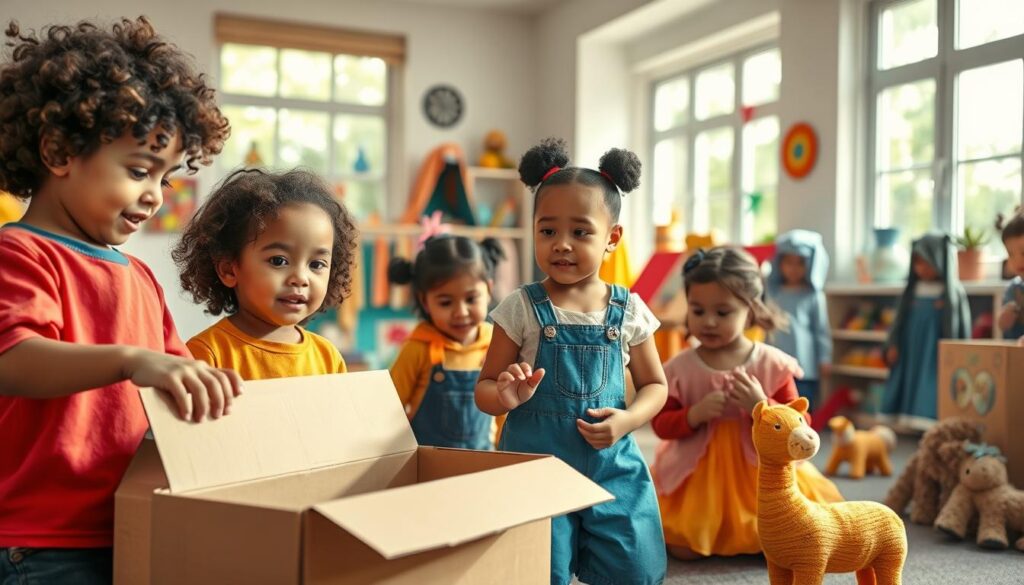
Looking for ways to boost your child’s language skills through play? You’re not alone. Parents, teachers, and therapists all seek activities that enhance vocabulary and social language. Here are some simple ideas to get you started.
How the exact phrase maps to search intent and content focus
Searching for imaginative play tips shows you want to help your child’s language grow. You’re looking for activities that teach new words and improve conversation skills. These activities should be fun and show real results.
Practical examples caregivers can search for and implement
Start with “restaurant dramatic play ideas” to teach about food and money. “Doctor role-play props” can introduce medical terms. “Grocery store play vocabulary lists” are great for learning food names and counting.
Set up a play area with menus and signs. Use everyday items like play food and markers for role-playing. Try scripts for longer conversations to improve sentence structure.
Linking the phrase to learnable outcomes (vocabulary, syntax, pragmatics)
Imaginative play boosts vocabulary, sentence structure, and conversation skills. Kids learn new words and practice longer sentences. They also improve at taking turns and understanding different perspectives.
Match each play theme with a story or key words. Label areas and use signs to connect print to sound. Keep track of new words, sentence length, and conversation skills.
For more on the link between pretend play and language, check out this resource. It offers research and practical tips to support your child’s language development through play.
Practical strategies for caregivers to foster language through play
Make playtime a daily chance to learn new words. Short sessions help you teach without overwhelming your child. These tips make learning fun and natural through play.
Be an active co-player. Join your child’s pretend games and share their ideas. Say something like, “Yes, the car’s broken. Let’s fix the flat tire with the wrench.” This adds words and shows how sentences work.
Ask open-ended questions. Questions like “What happens next?” and “Tell me more about that” encourage storytelling. They help with speaking in sequences and narratives. Use them to get your child to talk more and describe things better.
Create inviting play spaces. Set up areas with props, costumes, and books for role-play. Labeling these spaces links spoken and written words. A print-rich area helps kids match words to objects and routines. Change themes weekly to keep things interesting and introduce new words.
Follow your child’s lead but gently guide their language. Focus on expanding what they say instead of correcting them. This builds confidence and encourages trying new words and ways of speaking.
Play simple games that need following directions, like puzzles or sorting, to improve understanding and speaking. For more on using play to help with language, see this guide at play and language development.
Here’s a quick checklist to start:
- Join in as a co-player for 10–15 minutes daily.
- Pre-teach 3–5 theme words before play.
- Ask at least two open-ended questions each session.
- Keep a small, labeled prop box for quick setup.
These steps make play a fun and easy way to improve speaking. They focus on interaction and show how play boosts vocabulary and conversation skills.
Imagative play activities for speech and vocabulary development

Simple, repeatable routines help language stick. Baby-doll play is great for naming body parts and actions. For example, while dressing the doll, say “Button the coat” or “The arm is soft.”
Use words like first and then to improve sentence structure. This helps with sequencing language.
Singing and rhyming can teach sound awareness. Short songs and rhymes sharpen phonological skills. Change a word in a song to encourage prediction and repetition.
Outdoor play boosts descriptive skills. Ask children to describe what they see and feel. This encourages the use of adjectives like squelchy and crunchy.
Outdoor play can also help shy children speak louder. It expands their expressive vocabulary.
Combine play with print and props to reinforce words. Label bins and display song lyrics. Add role-play cards for doctor visits or grocery trips.
Ask open questions while narrating to encourage deeper language use. Use prompts like “What will you do next?” and “How does that feel?” This helps grow vocabulary and sentence complexity.
For more ideas on sensory play, see this list.
| Activity | Target Language | How to Prompt |
|---|---|---|
| Baby-doll routines | Body parts, actions, descriptors, sequencing | Label parts, narrate steps, use “first/then,” ask “What next?” |
| Singing & rhyming games | Phonological patterns, repetitive vocabulary, sentence frames | Change words in songs, use clapping for rhythm, invite echoing |
| Outdoor exploration | Descriptive adjectives, sensory verbs, comparative language | Ask descriptive prompts, compare textures, encourage storytelling |
| Integrated props & print | Label recognition, contextual vocabulary, functional phrases | Attach labels, display simple lyrics, add role-play cue cards |
| Combined practice | Generalization of new words across settings | Use same words in play, books, and daily routines to reinforce |
Use these ideas to support vocabulary growth through imaginative play. Plan activities with clear language goals. This makes every play session a chance to practice speech targets.
Small, consistent prompts during creative play for children lead to steady gains. This is true over time.
Addressing barriers and ensuring equitable access to play
Limited time, tight budgets, and unsafe outdoor spaces can cut play chances for many families. You may notice children miss out on everyday pretend moments that boost vocabulary and social skills. Equity starts with recognizing these gaps and planning small, consistent steps to close them.
When caregivers juggle long work hours, brief play sessions replace richer, extended interactions. Fewer toys and props can narrow themes that children explore, which reduces chances for new words to appear in context. Community centers and preschools that lack materials often struggle to offer varied pretend scenarios that support imaginative play language development kids.
Low-cost, high-impact play ideas for families facing constraints
Household items make powerful props. Use cardboard boxes for castles, wooden spoons for wands, and towels as capes. Short daily routines of 10 to 15 minutes create reliable windows for language-rich exchanges. You can turn mealtime into a restaurant role-play or bath time into a pirate voyage, applying low-cost imaginative play ideas that require no special purchases.
Supporting children with language delays during imaginative play
Begin with simple role scripts and clear models you repeat across sessions. Visual supports like picture cards and labeled props help children connect words to objects and actions. Start as the play leader, then step back to guided play so your child practices phrases with gentle prompts. Work with a speech-language pathologist or early childhood program to align strategies and reinforce progress.
Programs can widen reach by lending play kits or hosting short play labs at libraries and YMCAs. Educators should use varied adult roles, from onlooker to active co-player, to include children at different levels. These small moves promote equitable access to play and strengthen the conditions that let imaginative play language development kids flourish.
| Barrier | Practical low-cost action | Expected language benefit |
|---|---|---|
| Limited time | Set 10–15 minute daily play routines tied to meals or bedtime | Repeated exposure to vocabulary and turn-taking practice |
| Few materials | Repurpose household items and thrift-store finds as props | Broader object naming and flexible symbolic play |
| Safety concerns outdoors | Create indoor movement and exploration prompts | Descriptive language and action verbs development |
| Language delays | Use picture cards, simple scripts, and speech-path collaboration | Improved word retrieval, syntax, and pragmatic skills |
| Community resource gaps | Partner with libraries, Head Start, or community centers for play events | Access to varied play settings and peer interaction |
Measuring progress and linking play to school readiness
Track your child’s growth in everyday play with simple observations. Look for more specific words, longer sentences, and clearer communication. These signs show how their language skills are improving.
Keep a short record of play episodes. Note new words, sentence length, and how they clarify meaning. A simple checklist makes comparing easier.
Watch for symbolic and sociodramatic play to see how it links to reading readiness. When a child uses a block as a phone or tells a story, it shows their learning. These moments relate to reading skills and understanding stories.
Use small, repeatable measures during play. Count new words, time stories, and track communication skills. These steps show how imaginative play boosts language skills.
Work with early childhood programs to align goals. Share play themes and words with teachers. Ask them to mirror home play and report on classroom observations.
Set simple, shared goals. For example, aim for a child to use five new themed words or tell a three-step story. Use free resources to build consistent routines. This joint effort makes learning more visible and actionable.
Monitoring growth and sharing notes with educators makes play progress part of a plan. This plan supports kindergarten transitions and highlights the importance of imaginative play in language skills.
Conclusion
Imaginative play is a great way to help kids develop their language skills. When you play along with your child, you help them learn new words and how to put sentences together. This kind of play also improves their ability to talk and think symbolically.
Make play a regular part of your day. Join in on your child’s games and use new words. Ask questions that encourage them to talk more. You can also use simple toys and items at home to practice language skills.
Keep an eye on how your child is doing and talk to their teachers if needed. Make sure all kids have a chance to enjoy imaginative play. By doing this, you help your child grow their vocabulary and get ready for school.