
Can a box of LEGOs or a set of Melissa & Doug wooden blocks teach your child more than just how to build a tower?
This article is for parents, caregivers, and educators in the United States. It offers practical ways to improve executive function, sustained attention, and grit through play. You’ll find actionable activities and recommended titles like LEGO, Magna-Tiles, K’NEX, Revell model kits, and tools for older kids such as Tinkercad.
We’ll show how building games focus patience children ties play to real learning goals. Children’s building games and patience-building games for kids serve as hands-on labs for planning, testing, and persisting. The result is better focus, increased patience, and stronger perseverance — all through play you can set up at home or in the classroom.
Later sections cover the research-backed why, SEO-friendly content tips for educators, types of construction activities, game recommendations (physical and digital), design principles, practice exercises, parental scaffolding strategies, and simple ways to measure progress.
Key Takeaways
- Building games focus patience children by linking play with executive skills.
- Children’s building games like LEGO and Magna-Tiles offer measurable learning moments.
- Patience-building games for kids include both physical sets and digital tools.
- You’ll get practical activities and design tips to keep kids engaged without frustration.
- The article includes ways to track focus and perseverance gains over time.
Why building games matter for children’s focus and patience
You want activities that shape thinking and calm. Educational construction activities give children hands-on chances to practice planning, spatial reasoning, and fine motor control. These tasks strengthen working memory and problem-solving skills, just like Montessori and STEAM classrooms use tactile materials to build executive function.
How construction play supports cognitive development
When a child stacks blocks or follows a kit, they practice sequencing and motor control. Toddlers using simple stacking sets refine hand-eye coordination. Preschoolers move into symbolic play and basic planning. Elementary-age kids work through multi-step projects that boost sequential thinking and project planning.
The link between hands-on building and sustained attention
Tactile feedback and visible progress keep kids on task for longer periods. Each added brick or completed subassembly gives a small reward. Those incremental successes form a loop that increases time-on-task and lowers distractibility.
Collaborative builds add social attention. Working with peers teaches turn-taking and shared focus, which strengthens listening and group persistence.
Why patience and perseverance grow through iterative play
Iterative play is trial, error, reflection, and revision repeated. Model kits and complex sets demand multi-step planning and tolerance for setbacks. Facing small failures during a build teaches children to try again and adapt their approach.
You can use construction games for developing patience in children by setting clear short-term milestones. Patience-focused educational games work best when they show visible progress toward a longer goal. Use growth-mindset language to help kids view mistakes as learning steps.
| Age Group | Typical Activity | Cognitive Skills Targeted | Patience Milestone |
|---|---|---|---|
| Toddlers (1–3) | Stacking blocks, large-piece sets | Hand-eye coordination, basic problem-solving | Complete a three-block tower without toppling |
| Preschool (3–5) | Simple model kits, guided builds | Symbolic play, short-term planning, fine motor control | Follow 3–5 step instructions to finish a small model |
| Elementary (6–10) | LEGO sets, magnetic tiles, model assembly | Sequential thinking, working memory, project planning | Complete a multi-session build with checkpoints |
| Mixed-age groups | Collaborative projects, team builds | Social attention, turn-taking, joint problem-solving | Finish a shared structure through coordinated roles |
Related Guides on Focus, Patience, and Perseverance Through Building Play
If you want to explore this topic in more detail, these related guides explain how block play, building toys, and screen-free construction activities can help children build focus, patience, self-control, resilience, and persistence.
- How Block Play Teaches Patience and Self-Control in Young Children
- How Building Toys Improve Focus and Attention Span in Kids
- My Child Gives Up Easily: How Block Play Builds Persistence
- How Construction Play Builds Perseverance in Preschoolers
- Best Building Toys for Kids Who Struggle to Focus
- Using Block Play to Build Patience and Confidence in Toddlers
- What Happens When the Tower Falls: How Block Play Builds Resilience
- Screen-Free Building Activities That Help Kids Slow Down and Focus
- How Trial-and-Error Play Builds Resilience and Grit in Young Children
- Best Building Activities for Kids With Short Attention Spans
building games focus patience children
You’re looking to help kids improve their focus and patience. Start by introducing building games that offer step-by-step challenges. These games reward kids for their persistence.
Using the main keyword naturally in content and headings
Use the main phrase in your title tag, the first paragraph, and one H3. Mix it up with similar phrases to avoid repetition. For example, try “construction games for developing patience in children” or “patience-focused educational games.”
Search intent: what parents and educators are looking for
Parents and educators want to know why building games help with attention. They also want to know where to buy reliable sets and how to set up these activities. Make sure to mention U.S. safety standards and age recommendations for each activity.
How to structure pages and content around this topic for SEO
Start with an H1 that matches your meta title. Then, use H2 blocks for benefits, types, and recommendations. Use H3s for specifics and steps. Add structured data like how-to schema for guides and product schema for kits.
Include multimedia to keep readers engaged. Short videos and photos work well with printable checklists and logs. Use alt text that’s natural, like “children’s building games that teach patience building activities for children.”
Write concise meta descriptions that match search intent. Keep internal links to related topics like STEM and gross motor play. Use long-tail keywords in headings and captions for queries like “interactive building games for kids” and “construction games for developing patience in children.”
Types of educational construction activities that teach patience
There are many hands-on activities that help kids focus and keep trying. Each one shows how building things can teach patience. Mix simple tasks with longer projects to help your child keep coming back and improving.
Block building and stacking challenges
Start with wooden blocks, foam bricks, and interlocking pieces. They teach kids about careful placement and balance. Brands like Melissa & Doug, Tegu magnetic blocks, and LEGO Duplo offer options for different ages.
Try different tasks: build the tallest tower, make patterns, or do timed builds. These activities help kids learn from mistakes and try again. This builds persistence.
Model kits and step-by-step construction sets
Sequential kits like LEGO Technic and Revell models need following instructions and sorting parts. Choose the right level of difficulty for your child’s age. Younger kids do guided sets, while older ones can do more complex projects.
Working on projects over time teaches patience. It shows the value of planning and revisiting tasks. These activities also improve fine motor skills.
Collaborative building projects and patience through teamwork
Group projects add a social aspect to learning patience. Classroom builds, cardboard challenges, and community projects require teamwork and problem-solving.
Try two-person challenges, rotation stations, and team projects. Assign roles to teach waiting and steady contribution. Group projects help manage different work speeds and move forward together.
| Activity | Recommended Brands/Materials | Patience Skills Developed | Typical Age Range |
|---|---|---|---|
| Stacking and balancing challenges | Melissa & Doug blocks, Tegu magnets, foam bricks | Fine motor control, iterative problem solving, calm repetition | 2–6 years |
| Pattern replication and timed precision builds | LEGO Duplo, wooden pattern sets | Attention to detail, steady pacing, frustration tolerance | 3–7 years |
| Model kits and step-by-step sets | LEGO Technic, Revell kits, Snap Circuits, K’NEX | Following instructions, parts organization, multi-session persistence | 6+ years |
| Cardboard forts and maker-space builds | Cardboard, craft tools, recycled materials | Collaboration, planning, shared responsibility | 4+ years |
| Community STEM projects and classroom builds | Mixed kits, donated materials, school maker tools | Teamwork, role assignment, delayed gratification | 6+ years |
For more ideas and a list of kid-friendly construction games, visit building games for kids. Use these activities to create daily play that improves focus and shows patience through progress.
Patience-building games for kids: recommended titles and formats
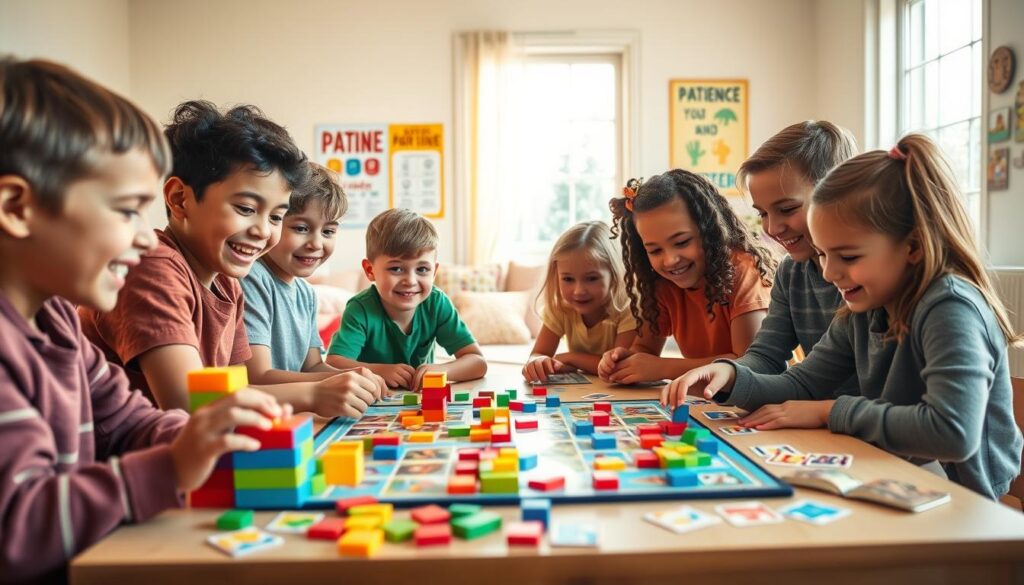
Choose toys and apps that guide your child through stepwise problem solving. Physical sets like LEGO Classic and LEGO Creator invite open-ended play. They improve fine motor skills and spatial reasoning for ages 4–10. LEGO Technic suits older children who want mechanical challenges and need supervision with small parts.
Magna-Tiles and PicassoTiles offer magnetic construction for preschoolers to school-age kids. They practice balance and planning. Melissa & Doug wooden block sets work well for toddlers. They encourage durable, hands-on practice.
Digital options pair well with hands-on play. Minecraft in Creative and Survival modes teaches large-scale planning. It also teaches project persistence and versioning. Roblox building experiences give you design objectives that reward iteration.
Tinkercad introduces older kids to 3D design and stepwise refinement. Bloxels helps children prototype games and learn sequencing. When you add screen-time limits and age filters, these games boost delayed gratification through saved progress and revisits.
Low-cost DIY builds let you split projects into stages. This way, kids return to work with fresh focus. Try cardboard box cities, paper cup towers, pasta-and-marshmallow bridges, straw-and-tape structures, or recycled-material crafts.
Provide a simple supply list and printable templates. Then, break the activity into planning, construction, testing, and rebuild sessions. This practice perseverance across days.
Physical play recommendations
Match sets to age and skill targets. Younger children benefit from large-piece magnetic tiles and Melissa & Doug blocks. They build hand strength and spatial awareness.
Elementary kids enjoy LEGO Classic and Creator for creativity and patience. Teens can tackle LEGO Technic for engineering thinking.
Digital and blended formats
Use games that save progress so your child learns revision and delayed reward. Minecraft, Tinkercad, and Bloxels support iterative design. After a digital session, prompt a physical follow-up project to reinforce planning skills and deepen learning.
DIY, low-cost projects you can set up at home
Lay out materials in labeled bins, print simple instructions, and schedule short work sessions. This approach helps your child practice patience without large expense. Rotate projects to maintain novelty and encourage steady improvement.
| Format | Examples | Age range | Skill targets | Notes for parents |
|---|---|---|---|---|
| Open-ended physical | LEGO Classic, LEGO Creator, Melissa & Doug blocks | 3–12 | Fine motor, spatial reasoning, planning | Provide challenges, not solutions; encourage multi-session projects |
| Engineering sets | LEGO Technic | 10+ | Mechanical thinking, persistence, sequencing | Supervise small parts; set step goals for larger builds |
| Magnetic tiles | Magna-Tiles, PicassoTiles | 2–8 | Balance, geometry basics, cooperative play | Encourage pattern copying and free design |
| Sandbox digital | Minecraft (Creative/Survival), Roblox builds | 7+ | Long-term planning, iteration, project management | Set time limits; plan a physical follow-up activity |
| Design & prototyping apps | Tinkercad, Bloxels | 8+ | 3D thinking, versioning, design testing | Pair with printing or building a real model |
| Low-cost DIY | Cardboard cities, pasta bridges, straw structures | 4–12 | Creativity, staged planning, resourcefulness | Use templates, split into stages to build patience |
If you want a deeper list of digital and physical titles to try, visit recommended building games for children. There, you’ll find curated ideas and age guidance on children’s building games and patience-building games for kids.
Designing kid-friendly construction games that improve focus
Make construction play fun and engaging for kids. Break down big projects into smaller steps. Use simple checklists or sticker charts to show progress.
Setting clear goals and incremental milestones
Focus on skills like measuring and sequencing. Give kids a list of tasks they can do in 5–10 minutes. Use a visual board to show what’s next and why it’s important.
Learn more about building play benefits at building play benefits.
Adjusting difficulty to maintain engagement without frustration
Make tasks more challenging but not too hard. Assign roles to fit everyone’s abilities. Watch for signs of frustration and adjust as needed.
Incorporating time management and turn-taking
Use timers to teach kids to work within limits. Rotate roles to practice patience. Use visual cues for fair play and to teach sharing.
| Design Element | Practical Tip | Why it helps |
|---|---|---|
| Incremental milestones | Break builds into 3–6 tasks with a checklist | Creates clear focus points and frequent rewards |
| Adaptive difficulty | Limit pieces or add complexity gradually | Prevents boredom and reduces frustration |
| Tiered roles | Assign designer, builder, quality controller | Matches tasks to skill level and encourages teamwork |
| Timed intervals | Use short timers for 8–12 minute work cycles | Supports sustained attention and planning under time |
| Progress visuals | Sticker charts, milestone boards, or photos | Provides tangible evidence of effort and growth |
| Frustration cues | Train adults to offer hints, not take over | Promotes resilience and continued engagement |
| Sharing rules | Use turn cues like sand timers or bells | Teaches patience and respectful collaboration |
Designing play with these elements makes patience building fun. It turns practice into play, helping kids focus and persevere.
Activities and exercises to practice patience during building
Start with a calm prompt to get you and your child ready. Use short breathing cues and a goal like “three careful moves” to slow down. These steps help build patience and avoid rushing.
Mindful building: teaching calm, deliberate play
Start with a deep-breathing exercise. Have the child breathe in for four counts and out for four. This helps them focus on the project.
Guide them to notice the texture and weight of each block. Say, “Place the red block slowly and feel its weight.” This helps them build steady hands and clear attention.
Use narration to slow down actions. Describe each move out loud. This helps the child learn to name steps and notice choices. It also improves concentration and reduces impulsivity.
Slow-build challenges and reward systems
Make projects that span several days. Break them into small steps and track progress with a chart. Reward persistence with stickers, certificates, or special displays.
Design challenges that focus on precision, not speed. For example, build a tower that lasts ten breaths. Offer rewards like extra activity choices to motivate sustained effort.
Reflection prompts to reinforce perseverance after play
End sessions with reflection questions. Ask, “What was hard? How did you solve it?” Encourage them to draw a failed step and its fix. Journaling or quick sketches show progress.
Use group reflection circles and one-on-one debriefs to discuss trial and error. Ask questions that celebrate strategy and resilience. For more ideas, visit construction play resources.
How parents and educators can support perseverance through building play
You can help children learn grit through building play. Start with small supports and remove them as their skills grow. Use hands-on moments to teach step-by-step problem solving and steady effort.
Scaffolding tasks and giving effective encouragement
Scaffolding means giving temporary help like hints or partial demonstrations. Offer one clear hint at a time. Model how you plan a small section of a model kit and then ask the child to try the next step.
Use process-focused praise. Say, “You kept trying different ways—that shows persistence,” instead of just praising the result. Ask guiding questions like, “What will you try next?” or “Which part should we sort first?” These questions build strategy and self-reliance.
Balancing help and independence to foster resilience
Set limits on direct intervention. Offer choices instead of solutions. For example, ask whether they want to sort pieces by color or size. Let the child work independently for short, timed intervals, then check in briefly.
Allow manageable setbacks. When a tower collapses, pause and ask what can be changed for the next attempt. Experiencing small failures builds grit and self-efficacy more than endless rescue from adults.
Tracking progress and celebrating persistence
Keep simple records to show growth. Use a progress chart, a play portfolio, or a photo timeline for multi-session builds. Add short notes about moments of persistence, such as repeating a step or trying a new strategy during construction games for developing patience in children.
Create rituals that recognize effort. Display completed projects on a shelf, host a build showcase for the class, or read reflection entries aloud. These routines reinforce the value of sustained work and make patience-focused educational games feel meaningful.
| Support Strategy | What to Do | Benefit |
|---|---|---|
| Scaffolding | Give hints, model a small step, withdraw help gradually | Builds competence and autonomy |
| Guided Questions | Ask “What will you try next?” or “How can you make that stronger?” | Promotes strategic thinking during play |
| Timed Independence | Set short solo work intervals followed by check-ins | Encourages focus and problem-solving |
| Progress Tracking | Use charts, photo timelines, and brief observation notes | Visualizes growth and reinforces persistence |
| Celebration Rituals | Display projects, host showcases, read reflections aloud | Validates effort and sustains motivation |
Measuring outcomes: assessing focus, patience, and perseverance gains
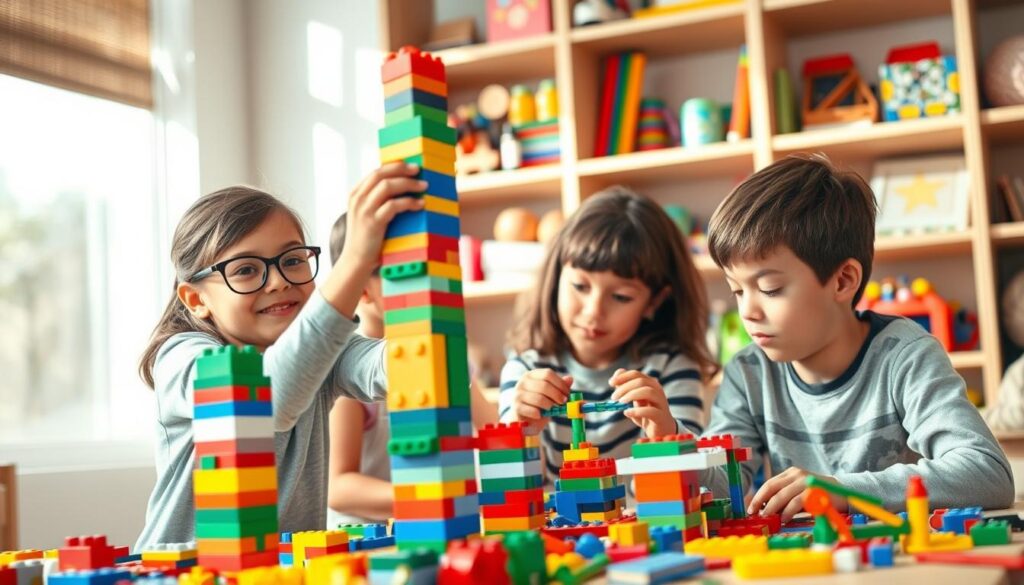
Start by tracking progress in simple steps. Use a checklist to note behaviors during play. Look for how long they play, if they try again after failing, and how many times they ask for help.
Rate each item on a 1–5 scale. This helps you see how much they’ve improved over time.
Simple observation checklists for parents and teachers
Make your checklist easy to use at home or in school. Include things like how long they play without stopping, how many times they rebuild, and if they solve problems on their own.
Keep your notes short and clear. This makes it easier to compare different sessions.
Short-term vs. long-term indicators of improvement
Short-term signs show up in a few weeks. Look for longer focus, fewer tantrums, and better following of instructions. These are quick wins.
Long-term signs take months to show. Watch for starting big projects, solving problems by themselves, and keeping at it even when it’s hard.
Using play portfolios and photo journals to document progress
Keep a play portfolio with photos and notes. Use tools like Seesaw or Google Photos to organize and share. It’s a great way to show how much they’ve grown.
For ideas and activities that help with focus and resilience, check out building-games-by-age. Use portfolios and checklists together to track their progress.
| Measure | Short-term Indicator (weeks) | Long-term Indicator (months) | How to Record |
|---|---|---|---|
| Focused play | Longer single sessions | Begins multi-session projects | Minutes per session; photos of progress |
| Patience with setbacks | Fewer tantrums when challenged | Rebuilds without prompting | Count rebuilds; note responses |
| Perseverance | More re-engagement after failure | Applies persistence across activities | Checklist scores; teacher/parent notes |
| Independent problem-solving | Attempts before asking for help | Solves multi-step problems alone | Number of attempts; brief child reflection |
| Social patience | Turns taken with minimal prompting | Cooperates on group builds consistently | Turn-taking logs; group photos |
Conclusion
You can use building games to help your child focus, be patient, and persevere. Activities like block play, model kits, and timed digital challenges improve planning and attention. They also help with working memory and sustained focus.
When you mix open-ended play with structured projects, kids learn to be creative and patient. This mix helps them practice both skills.
Here’s what you can do: pick the right construction sets for your child’s age. Set clear goals and include slow-build exercises. Start with support and gradually let your child do more on their own.
Keep track of their progress with simple checklists or photo journals. This helps them see how far they’ve come and keeps them motivated.
It’s important to find a balance. Mix free-form building with activities that need focus and patience. Celebrate their efforts and let them learn from mistakes.
Be a role model by solving problems calmly. Use these tips to help parents or teachers too. Bring these practices into your home or classroom for lasting benefits.