
Can a set of blocks or a simple app change how your child thinks?
Intelligence is about solving new problems. Classic thinkers like Wilhelm Stern and today’s experts agree. They say it’s about reasoning, planning, and learning from experience.
Building games are more than fun. They offer challenges that need planning and adapting. When your child builds, they solve small problems like puzzles.
Games for kids and brain training activities vary. Some have clear steps, while others encourage creativity. Each type teaches different skills, like algorithms or trial-and-error.
This article explores how building games improve cognitive skills. You’ll learn how to pick activities for different ages and goals. Plus, you’ll see how play boosts reasoning and creativity.
Why building games matter for child intelligence
Intelligence is about solving problems. Building games are a great way to practice thinking. Kids learn to set goals, try out ideas, and adjust their plans. This process is similar to how people solve problems in tests like Raven’s Progressive Matrices.
Defining intelligence as problem-solving ability
Intelligence models focus on solving new problems. When we see intelligence as practical, we notice skills in play. These include making guesses, checking results, and improving strategies. Such skills are seen in games that need planning and quick thinking.
How building games create problem states
Good building toys offer both simple and complex problems. Some tasks follow strict rules, teaching step-by-step skills. Others have open goals, asking for creativity. Both types of tasks help kids learn through trial and error.
Evidence linking play and cognitive development
- Play supports creative problem-solving stages: recognizing, generating, evaluating, and improving ideas. These stages match classroom goals.
- Play with heuristics boosts strategy use. Regular play enhances working memory, planning, and mental model building.
- Research links open construction and structured tasks to better fluid reasoning and convergent thinking. This makes games for kids important for overall ability.
Practical takeaway: Building play is key for kids to test hypotheses, plan, and think creatively. Mix structured sets with open materials. This targets both convergent and divergent skills, supporting long-term cognitive growth.
Types of building games that stimulate reasoning and creativity
There are many types of building games that help your child think in different ways. Kits with steps teach them to follow rules and think logically. On the other hand, open-ended materials let them try new things and find creative solutions.
Digital games mix both, adding fun challenges and rules. This way, your child learns to solve problems quickly and creatively.
Structured construction games and algorithms
Games like puzzles and step-by-step challenges are great for learning. They help your child plan, predict, and follow a sequence. This improves their ability to think strategically and solve problems.
These games also teach your child to think step by step and solve problems systematically. They are perfect for kids who enjoy learning through play.
Open-ended building toys and divergent thinking
Open-ended toys like wooden blocks and LEGO encourage creativity. Your child tries different ideas, learns from mistakes, and improves their designs. This process boosts their originality and ability to think outside the box.
Playing with these toys helps your child develop spatial awareness and learn to adapt. By setting goals and changing rules, they become more flexible and creative.
Digital building games and hybrid play
Digital games and hybrid play add rules and instant feedback. Apps and games teach algorithms and problem-solving skills. They help your child become faster at recognizing patterns and solving puzzles.
Combining digital games with physical blocks makes learning more fun and effective. It helps your child remember what they learn by mixing visual and hands-on activities.
For a well-rounded approach, mix algorithmic sets, open materials, and interactive games. This balance helps your child develop both problem-solving skills and creativity. For more on the benefits of building games, check out building activities that boost reasoning.
How building games train core cognitive skills
Building games offer your child real challenges that help improve their thinking skills. They learn to follow instructions and imagine how things fit together. This sharpens their working memory and planning skills.
When they try different ways to assemble parts, they boost their spatial reasoning. They also get better at mental rotation. And when they try again after a failure, they practice staying focused and flexible.
Ask your child to build something step by step to improve their working memory. Games that require remembering steps are like puzzles that researchers use to study thinking. Puzzles and challenge cards help your child remember important information and test ideas.
These activities lay the groundwork for solving complex problems and improve overall thinking.
Spatial reasoning and mental rotation
Games that ask children to see things from different angles improve their spatial skills. Puzzle and construction play help with mental rotation and seeing things in new ways. Encourage creative designs and timed challenges to boost speed and accuracy.
Research shows that playing games can improve memory, attention, and processing speed. This supports spatial training. For more information, see this review: game-based learning and cognitive outcomes.
Inhibition, attention, and cognitive flexibility
Building games teach children to resist acting on impulse and stay focused on goals. They learn to adapt when things don’t work out. Simple routines, like pausing to think about a failed attempt, help with self-control.
Adding physical blocks and reflection turns trial-and-error into a learning experience.
- Choose projects that require remembering sequences to boost working memory.
- Offer mirror-image or rotated instructions to train mental rotation and spatial reasoning.
- Introduce rule changes mid-build to practice cognitive flexibility and attention control.
It’s important to choose the right materials. Mix classic sets like LEGO with brain training games and educational toys. This variety keeps play interesting and helps improve thinking skills.
Designing building game activities for different ages and abilities
Make activities that fit each child’s skills and gently challenge them. Start with simple goals for young ones and add more complex tasks as they grow. This way, kids practice thinking and using what they’ve learned, helping them in other areas too.
Preschool and early childhood
For kids 1–4, focus on exploring with their senses and short, focused games. Use big blocks, pillows, and safe materials for them to learn balance and cause-and-effect. Show them simple steps and routines while playing.
Give them time to play and make mistakes. This freedom boosts their creativity and helps them refine their ideas. For research-backed ideas, check out studies on social and cognitive gains with weekly sessions at a clinical repository.
Elementary and middle childhood
Kids 5–11 do well with tasks that ask them to plan, test, and revise. Introduce puzzles, layered challenges, and timed building games. Teach them strategies like working backwards and breaking problems into steps.
Mix free play with guided challenges. Use block cities, cardboard kits, and digital builders to improve spatial skills and persistence. For DIY ideas and age-specific activities, see a guide at a parenting resource.
Adolescents and advanced learners
Teens and advanced learners need complex tasks that test hypotheses and require planning. Offer engineering projects, algorithmic building tasks, and simulation challenges. These tasks demand sustained strategy and detailed planning.
Provide tools like sample steps, hints, or reduced constraints. Ask them to reflect on their strategies after playing. This helps them apply what they’ve learned to math, science, and design. Use competitions and open design briefs to keep them motivated and build problem-solving skills.
- Practical tip: Adjust complexity, not time; short, focused sessions beat long unfocused ones.
- Practical tip: Use a mix of screen-based and hands-on activities to balance digital literacy with physical coordination.
- Practical tip: Frame play as guided experimentation so educational games for kids become intentional practice for reasoning.
Across ages, mix social play, creative risk-taking, and structured feedback. This supports deeper cognitive growth. Thoughtful design of building games for kids strengthens skills and boosts the link between play and measurable gains in building games child intelligence.
Using building games to teach problem-solving strategies
Building games are great for teaching strategy to kids. They offer a safe space to test ideas and learn about thinking tools. Simple prompts can help: ask kids to predict outcomes, make one change, and observe the result.
This pattern trains them in hypothesis testing. It shows how small experiments lead to better designs.
Trial and error is a natural starting point. Let kids try different connections, see which ones hold, and adjust. This builds persistence and shows that failure is useful.
Label each step: try, observe, change. When kids play problem-solving games, they learn to form and refine simple hypotheses.
Working backwards helps with complex goals. Encourage kids to imagine the finished structure, then break it down into earlier steps. Use a LEGO set or a block tower to practice.
Ask, “What piece must be placed first to reach that top?” This teaches step decomposition, making searches manageable and reducing wasted attempts.
Heuristics and rules of thumb speed up decisions. Teach common shortcuts like “start with a wide base” or “balance weight near the center.” These rules work fast in many plays.
Point out limits when a shortcut fails. This shows when to switch to a systematic method. Mixing heuristics with algorithms trains flexible thinking useful in brain training games for children.
- Model explicit language: say the strategy name as you apply it.
- Use short challenges that require one strategy to solve.
- Offer reflection questions after play: “What did you change? Why?”
For measurable practice, cycle through trials that emphasize different strategies. Use timed rounds for fast heuristic use and open-ended rounds for algorithmic thinking. This balance promotes both quick decisions and careful planning.
Integrating building games with educational goals and curricula
Building games can connect hands-on learning with specific goals. You can set clear targets and link challenges to standards. This shows growth in reasoning and content knowledge.
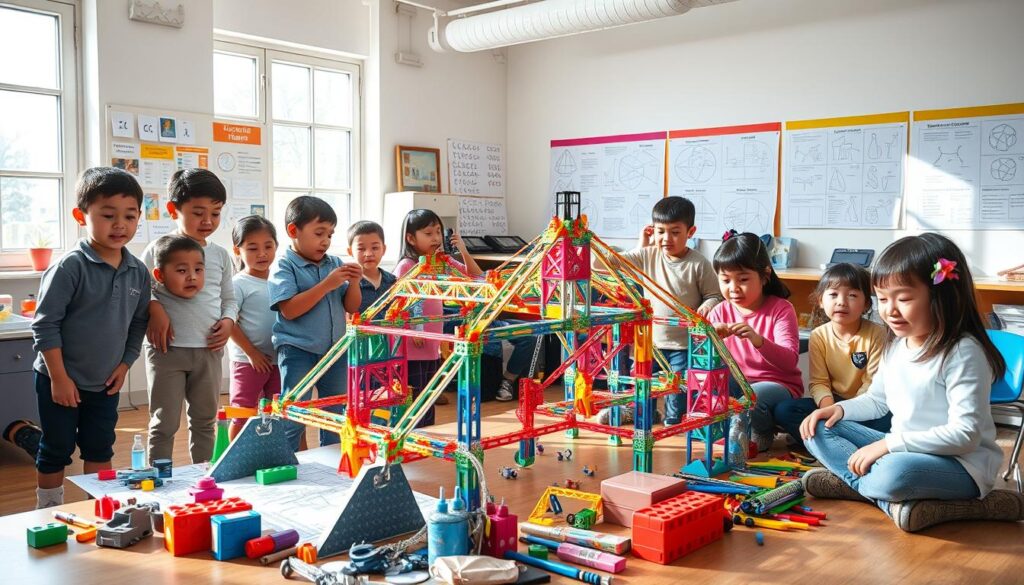
Design tasks that meet science, technology, engineering, and math standards. For example, ask students to design a bridge that spans 30 cm and supports a certain weight. This targets engineering design, measurement, and physics while being fun.
Use rubrics to score planning, iteration, and testing. Record metrics like design revisions and success under load. These measures link playful work to academic standards and broader skills.
Cross-curricular connections
Frame projects with real-world contexts to link subjects. Ask learners to design a community playground for civic literacy and spatial planning. They can write proposals to improve language skills. Pair building with art lessons on form and balance.
These connections show how STEM activities support math, writing, social studies, and art. Building games become platforms for multiple standards and learning goals.
Assessment and documenting growth
- Observe strategy use during play: note hypothesis testing, tool selection, and collaboration.
- Use short performance tasks: time to complete a puzzle, accuracy of measurements, and load-bearing tests.
- Create portfolios with photos, work samples, and teacher notes to capture longitudinal growth.
Combine informal observation with simple rubrics. This helps show how educational games lead to problem-solving changes over time.
Practical takeaway: align each activity to a clear goal, use concise rubrics, and collect artifacts. This makes STEM building activities and educational games reliable for teaching and documenting learning progress.
Digital building games, educational apps for enriching intelligence, and their evidence base
Digital building games and educational apps can be great tools for learning. Look for apps that have clear goals, adjust to your child’s skill level, and give feedback quickly. This keeps your child interested and focused, without getting distracted by too many rewards.
Types of apps and interactive learning games
There are three main types of apps: puzzle games, construction simulators, and apps that mix physical blocks with digital challenges. Each type helps build different skills in child intelligence.
Interactive games range from simple puzzles to complex simulations. They help kids learn about cause-and-effect. Check out recommended learning apps and read reviews to find the best ones.
What research shows about transfer and training
Research shows that short, focused digital exercises can teach kids about cause-and-effect. They also improve strategic thinking. Kids tend to do better on these tasks.
But, how well these skills transfer to other areas is mixed. Apps that make kids think deeply and apply what they learn are more likely to help in other areas. This is because they encourage kids to reflect, test ideas, and see how they apply in real life.
Choosing effective educational apps
Look for apps that encourage exploration and strategy. Avoid ones that just give rewards without a challenge. Choose apps that let you adjust the difficulty and require kids to explain their ideas.
- Choose interactive learning games with clear learning goals and immediate, informative feedback.
- Prefer construction simulators that reward hypothesis testing over points for repetition.
- Pair apps with physical building time and guided discussion to strengthen building games child intelligence.
Practical tip: For the best results, follow digital play with a short discussion or a hands-on task. This helps kids transfer what they learned and understand it better.
Social, emotional, and collaborative benefits of building play
When kids build together, they learn more than just how to build. They work out who gets what, share tools, and mix their ideas. This teaches them how to solve problems together and talk clearly, skills they’ll use in life.
Collaborative problem-solving and communication
Building together makes kids work as a team. They plan, share ideas, and listen to each other. Ask them questions and make them explain their choices to improve their teamwork.
Try simple tasks from social skills activities to help them practice listening and taking turns.
Persistence, growth mindset, and learning from failure
Building play teaches kids to keep trying. When their tower falls, they try new things and learn from mistakes. Tell them you’re proud of their effort and how they solve problems.
It’s good to let kids fail sometimes. This helps them learn to solve problems over and over again and be brave.
Motivation, engagement, and play-based learning
Play that feels important makes kids want to do it more. Make tasks fun and challenging. Use short, focused times with clear goals to keep their interest.
- Encourage collaborative building challenges that require planning and role-sharing.
- Praise persistence, not only success, to build resilience and curiosity.
- Create low-stakes experiments where mistakes become learning data.
For more ideas on group building and tasks for different ages, check out building games for children. These activities are great for kids’ learning and building skills, making them smarter and more cooperative through play.
Educational toys for brain development: choosing materials that maximize impact
You want toys that challenge thinking without getting too hard. Look for toys that have clear goals, adjust to your child’s skill level, and encourage trying new things. These toys should help improve fluid thinking and spatial skills, which are key for learning.
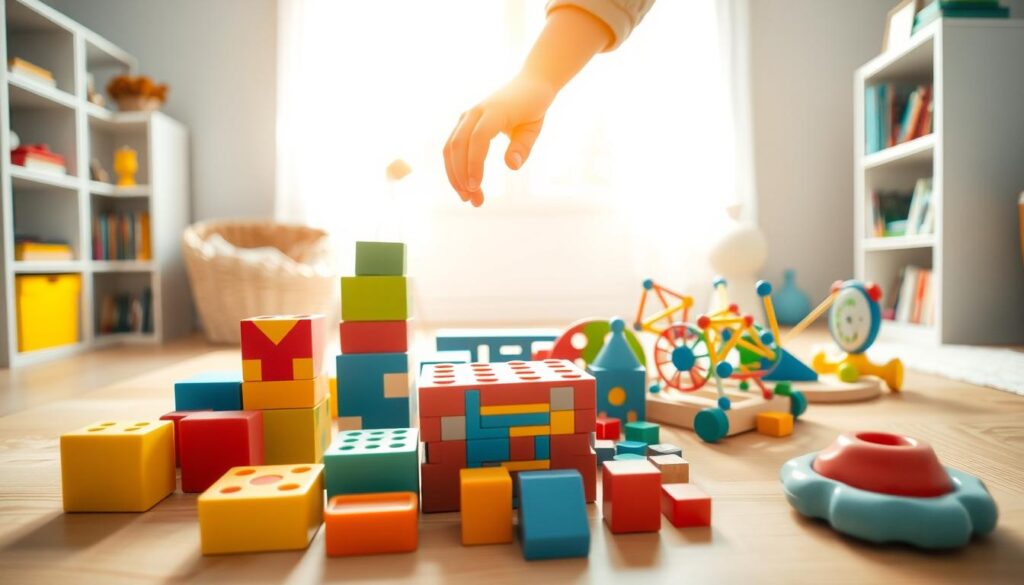
Key features of high-impact toys
- Adjustable difficulty so tasks match your child’s current skill level and grow over time.
- Multiple solution paths that encourage divergent thinking and deeper exploration.
- Tactile feedback and spatial affordances that support mental rotation and manipulation.
- Opportunities for planning, testing, and reflection to strengthen problem-solving habits.
Examples of evidence-backed toys and manipulatives
- Open-ended blocks and LEGO sets for creative construction and sequential planning.
- Magnetic tiles for spatial reasoning and swift prototyping of designs.
- STEM kits that require iteration, like circuit sets and simple robotics, to teach cause and effect.
- Puzzles that vary in complexity to improve working memory and strategy use.
Balancing screen-free and digital options
Use a mix of hands-on toys and digital tools. Hands-on play helps with fine motor skills and feeling the world around us. Digital tools, like apps and LEGO robotics, offer practice and quick feedback. Interactive games help build step-by-step skills and adapt to your child’s level.
When picking toys, look for ones that offer adjustable challenges, many ways to solve problems, and time for thinking. A mix of touch and tech toys will help your child’s thinking and determination grow.
Measuring gains: informal and formal ways to track intelligence and problem-solving progress
Tracking progress in play and learning shows real change. Use a mix of casual observation, simple checks at home or school, and targeted tasks. This mix gives a clear picture of cognitive development and shows how play connects to educational games and building games.
- Faster completion times on familiar tasks and puzzles. A drop in time often signals improved planning and strategy use.
- Fewer random attempts during trial-and-error. You will see more deliberate testing, hypothesis-driven moves, and step decomposition.
- Use of heuristics such as working backwards or chunking steps. These patterns show growing strategy fluency from building games child intelligence practice.
- Greater persistence and smoother collaboration during group builds. Social cues often mirror cognitive gains.
Simple classroom or home assessments
- Portfolios of projects with dated photos to document iteration and creativity. Compare early and later versions to measure growth.
- Short rubrics for planning, iteration, and problem explanation. Teachers and parents can score steps like goal-setting, tool selection, and reflection.
- Timed mini-tasks and puzzles, for example pattern completion or age-appropriate Sudoku, to chart speed and accuracy over weeks.
- Checklists from known frameworks that relate to educational games for kids, focusing on working memory, spatial reasoning, and cognitive flexibility.
When formal testing or specialist input is appropriate
- Consider standardized measures such as Raven’s Progressive Matrices or microworld tasks like MicroDYN when you need objective data on fluid reasoning.
- Seek a school psychologist or educational diagnostician if you notice persistent plateaus despite rich stimulation, or if learning differences interfere with daily functioning.
- Use formal intelligence testing when interventions require diagnostic clarity, specially to distinguish general ability (g) from specific skills like Gf/Gc.
Practical steps you can take: keep brief, regular notes after play sessions, collect work samples, and run a few objective tasks every term. This approach to measuring cognitive development balances the insight of everyday observation with the precision of structured assessment. It ties progress back to educational games for kids and the role of building games child intelligence.
Addressing common concerns: safety, equity, and screen time
Bringing building play into home or classroom routines raises three main concerns. These are safe design, fair access, and finding the right balance between screens and hands-on activities. You can ensure learning is supported while keeping children safe. This way, all learners have chances to solve creative problems.
Safety and age-appropriate design
It’s important to choose toys that fit the child’s age and stage. This prevents choking hazards and frustration. Always follow the manufacturer’s guidelines for small parts and battery use.
For tools and complex kits, adult supervision is key. Teach kids to keep their workspace clean, store pieces after play, and check items for wear. Using durable materials lets kids build and improve skills without needing to replace things often.
Equity and access to quality building materials
Access to manipulatives and educational apps varies across communities. Support efforts to bring classroom kits, library lending programs, and makerspaces to your area. This way, kids won’t rely only on what they have at home.
You can also work with neighbors or donate sets like LEGO and basic robotics. Focus on activities that use everyday materials. This makes creative problem-solving accessible to everyone, regardless of cost.
Managing screen time while preserving interactive learning
Digital tools and apps can offer practice and support for reasoning. But, they need devices and internet. Mix short, focused sessions of educational games with hands-on building tasks. This helps reinforce what kids learn.
Choose apps that encourage explanation, prediction, or pairing digital challenges with physical projects. Encourage co-play. This way, you can guide reflection and help kids make connections between screen time and real-world building.
- Prioritize safe, developmentally appropriate toys and tools.
- Seek community resources to improve equity in educational play.
- Use digital tools selectively, pairing them with hands-on practice to support building games child intelligence while managing screen time.
Conclusion
Building games can really help kids improve their thinking skills. They learn to solve problems and think creatively. These games help kids develop important skills like memory, reasoning, and planning.
When kids play these games, they practice solving problems in a fun way. They learn to think critically and make smart choices. This helps them in school and in life.
It’s important to use games that teach kids new things. Make sure they have a safe place to learn and try new things. This way, they can grow and become more confident.
Playing games that challenge kids can really help them grow. It’s like a workout for their brain. They learn to think on their own and come up with new ideas.
By making learning fun, kids are more likely to enjoy it. They will want to keep learning and exploring. This is how they become smarter and more curious.
Make learning a part of your child’s daily routine. Keep track of their progress and celebrate their successes. This will help them stay motivated and excited about learning.