
Ever thought about how building games for kids can shape their future? These games are more than fun; they’re key for learning and growing. Through building games, kids tap into their creativity, solve problems, and grow their minds.
This guide will show you different building games for kids, from classic blocks to cool digital apps. We’ll explore the special benefits of each game. They help your child grow while making playtime fun. Learn how building games can turn playtime into a learning adventure.
Understanding Construction Play and Its Importance in Child Development
Construction play is key for kids’ growth. It lets them build and create with different materials. This play helps them learn by doing and exploring.
It’s based on Jean Piaget’s theory. It helps kids grow smarter and better at working with others. Construction games boost creativity and fine motor skills.
What is Constructive Play?
Constructive play lets kids play with blocks, sand, or LEGO. They use these to share their ideas and solve problems. Kids do this by:
- Building structures with blocks
- Creating shapes with clay or sand
- Designing projects using recycled materials
The Developmental Benefits of Construction Play for Early Childhood
Construction play has many benefits. It helps kids in many ways. For example, it:
- Improves Math Skills: Helps them understand shapes and sizes.
- Introduces Science: Teaches about balance and materials.
- Boosts Creativity: Encourages new ideas and thinking.
- Enhances Motor Skills: Improves hand-eye coordination.
- Helps with Language: Increases vocabulary through talking about projects.
- Develops Social Skills: Teaches teamwork and cooperation.
- Builds Self-Esteem: Gives kids confidence in their creations.
How Construction Play Enhances Creativity, Motor Skills, and Problem Solving
Preschool building activities make kids think deeply. They plan, try, and change their designs. This improves their problem-solving skills.
As they build, they feel proud of what they’ve made. This shows how important construction play is for young kids.
Main Types of Building Games for Kids
Building games for kids can include blocks, magnetic tiles, cardboard, recycled materials, forts, marble runs, and outdoor structures. Each type helps children build creativity, problem-solving, spatial reasoning, patience, teamwork, and early STEM skills.
Magnetic Tile Building Games
Magnetic tile building games are colorful, easy to connect, and great for open-ended construction. Children can build houses, towers, bridges, or castles while exploring shapes, balance, and early geometry.
Wooden Block Building Games
Wooden block building games help children understand balance, weight, height, and structure. Because the blocks do not snap together, kids must place each piece carefully and learn through trial and error.
Interlocking Brick Building Games
Interlocking brick building games help children practice planning, sequencing, and precision. They are useful for building detailed models such as cars, robots, animals, houses, and bridges.
Cardboard Building Games
Cardboard building games are low-cost and very creative. A simple box can become a castle, robot, garage, store, rocket ship, or tiny house.
Recycled Material Building Games
Recycled material building games turn everyday objects into creative construction projects. Paper rolls, boxes, containers, bottle caps, and cartons can become towers, boats, robots, bridges, or mini villages.
STEM Engineering Building Games
STEM engineering building games challenge children to design, test, improve, and rebuild. They introduce ideas such as balance, stability, ramps, floating, force, and structure through hands-on play.
Marble Run and Ball Run Building Games
Marble run and ball run building games help children explore motion, gravity, cause and effect, and prediction. Kids build a path, test it, and adjust the design when the ball stops, falls, or moves too fast.
Fort, Tent, and Structure Building Games
Fort, tent, and structure building games use pillows, blankets, chairs, cushions, boxes, or household objects. Children create spaces they can enter, decorate, and use for imaginative play.
Nature Building Games
Nature building games use sticks, stones, leaves, sand, pinecones, and outdoor materials. Children can build stick houses, stone towers, fairy homes, bug hotels, sandcastles, or animal shelters.
Group Building Games for Daycare, School, and Camps
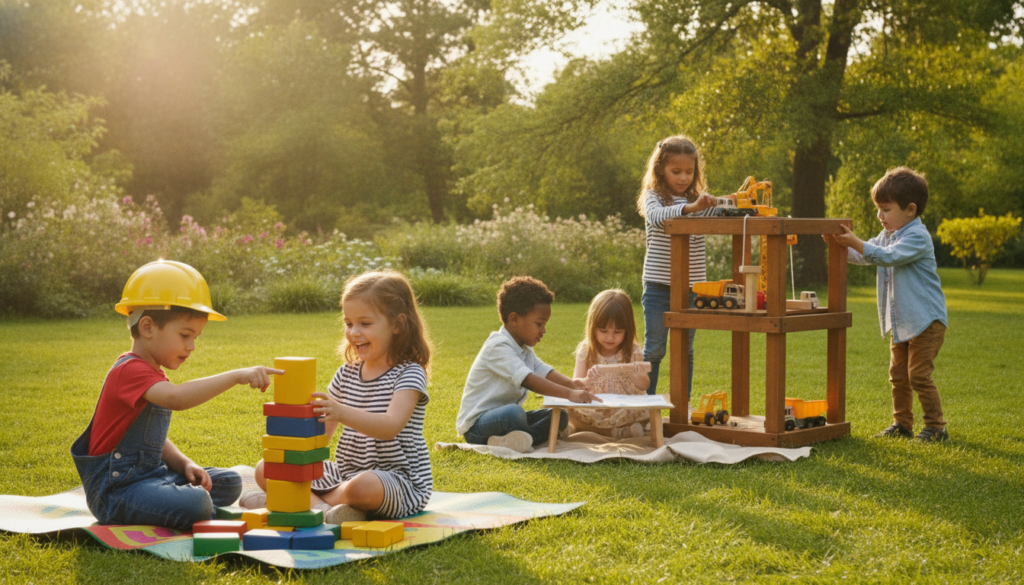
Group building games help children build together, share materials, and solve problems as a team. They are excellent for daycare, classrooms, homeschool groups, and summer camps because they support cooperation, patience, and communication.
Educational Construction Games That Boost STEM Learning
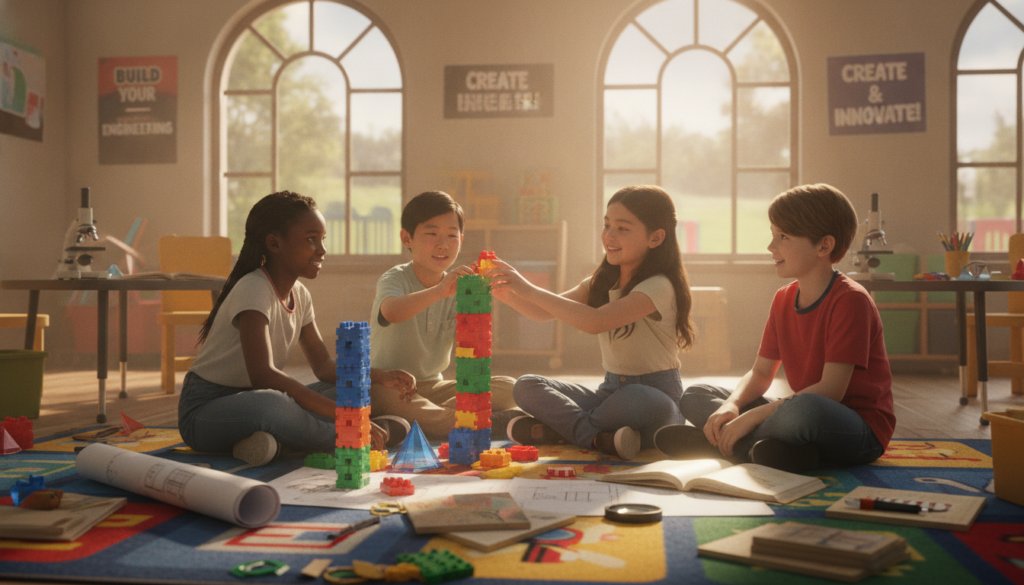
Educational construction games are key for kids to learn STEM. They make math, science, and engineering fun. Kids get to explore complex ideas in a hands-on way.
Integration of Math, Science, and Engineering Concepts Through Play
Building games for preschoolers mix STEM concepts in a fun way. Kids learn:
- Shapes and Sizes: Shapes help with geometry.
- Balance and Stability: Building stable structures teaches physics.
- Cause and Effect: Kids see how actions affect results.
- Problem-Solving: Overcoming challenges boosts critical thinking.
How STEM Building Activities Support Cognitive Development
STEM building activities help young learners grow. They:
- Creative Thinking: Kids think creatively while building.
- Collaboration: Teamwork and communication skills improve.
- Fine Motor Skills: Handling small pieces boosts dexterity.
These games are not just fun. They also prepare kids for school. They help build creativity and problem-solving skills.
Creative Building Apps for Kids: Digital Tools for Learning and Fun
Creative building apps for kids mix fun with learning. They let kids explore their creativity and learn important skills. Look for apps that make learning fun and engaging.
Features to Look for in Creative Building Apps
When looking for an app, consider these key features:
- Age-appropriate content that matches your child’s developmental stage.
- Educational value that promotes learning in fun ways.
- User-friendly interface for easy navigation.
- Safe, ad-free environments to protect young users.
Popular Apps Like Bimi Boo and Minecraft for Kids
Bimi Boo and Minecraft for kids are top choices. Each app offers unique benefits:
| App Name | Age Suitability | Key Features | Educational Benefits |
|---|---|---|---|
| Bimi Boo | 2-5 years | Colorful graphics, hands-on activities | Enhances fine motor skills and creativity |
| Minecraft for Kids | 7+ years | Open-world exploration, building mechanics | Encourages problem-solving and teamwork |
These apps are great for toddlers and older kids. They boost creativity and ensure a safe online space. The right apps can spark a love for learning and discovery.
Lego Building Games: Combining Classic Play with Modern Learning
Lego building games are a great mix of old-school fun and new learning. They let kids be creative and learn important skills. With Lego bricks, they can make simple towers or complex models, boosting their imagination and determination.
Building games for kids help in many ways:
- Fine Motor Skills: Handling the bricks improves their dexterity and hand-eye coordination.
- Logical Thinking: Designing and building requires solving problems, which sharpens their critical thinking.
- Collaboration: Many Lego games teach teamwork, showing kids how to work well together.
Adding Lego games to learning settings supports STEM education. These activities meet educational goals and keep kids interested. For instance, the Lego activities in the article make learning math and science fun through play.
In summary, Lego building games are more than toys. They are powerful tools for learning and growth. They foster creativity and logical thinking, setting a strong base for future success.
Block Building Games and Screen-Free Building Activities for Preschoolers and Toddlers
Block building games and activities without screens are key for young kids. They help kids be creative and learn important skills. These activities improve hand-eye coordination, spatial thinking, and how they work with others. They’re great for daycare and classrooms, helping kids play and think together without screens.
Benefits of Hands-On Block Play Activities
Block play is super good for young kids. Here’s why:
- It makes their hands stronger by handling blocks.
- It helps them understand how things fit together.
- It teaches them to solve problems, like building tall structures.
- It helps them work better with others, like in group building projects.
- It lets them show their creativity and ideas.
Encouraging Daycare and Classroom Building Games Without Screens
To make kids love building in school, try these ideas:
- Make special building areas with different blocks.
- Give them fun building challenges to spark their creativity.
- Have them work together on projects to learn teamwork and talking skills.
- Make sure they have time for hands-on play, not just screens.
- Let them play freely, so they can explore at their own pace.
| Activity Type | Benefits |
|---|---|
| Block Building Games | Boosts creativity, fine motor skills, and teamwork. |
| Screen-Free Building Activities | Helps kids focus, stay engaged, and learn by doing. |
| Daycare Building Activities | Encourages kids to play together and solve problems. |
| Classroom Building Games | Supports learning and teamwork skills. |
Adding block building games and activities without screens to your program is great. Kids do best when they can explore, make things, and work together without screens.
Sandbox Games for Children: Encouraging Open-Ended Exploration
Sandbox games are great for kids to explore freely. They get to play with different textures and shapes. This play boosts their creativity and helps with their senses.
As they dig and build, they think creatively and solve problems. It’s a fun way for them to learn and grow.
Playing in the sandbox is both fun and educational. Kids can make anything they want, from castles to simple shapes. The best part is, there are no rules, so they can play their way.
- Promotes sensory development through tactile experiences.
- Encourages imaginative play and storytelling.
- Enhances fine motor skills with scooping, pouring, and shaping.
- Fosters social skills when playing with peers.
Sandbox games help kids develop physically and socially. When they play together, they share ideas and work as a team. This teamwork builds friendships and teaches important social skills.
Adding sandbox play to your child’s routine opens up a world of possibilities. Watch them explore, create, and learn in their own special way. It’s a key part of their development and a fun way to learn.
Engineering Games and Architecture Games for Young Builders
Introducing your child to engineering and architecture games can spark their creativity. These games let kids explore design and construction concepts. They help develop skills that might inspire them to become innovators.
How These Games Inspire Future Innovators
Through play, kids learn to think like designers. They face challenges that need planning and problem-solving. These games boost:
- Creativity: Kids can freely express their ideas.
- Critical Thinking: They learn to analyze and solve problems.
- Collaboration: Many games teach teamwork, improving social skills.
Examples of Engaging Engineering and Architecture Games for Kids
Many games make learning fun. Here are some favorites:
- LEGO Builder: A classic for imaginative building.
- Minecraft: A digital world for building and exploring.
- Roblox: Kids can create their own games and experiences.
- Architecto: Focuses on spatial reasoning and design.
These games not only entertain but also prepare for STEM learning. By encouraging your child to play, you help them love learning and innovation. This can last a lifetime.
Construction Games for Kids That Encourage Social Skills and Cooperative Play
Construction games for kids are more than just building. They help kids develop social skills. By working together, kids learn to talk, share, and decide roles. This teamwork and problem-solving are key for their growth.
Playing in groups teaches kids patience and empathy. They learn to lead and support each other. This boosts their social skills. Here are ways to help kids play well together:
- Encourage open-ended discussions about ideas and designs.
- Set up building challenges, such as creating the tallest tower or a themed city.
- Ask open-ended questions to spark exploration and problem-solving.
- Provide opportunities for children to take turns leading projects.
These activities make learning fun and help kids work better with others. Digital building apps like Minecraft let kids work together online. You can learn more about these games here.
| Benefits of Construction Games | Examples of Skills Developed |
|---|---|
| Encourages Teamwork | Cooperation, Communication |
| Enhances Problem-Solving | Critical Thinking, Negotiation |
| Fosters Creativity | Innovation, Imagination |
| Builds Patience | Empathy, Leadership |
Conclusion
Building games are key for your child’s growth and learning. Activities like LEGO, block building, and digital apps boost creativity and problem-solving. These skills are vital for many areas of life.
When looking for the best building games, remember there’s a wide range. From physical blocks to digital engineering games, each one helps your child grow. These games make learning fun and encourage teamwork.
Adding different building activities to your child’s day can help them learn more. Make sure their play area is safe and inspiring. For tips on encouraging construction play, check out this resource. Your support will help them grow and feel confident.