
Have you ever thought that stacking blocks could change your child’s brain? Many parents see playtime as just a way to keep kids busy. But, science shows that building games for children are much more than fun.
These games are essential tools for growing their minds. They help shape their brain during important years. Through play, kids learn to solve problems and understand space in a way that lasts forever.
Studies show that certain play styles boost mental skills. By creating the right play space, you’re helping your child’s brain grow. Learn how building games for children are key to their brain health and school success.
The Science Behind Building Games for Children
Your child’s brain is always growing and changing. Building games for children do more than just keep them busy. They help their brain grow and get smarter.
The brain can change and adapt its connections throughout life. This is called neuroplasticity. It’s most active when kids are young. Through purposeful play, kids make new connections that help them learn and solve problems later on.
Neuroplasticity and Early Childhood Development
Neuroplasticity lets the brain get better at handling new things by making strong pathways. When kids play, their brain maps out these experiences. This makes their brain network stronger.
Studies show the brain is most open to growth in the first ten years. Hands-on building challenges help kids understand space and logic. This active play is better than just watching.
How Hands-on Construction Shapes Neural Pathways
Touching and feeling things helps kids understand the world. Every time they build or connect something, they get feedback. This helps them with fine motor control and knowing where things are.
Research shows that playing with physical objects is key for learning. Hands-on building challenges make kids think ahead and adjust plans. This builds their confidence in tackling tough tasks.
Building games for children connect thinking with doing. By focusing on these games, you help your child’s brain grow. The research building toys children use shows that this play is essential for a good education.
Cognitive Benefits of Block Play and Construction
Hands-on building challenges connect physical play with mental growth. Giving your child construction sets is a great way to help them grow. These activities turn playtime into a place where kids can explore and learn.
Developing Fine Motor Skills Through Manipulation
Every time your child picks up a small brick or balances a wooden piece, they are improving their dexterity. This fine work needs the hands and fingers to work together well. As they do this, their skills get better and more precise.
These fun learning games help kids pay attention to how things fit together. By doing this over and over, they build the skills needed for things like writing or drawing. You’ll see their ability to handle complex tasks grow as they work with smaller pieces.
Understanding Structural Integrity and Physics
Construction play lets kids learn about the world in a real way. When they stack blocks, they learn about gravity, balance, and weight distribution by trying different things. If a tower falls, they figure out why and try again.
This process of trying and learning is key to block play brain development. Kids learn that a wide base is more stable than a narrow one. Through these activities, they get a basic understanding of physics that helps them learn more advanced science later.
Developing Logic and Spatial Reasoning Through Play
Interactive play for kids is a key to unlocking their spatial awareness. When they play with objects, they learn how each part fits into the whole. This is vital for their mental growth and future success in school.
Mapping 3D Concepts from 2D Instructions
Turning a 2D image into a 3D object is a big brain challenge. It boosts building games child intelligence by making them think in 3D. Kids learn to see how shapes fit together in space as they follow instructions.
This skill is more than just following directions. It’s about seeing things in space. Kids learn to:
- Picture the final product before they start.
- Know which pieces fit where.
- Spot mistakes by comparing their model to the diagram.
- Understand how angles and positions work together.
Pattern Recognition and Mathematical Foundations
Construction toys help teach early math. Kids start to see patterns and shapes as they build. These patterns are the foundation of math and problem-solving skills.
Logical reasoning grows when kids play with balance and symmetry. They figure out which sequences make structures stable and which don’t. This hands-on learning helps them understand physics and geometry.
Through these activities, kids are doing more than playing. They are strengthening their cognitive pathways. This prepares them for solving complex problems in science and tech. Regular challenges help their logical thinking grow with their creativity.
Enhancing Concentration and Focus in Young Learners
Interactive play is key for kids to focus and do well in school. When they play with construction sets, they’re not just stacking blocks. They’re training their minds to stay focused for a long time.
This active engagement connects simple play to deeper learning. It helps kids grow their minds in important ways.
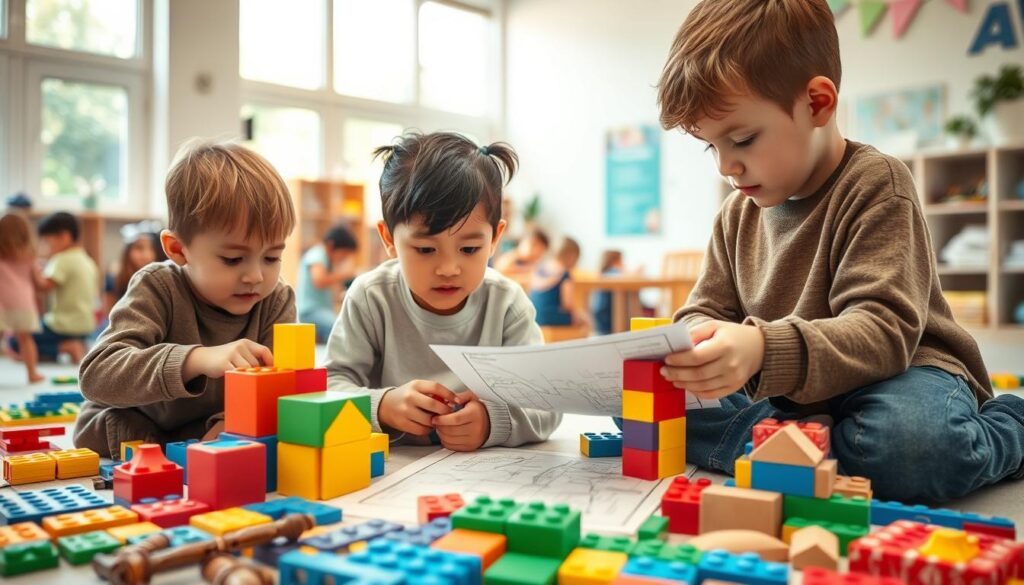
The Flow State in Construction Tasks
Have you seen your child get totally lost in building a tower or bridge? That’s called the flow state. It’s when they’re so into the task, they ignore everything else.
This state is key for building games concentration children need for school. By focusing on their building, they learn to calm their minds. This helps them stay focused, even when school gets tough.
Reducing Distractions Through Goal-Oriented Play
Setting clear goals helps kids stay on track. When they aim to build something specific, they have a plan. This goal-oriented approach keeps them focused and away from distractions.
As they work, they learn to keep going and manage their attention. These play strategies teach kids to see challenges as chances to grow. This kind of play helps them develop a disciplined mindset that helps in all areas of life.
Building Games and the Development of Patience and Perseverance
When a child builds, they do more than just stack blocks. They train their mind for success. The real growth happens inside, not just in what they build.
Playing building games and patience and perseverance helps kids deal with tough tasks. They learn to handle the ups and downs of a challenge.
Overcoming Frustration During Complex Builds
It’s normal for a build to fail. This can be really frustrating for kids. But it’s a key lesson in being resilient.
Instead of quitting, kids learn to figure out what went wrong. They try again, using a new approach.
This back-and-forth is key to block play brain development. Kids learn to handle their feelings when things don’t go as planned. They see that failure is just a step to success.
The Value of Delayed Gratification
Today, we often want things right away. But building things takes time. When kids work on a project for a long time, they learn patience.
This patience is a critical life skill that goes beyond play. Completing a tough build makes kids feel proud. They see that their hard work and persistence are the most important things in their creativity.
The Role of Creative Building Activities in Emotional Intelligence
Creative building activities are key for kids to develop social and emotional skills. Many parents focus on logic, but these activities also help with emotional growth. Kids learn to handle their feelings and connect with others in meaningful ways.
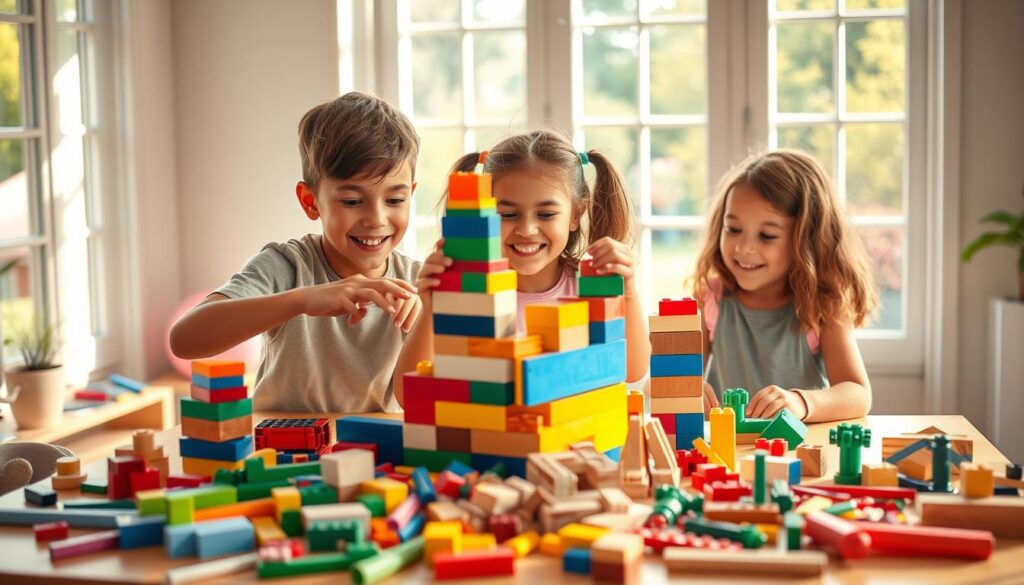
Collaborative Building and Social Skills
When kids work together on a project, they must communicate well. They learn to share ideas, listen to others, and find common ground. This collaborative environment helps them develop empathy and patience.
Teamwork lets kids see different views during design. They find out that compromise is key to success. These experiences help them build social skills for school and life.
Building Self-Confidence Through Accomplishment
Turning a pile of bricks into a structure gives kids a sense of pride. Self-confidence building games show them that their hard work pays off. This sense of achievement motivates them to take on more challenges.
Watching your child play build learn kids, you’ll see their determination grow. They learn that mistakes are part of learning, not failures. This resilience is a key part of emotional intelligence, making them feel capable and confident.
Integrating Educational Building Games into Science and STEM Learning
Adding educational building games to your child’s day can lay a strong foundation for their future. It turns a simple living room into a place for discovery. This way, kids can understand complex ideas while enjoying the creative process.
Connecting Construction Toys to Engineering Concepts
Using educational building games can introduce basic engineering ideas. Kids learn about how structures work by playing with different shapes and materials. They see why some towers stand up and others fall down.
Looking for more resources? Check out educational STEM games for students. These games let kids test their ideas safely. Observation and trial-and-error help solve real-world problems.
Encouraging Scientific Inquiry Through Design
Using educational building games science at home makes kids think like engineers. Asking them to build a bridge that holds a certain weight sparks curiosity. They learn to analyze and improve their designs based on results.
Studies show that research building toys children improve their thinking skills over time. By focusing on design, you teach them to be persistent and analytical. Regular play with research building toys children keeps them curious about the world. It prepares them for a future filled with technology.
Selecting the Right Tools for Imaginative Play Experiences
Choosing the right tools is key for deep, imaginative play experiences. A well-thought-out set of educational construction games lays the groundwork for lifelong learning. These tools connect simple play with complex thinking.
Age-Appropriate Construction Toys for Logic Skills
Choosing the right construction toys logic kids need is about knowing their developmental stage. Young kids start with big, chunky blocks to learn about balance and gravity. As they get older, introduce smaller pieces and more complex connections.
It’s vital to pick toys that are just right, not too hard. This keeps them interested and engaged. For ideas, check out the top-five-play-based-learning-must-haves to make sure your home is ready.
Balancing Open-Ended Play with Structured Challenges
The best learning comes from mixing free play with specific goals. Free play lets kids show their creativity without limits. But, adding structured challenges sharpens their critical thinking skills.
Here are ways to balance your child’s play:
- Give them a special space for free building to spark unrestricted exploration.
- Use “challenge cards” to ask them to build something specific, like a bridge or tower.
- Change up the toys often to keep things fresh and exciting.
- Have them share their creations through drawings or photos to boost their confidence.
Switching between these two types of play keeps your child engaged. This variety prevents boredom and keeps their problem-solving abilities sharp.
Digital vs. Physical: Navigating Child-Friendly Building Apps
Modern parents face a big challenge: balancing virtual play with hands-on building. Traditional toys are key, but creative building activities now include advanced software. This software offers new ways to challenge the mind. It’s important to know how to use these tools to give your child a well-rounded experience.
The Benefits of Virtual Construction Environments
Virtual platforms let kids explore complex physics and designs that are hard to do with blocks. These child-friendly building apps are like a sandbox for testing ideas. Kids can play with 3D objects on a screen, learning about space and shapes.
These digital worlds help kids think logically with step-by-step challenges. They get instant feedback, helping them spot mistakes fast. This quick feedback loop is great for improving problem-solving skills in a safe space.
Complementing Screen Time with Physical Building
Digital tools have their perks, but they shouldn’t replace hands-on play. Mixing both helps kids develop fine motor skills and digital smarts. Try alternating between screen time and building with blocks.
Combining digital and physical play teaches building games patience perseverance. Kids learn to turn their digital plans into real structures. Here are some tips to keep a good balance:
- Use apps to plan a project before building it with physical bricks.
- Set clear time limits to ensure physical play remains the primary focus.
- Encourage your child to explain their digital design choices to you.
- Select apps that emphasize open-ended creation.
- Rotate between digital challenges and hands-on construction tasks daily.
By managing these resources wisely, you make screen time productive. This keeps your child engaged and helps them develop the skills needed for real-world building.
Related Building Games and Brain Development Articles
Learning more about child development can help you support your little builder with more confidence. Building games are not only fun; they can also help children think, plan, focus, solve problems, and learn through hands-on experience.
If you want to explore this topic in more detail, these related guides will help you go deeper:
- How Building Games Boost Brain Development in Children Under 5
- Block Play & Brain Development: 7 Things Every Parent Should Know
- Building Games That Teach Kids to Think, Plan & Solve Problems: 6 Expert Picks
- Construction Toys and Child Development: The Science Behind the Benefits
- How Building Games Strengthen Kids’ Cognitive Skills (Ages 2–8)
- Are Building Games Good for Brain Development? Yes, Here’s the Science
- 7 Hidden Brain Benefits of Block & Construction Play for Toddlers
- How Building Games Teach Kids Problem-Solving Skills (Trial & Error Method)
- What Happens in a Child’s Brain During Building Play? Neuroscience Explains
- Why Pediatric Experts Recommend Hands-On Building Play for Kids in 2025
Exploring the latest in child psychology is important. Here are some key areas to look into:
- The effect of structured play on keeping information in the long term.
- How fun learning games connect abstract math to building things.
- Ways to boost building games concentration children need for school.
- The importance of parents in creative problem-solving activities.
These resources keep you up-to-date on the best ways to support your child’s growth. Continuous learning makes you sure you’re picking activities that challenge and inspire your child every day.
FAQ About Building Games and Brain Development
Are you wondering how building activities affect your child’s brain? Many parents want to know how to use these tools every day. Whether it’s with physical blocks or child-friendly building apps, knowing the impact is vital for growth.
How do I balance digital tools with physical play? It’s key to see tech as a helper, not a replacement. You can help your child grow through games and setting screen time limits. Digital tools can introduce complex ideas that help young minds solve problems.
Can construction activities really boost my child’s self-esteem? Yes, they can. Self-confidence building games let kids see their hard work pay off. When they build something and it works, they feel proud and believe in themselves.
Here are some common questions about using these activities:
- Are these games safe for all ages? Always check if the pieces fit your child’s age.
- How do I know if a game is educational? Look for games that let kids design freely, not just follow rules.
- Do these activities help with social skills? Yes, building together teaches kids to talk and share ideas.
- Are these truly self-confidence building games? Yes, because they let kids try and learn without fear of failure.
By using a mix of child-friendly building apps and physical sets, you give your child a solid base. Make sure it’s fun and engaging. Your support and encouragement will greatly impact their growth.
Conclusion
Adding building games to your child’s daily routine is great for their brain. It mixes fun play with learning about science. This mix helps them grow in many ways.
Studies show that game-based learning is very helpful. It teaches kids important skills like solving problems and feeling empathy. You help by choosing the right games for your child’s needs.
It’s important to keep things interesting and not too much. Mix digital games with real toys like LEGO or Magna-Tiles. This mix helps kids understand both virtual and real-world ideas.
These games help your child learn and think critically for life. By playing together, you make learning fun and exciting. Try new games with your child and see their confidence grow with each new creation.