Could a simple stack of blocks be the spark that shapes your child’s future in math and science? Building games can support children’s learning and development by encouraging hands-on exploration, problem-solving, creativity, and early thinking skills.
Building games for children connect everyday play to real math and STEM learning. They teach measurement, logic, and problem solving. All while keeping creativity at the center.
For a broader overview of how building play supports child growth, you can start with this complete guide to building games for children.
This article offers practical activities and research-backed benefits. You’ll find tools for home or school use. Resources like the PBS KIDS newsletter and ABCmouse STEM activity collections provide activity ideas and tips.
By signing up, you can receive regular inspiration. This includes activity ideas and tips by entering your name, email, and ZIP.
From hands-on projects to virtual options, this introduction sets the scene. When children play build learn kids routines, they develop important skills. Read on to learn more about educational building games science, measuring progress, and choosing the right toys for your child.
How building games for children boost early STEM learning
Start with simple, hands-on projects that encourage testing and measuring. Building games turn everyday items into learning tools. Cups, cardboard, tape, straws, and blocks become tools for learning about cause and effect.
Active, hands-on learning that develops critical thinking
Give your child a challenge and watch them explore. Ask What do you think will happen if…? to spark predictions and reflection. Through trial and error, kids learn to plan, try, fail, and revise, boosting critical thinking and executive function.
How building play connects science, technology, engineering, and math
Building play combines science, technology, engineering, and math in one activity. Science is seen when kids test buoyancy, gravity, or magnetism. Technology is introduced through simple tools and inventions. Engineering is evident in design and structure. Math is present in measuring and scaling.
Research-backed benefits: cognitive, social, and motor development
Research shows that building toys benefit children in many ways. Block play improves spatial reasoning, attention, and logical thinking. It also enhances communication and teamwork. Plus, it refines fine motor skills.
Match activities to your child’s grade level. Start with guided tasks and gradually move to open-ended ones. Encourage trying new things, mix building with books and outdoor play, and add art to make learning fun.
| Focus | Example activity | Skills developed |
|---|---|---|
| Science | Build a boat from recycled materials and test floatation | Hypothesis testing, observation, buoyancy concepts |
| Technology | Create a simple pulley or lever with household items | Tool use, systems thinking, cause-effect |
| Engineering | Design and iterate a bridge from straws and tape | Design process, problem solving, structural reasoning |
| Math | Use blocks to explore patterns, measurement, and fractions | Numeracy, spatial measurement, pattern recognition |
What “building” means across STEM disciplines
Building in STEM is more than just blocks and bricks. It’s about creating knowledge, systems, and solutions. Kids learn by doing and thinking about what they’ve done.
Building understanding in science through experimentation
In science, building starts with questions. Kids can observe, make guesses, test ideas, collect data, and draw conclusions. Simple experiments like a baking soda volcano or a plant growth chart make science real.
Building systems and circuitry in technology projects
Technology learning is about putting systems together. Kids learn about wiring with copper tape, batteries, and LEDs. These activities teach tool safety and how to follow a sequence, like in a kitchen.
Engineering design: building solutions with trial and error
Engineering sees problems as chances to find solutions. Kids can identify needs, come up with ideas, make prototypes, test them, and improve them. Activities like building a spaghetti bridge or a catapult teach the importance of trying again.
Mathematics as building logic, patterns, and measurement skills
Math helps with building by providing logic and tools. Kids learn about patterns, fractions, and spatial thinking through activities like building with blocks or scaling recipes. These tasks show how math helps build reliable systems.
Try combining activities to see how they overlap. A paper rocket or a layered dessert can teach physics, engineering, measurement, and creativity. Educational games and activities help kids learn many skills at once.
Choose materials and activities that fit your goals. Construction toys and puzzles help kids practice specific skills. By mixing science, circuitry, and design, you create deep learning that lasts.
Educational construction games you can use at home and school
Begin with simple and practical building lessons. Mix quick challenges with longer projects. Use a central bin for materials and a printed activity list to change tasks weekly. This keeps students engaged and makes setup easier.
Low-cost household materials
Collect cups, cardboard, tape, straws, craft sticks, marshmallows, toothpicks, paper, balloons, jars, and recycled bottles. These items support quick, hands-on experiments. They teach structure and cause-and-effect.
Try building bridges with dry spaghetti, making balloon-powered cars on skewers, and creating craft-stick catapults. Each activity teaches planning, measurement, and simple engineering. You don’t need to buy special tools.
Construction toys and building blocks games for children that teach structure
Use wooden blocks, LEGO sets, magnetic tiles, and shape-sorting kits. They teach stability, symmetry, and patterning. Start with simple stacks and move to complex arches and towers.
Pair building games with short reflection questions. Ask what failed, what worked, and how to improve the design. These questions enhance reasoning and spatial skills.
Simple kits subscription boxes that integrate cooking, science, and engineering
STEM kits and monthly boxes offer ready-made projects. They mix cooking, science, and art. Examples include I’m the Chef Too!’s cooking + STEM kits and Chef’s Club subscription.
Combine these kits with printable worksheets from ABCmouse for math or literacy practice. Always check privacy and opt-in forms before subscribing. This respects family data preferences.
For setup, group materials by challenge type and label bins. Keep a rotating shelf of kits. Use short timers for sprints and a gallery wall for build photos. This keeps play organized for both classroom and home use.
Interactive kids’ building activities that teach math concepts
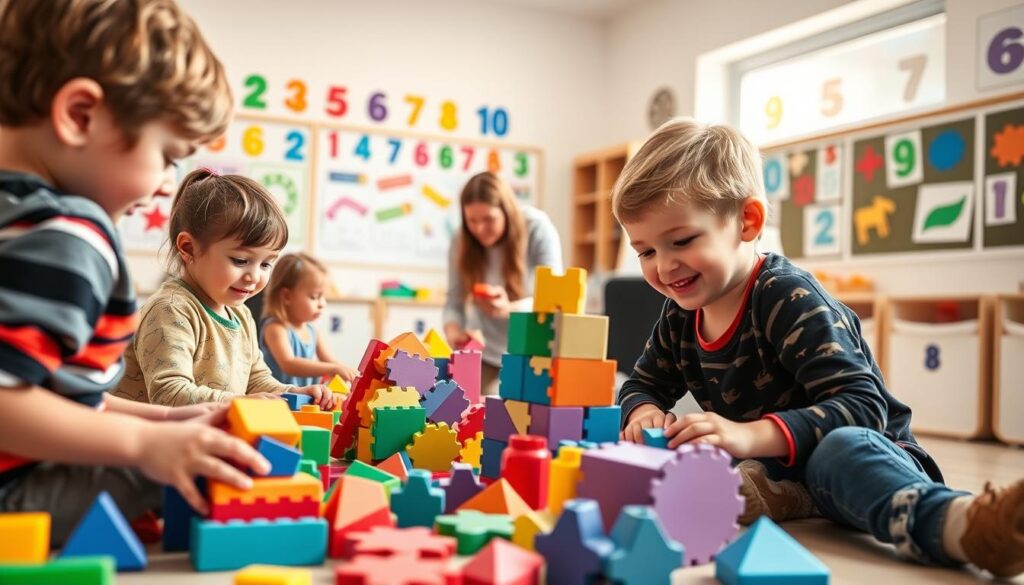
Give children playful tasks that focus on math goals. Use simple materials you already have to turn playtime into a lesson. These interactive kids’ building activities help you guide kids from concrete actions to abstract ideas with clear, hands-on examples.
Patterning, sequencing, and early algebra through block play
Set up a row of colored blocks, beads, or cereal pieces and ask your child to copy, extend, or fix a broken pattern. Challenge them to create the next two steps or to write a rule for the pattern. These exercises promote patterning sequencing early algebra skills by showing how repeats and rules work.
Try a “missing piece” game where the child predicts the absent element or designs a new repeating rule. Use counting charts or a simple worksheet to record patterns and encourage verbal explanation of the rule.
Measurement, fractions, and scaling using recipes and building tasks
Bring in cooking to teach measurement fractions scaling. Follow a basic cookie or no-bake recipe and ask your child to double, halve, or divide the batch. Measuring cups and spoons make fractions concrete and build proportional thinking.
Translate the same ideas to building models. Ask kids to measure parts for a small bridge or car, then change dimensions and predict how the size shift alters the structure. Have them note quantities in a measurement log to compare results.
Spatial reasoning and geometry from shape-sorting and bridge challenges
Use LEGO, marshmallows with toothpicks, or shape-sorters to explore spatial reasoning geometry. Start with shape identification and move to constructing simple 3D models. Ask questions about angles, symmetry, and balance as they build.
Run a bridge challenge where children design a span to hold weight. Prompt them to test and adjust, observing how triangles and arches distribute load. Encourage sketches and short notes so they link geometric ideas to physical outcomes.
For classroom or home extension, offer counting sheets, measurement logs, or printable number lines so children record steps and reflect on strategies. Prompt kids to talk through choices while you capture their reasoning. These habits make interactive kids’ building activities more powerful and lasting.
Creativity building games that encourage problem-solving and perseverance
Creative building play is a safe space to try new ideas and grow your thinking. It uses open-ended challenges that don’t have just one right answer. This makes projects feel like puzzles you can shape, boosting curiosity and persistence.
Open-ended prompts
Try prompts like “Build a machine that moves a toy from point A to B” or “Design a house for an animal that must survive rain.” These tasks push kids to plan, experiment, and think of many solutions. You’ll see kids sketch, prototype, and share ideas.
Encouraging trial and error
See failed attempts as learning, not failure. Teach the cycle: test, observe, adjust, repeat. When you show this approach, kids learn patience and perseverance. Use short moments to reflect on what worked and what to change.
Mixing STEAM
Add art to building to make it more engaging. Have kids decorate structures, apply color theory, or make edible prototypes. Projects like I’m the Chef Too! show how taste, design, and measurement can mix STEAM art play.
Use practical strategies to make play productive. Set a timer for focused work, then debrief for two minutes. Celebrate small wins like “first working hinge” or “third revision.” These steps turn creativity games into regular chances to solve problems.
Choose building tasks that grow with your skills. Start with simple projects and move to more complex ones. Offer roles that highlight strengths, like planner, tester, or decorator. Shared success boosts confidence and encourages trying harder next time.
| Prompt Type | Skills Targeted | Suggested Materials | Why it Builds Perseverance |
|---|---|---|---|
| Move-a-toy machine | Engineering, sequencing, trial-and-error | Cardboard, rubber bands, straws, wheels | Requires repeated tests and iterative fixes |
| Rainproof animal house | Design thinking, material science, measurement | Foil, clay, fabric scraps, tape | Promotes hypothesis testing and adjustments |
| Edible prototype challenge | Mix STEAM art play, fractions, chemistry | Fruit, crackers, frosting, toothpicks | Immediate feedback from taste and structure |
| Decorated bridge contest | Geometry, aesthetics, collaboration | Wooden blocks, paint, string | Encourages revisions to improve strength and look |
Virtual building games for kids and screen-time balance
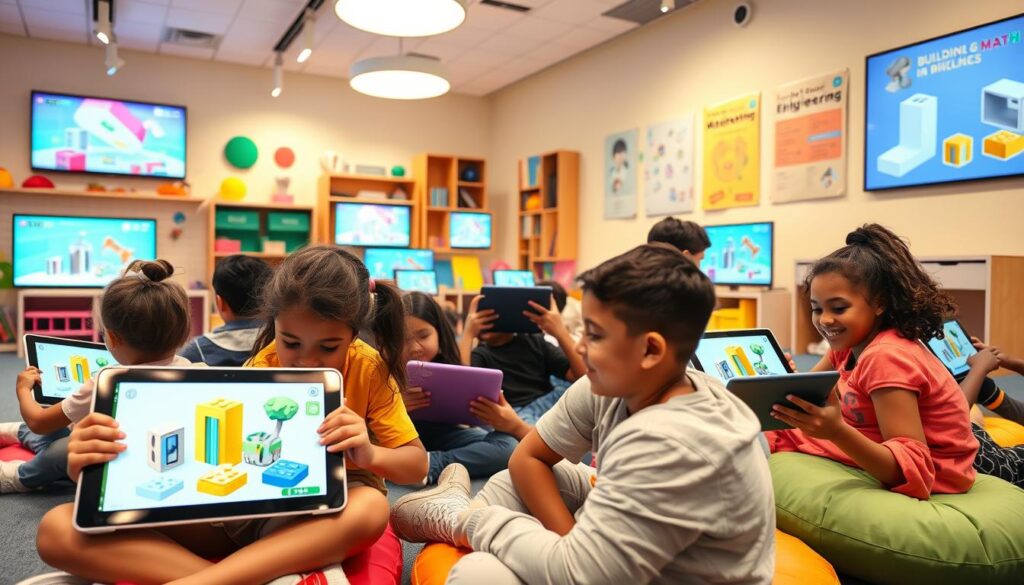
Digital building tools can help with math and engineering thinking in short sessions. Virtual building games for kids offer sandbox play and coding puzzles. They teach sequencing, spatial reasoning, and early systems thinking. Make sure play stays active and focused on learning.
When digital building games support conceptual learning
Games like ABCmouse math games, such as Draco’s Number Dash, teach counting and sequencing. They give immediate feedback. Apps that focus on logic and coding introduce systems thinking and cause-effect relationships. Choose games with clear goals and prompts for kids to predict and explain outcomes.
How to combine virtual play with physical construction for deeper learning
Blending virtual and real-world play strengthens learning. After a virtual challenge, have kids recreate designs with straws or craft sticks. Making a dish together after a recipe app teaches fractions. These activities help kids apply digital concepts in real life.
Guidelines for limiting screen time while maximizing educational value
Set short, scheduled sessions with a clear goal before play. Supervise or co-play to prompt reflection and connect digital tasks to real objects. Follow a rhythm: 15 to 30 minutes of digital play, then hands-on activity. Use apps as scaffolds when materials are unavailable, but check age-appropriateness and privacy settings. Note that ABCmouse may require a subscription and you should review account options and privacy notices.
| Strategy | What to do | Why it helps |
|---|---|---|
| Short sessions | Limit to 15–30 minutes with a set goal | Supports attention and improves screen-time balance |
| Paired follow-up | Replicate a digital build using blocks, straws, or recipes | Helps children combine virtual play physical construction for deeper learning |
| Guided reflection | Ask what worked, what failed, and how to change the design | Develops metacognition and conceptual learning |
| Screen-free alternatives | Monthly kits, printed challenges, and hands-on experiments | Provides practice without screens and reinforces skills |
| Privacy and access | Choose age-appropriate apps, review subscriptions and settings | Protects data and ensures safe, educational use |
Building games child intelligence: measurable skills and milestones
Playing with blocks and simple construction sets helps watch skills grow. You’ll see better planning, self-control, and focus. These skills are key for school success and solving problems.
How block play supports executive function and attention
When your child builds a tower, they practice important skills. They work on memory, self-control, and switching tasks. Activities like following a model or timing a build improve focus.
Try timed activities and see if your child can follow steps without help. This shows their ability to concentrate.
Links between construction play and language, numeracy, and memory
Construction play introduces new words and boosts vocabulary. It also helps with math, like counting and patterns. Remembering a build sequence improves memory and planning.
Use activity sheets and games from The Power of Play to support these skills. Online games and apps that focus on patterns and logic are great too.
Tracking progress: simple ways you can record growth at home
Keep a simple record to see progress over time. Try a photo timeline, short notes on skills used, and a checklist of milestones. This shows how your child is growing.
Use a log for experiments like bridge tests. Note design changes, weight, and success. This shows how planning and problem-solving skills improve over time.
Match activities to your child’s grade level. Preschool focuses on curiosity and safety. Kindergarten introduces cause-and-effect and simple engineering. First grade emphasizes logical steps and problem-solving. This keeps growth steady and realistic.
Designing building activities to build confidence and concentration
Design activities that make your child feel capable and focused. Start with short, guided projects that have clear steps. Use checklists and visual templates to show progress.
Celebrate small wins to make self-confidence building games rewarding.
Scaffolding challenges so kids experience success and stretch skills
Start with simple tasks and add one new element at a time. Offer a model, a partial template, or a list of materials. Gradually remove prompts to help your child become independent.
This stepwise approach keeps frustration low and learning steady.
Games that promote patience, focus, and self-regulation
Choose activities that require measured steps, like following a recipe or assembling a multi-part model. Include tasks with delayed rewards, such as planting seeds to watch roots form. Use timed focus intervals—try 10 to 20 minutes—with short restorative breaks to keep attention sharp.
Encouraging cooperative builds to strengthen communication and teamwork
Set shared goals for group projects and assign clear roles: designer, builder, tester. Ask teams to plan aloud before touching pieces and to reflect afterward on what worked. Cooperative builds communication teamwork grows when kids practice negotiation, listening, and solving disagreements together.
Practical tips you can apply now:
- Use simple progress charts so children track steps and celebrate each completion.
- Offer minimal prompts that nudge but don’t solve, to build independence.
- Rotate roles in group tasks so every child practices leadership and support.
- Document projects with photos or short notes to show growth over time.
| Activity Type | How it Builds Confidence | Focus Strategy |
|---|---|---|
| Guided model build | Clear steps and visible progress boost self-belief | 10–15 minute work blocks with checklist |
| Long-term experiment (seed growth) | Delayed outcomes teach patience and persistence | Weekly observations and short journaling |
| Precision tasks (measuring recipes) | Success with exact steps increases self-confidence | One-step-at-a-time prompts and calm workspace |
| Cooperative builds | Role practice strengthens social skills and trust | Verbal planning, role rotation, and reflection prompts |
Choosing child-friendly building games, toys, and materials
Choose items that match your child’s skills and keep safety first. Look for clear labels and compliance with safety standards. Also, find simple instructions that explain how safe they are for your child’s age.
For messy or edible kits, pick non-toxic ingredients. Always supervise your child during any steps that use heat or small open flames.
Safety, age-appropriateness, and material variety
Check choking hazard warnings for small parts before you buy. For toddlers, favor large wooden blocks, soft foam shapes, and big-peg puzzles. Preschoolers do well with stackers, chunky magnetic tiles, and sensory building trays that use rice or safe dough.
For older kids, pick kits with measured components and clear adult guidance. Choose parts labeled by size. Keep a mix of open-ended materials and guided activities for fresh and scalable play.
Construction toys and logic puzzles that match developmental stages
Toddlers need toys that build gross motor and hand-eye skills. Choose big, sturdy pieces that invite stacking and knocking down.
Kindergarteners can handle cause-and-effect toys, simple ramps, and basic pattern puzzles. Introduce LEGO Duplo or larger LEGO sets as fine motor control improves.
Early elementary children thrive on multi-step tasks: measured recipes, snap-circuit kits, or challenge cards that demand planning. Select construction toys logic kids can use for trial-and-error work and iterative redesigns.
Research building toys children: what studies recommend and why
Recent education guidance from providers such as ABCmouse emphasizes grade-organized activities that scaffold skills. Programs that marry cooking, simple chemistry, and construction show gains in reasoning when children repeat and refine projects.
Choose toys and kits that encourage open-ended exploration, repeated trials, and collaborative problem solving. These features align with research building toys children that links play-based STEM to improved executive function and spatial reasoning.
Practical shopping tips: buy items with reusable parts, clear learning goals, and strong community reviews. Compare single-purchase kits for one-off projects against subscriptions that deliver variety and curriculum pacing. Prioritize durability and the chance for kids to invent beyond the included instructions.
Related Building Games and Math / STEM Skills Articles
Building games can help children explore early math, STEM thinking, spatial reasoning, patterns, measurement, and problem-solving through hands-on play. If you want to go deeper, these related guides explain how blocks and construction toys support learning at home, in preschool, and in early childhood settings:
- How Block Play Builds Early STEM Skills in Toddlers and Preschoolers
- Building Toys and Math Skills: Why Blocks Are More Than Play
- Best Building Toys for Preschool STEM Activities at Home
- How Construction Play Teaches Shapes, Balance, and Measurement
- Why Block Play Helps Children Understand Early Math Concepts
- Easy Preschool STEM Activities Using Blocks and Building Toys
- How Building Toys Support Spatial Reasoning and Future Math Skills
- Screen-Free STEM Activities: What Kids Learn From Building With Blocks
- How to Use Blocks to Teach Counting, Sorting, and Patterns
- Why Spatial Reasoning Matters for Math (And How Block Play Helps)
- LEGO and Learning: How Building Sets Teach Math to Young Children
- Block Play Benefits by Age: What Your Child Learns at Each Stage
- Does Block Play Really Improve Math Skills? What the Research Says
Conclusion
Building games for kids are a fun way to support early math and STEM skills, and they are also part of a larger learning approach explained in our complete guide to building games for children. Simple block play, measuring, and pattern games boost creativity and social skills. These games also help with problem-solving and early math skills in a fun way.
Try simple building challenges at home, like measuring ingredients for snacks. You can also mix virtual building games with real-life projects. Keep track of your child’s progress with photos or a checklist to see how they grow.
For more help, sign up for newsletters from PBS KIDS or try a STEM kit like I’m the Chef Too! It combines cooking with engineering. Start a building activity this week and see how it enhances your child’s learning and creativity.