Have you ever wondered if your child’s pretend tea party is actually a masterclass in communication? Fred Rogers famously called such activities the work of childhood. It is through these moments that youngsters build vital cognitive bridges.
Symbolic interaction acts as a foundation for future academic success. When kids act out roles, they practice complex vocabulary naturally. This process fosters social skills that last a lifetime.
Parents who encourage this creative exploration provide a massive advantage. By observing these milestones, you support essential growth in your little one. Understanding these patterns helps caregivers nurture brighter futures.
Key Takeaways
- Pretend scenarios function as a primary method for early communication growth.
- Fred Rogers identified these activities as essential labor for young minds.
- Symbolic actions create a base for future academic achievement.
- Social competence improves through consistent creative interaction.
- Caregivers play a crucial role in supporting these developmental milestones.
Understanding Imaginative Play
When a child turns a simple cardboard box into a spaceship, they are engaging in a complex cognitive process. This activity is not merely a distraction; it is a fundamental way for children to make sense of their environment. By exploring the importance of imaginative play in language development, we can see how these moments build essential life skills.
Definition of Imaginative Play
At its core, imaginative play is a form of symbolic play. It requires children to use mental imagery to represent reality with symbols. For instance, a child might use a wooden block to represent a telephone or a blanket to create a secret fort.
This ability to substitute objects is a significant milestone in brain development. It shows that the child can think beyond the physical world. They are learning to assign new meanings to familiar items, which is a precursor to understanding abstract language.
Types of Imaginative Play
Children engage in various forms of play that challenge their growing minds. Role-playing allows them to step into the shoes of others, such as a doctor, a teacher, or a parent. This helps them practice social scripts and emotional regulation.
Object substitution is another common type where items take on new roles. Finally, social-dramatic play involves multiple children working together to create a shared narrative. These interactions are vital for the importance of imaginative play in language development as they require constant negotiation and verbal communication.
| Play Type | Primary Action | Developmental Goal |
|---|---|---|
| Role-Playing | Imitating adult behaviors | Social empathy |
| Object Substitution | Using props as symbols | Abstract thinking |
| Social-Dramatic | Collaborative storytelling | Language fluency |
Benefits of Imaginative Play
The benefits of these activities extend far beyond the playroom. Engaging in pretend scenarios allows children to practice flexible thinking and complex problem-solving. When a “boat” starts to sink, the child must quickly invent a solution to save the crew.
This rapid mental adjustment is a key indicator of cognitive health. By consistently practicing these skills, children become more adept at expressing their thoughts and feelings. Ultimately, the importance of imaginative play in language development lies in its ability to turn abstract concepts into tangible, spoken communication.
The Role of Imaginative Play in Child Development
When children engage in pretend play, they are doing much more than just having fun; they are building essential life skills. This type of activity acts as a powerful catalyst for growth, helping young minds navigate the complexities of their environment. Understanding the role of play in language acquisition is vital for parents and educators who want to support a child’s natural development.
Cognitive Development
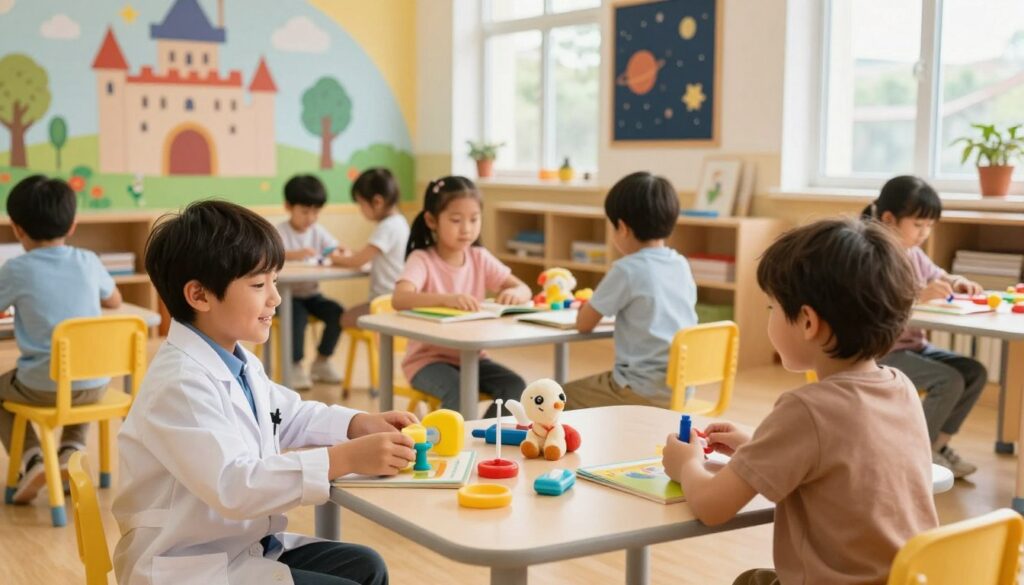
During imaginative scenarios, children constantly practice the art of thinking. They learn to classify objects, compare different items, and reason through various challenges that arise in their make-believe worlds. This mental exercise is a fundamental role of play in language acquisition, as it forces children to organize their thoughts and express them clearly.
By acting out pretend stories, children begin to grasp complex cause-and-effect relationships. They learn that their actions have consequences, which helps them build a logical framework for understanding the world. Key cognitive benefits include:
- Enhanced problem-solving skills through creative trial and error.
- Improved ability to categorize information and objects.
- Stronger logical reasoning as they navigate pretend obstacles.
Social Development
Play is rarely a solitary endeavor; it often involves interacting with peers or caregivers. These social exchanges are essential for building empathy and learning how to cooperate with others. When children step into different roles, they practice viewing the world from perspectives other than their own.
This shift in viewpoint is a critical role of play in language acquisition, as it requires children to communicate their needs and listen to the ideas of their playmates. Through these interactions, they develop the social intelligence necessary for future success. Collaborative play teaches them how to negotiate, share, and resolve conflicts in a safe and supportive environment.
Language Skills: An Overview
At its core, language is a sophisticated system of symbols that allows us to share our inner thoughts. It is far more than just a collection of vocabulary words; it is the bridge between a child’s internal world and the external environment. By using spoken words to represent objects, actions, and abstract ideas, children begin to navigate their social reality.
What Are Language Skills?
Language skills encompass a wide range of abilities that go beyond simple speech. They include pragmatics, which is the social use of language, and grammar, the structural rules that govern how we combine words. When children engage in activities, they naturally practice these components in real-time.
The role of play in language acquisition is fundamental because it provides a low-pressure environment for experimentation. Children learn to adjust their tone, listen to others, and follow the logical flow of a conversation. The following table outlines the key components of these essential skills:
| Component | Description | Example |
|---|---|---|
| Semantics | Understanding word meanings | Naming a toy |
| Syntax | Sentence structure | Ordering words correctly |
| Pragmatics | Social communication | Taking turns speaking |
Importance of Language Development
Developing strong communication skills is one of the most significant milestones in early childhood. It enables children to express their needs, feelings, and thoughts effectively, which reduces frustration and builds confidence. When a child can articulate what they want, they gain a sense of agency over their own life.
“Language is the road map of a culture. It tells you where its people come from and where they are going.”
Furthermore, the role of play in language acquisition cannot be overstated. Through imaginative scenarios, children test new vocabulary and complex sentence structures in a safe space. This active engagement ensures that language becomes a functional tool for connection rather than just a set of abstract rules to memorize.
How Imaginative Play Enhances Vocabulary
Exploring the benefits of imaginative play for language skills reveals how play transforms simple talk into complex communication. When children step into make-believe worlds, they often use higher forms of language than they would in everyday, structured situations.
Creating Meaningful Contexts
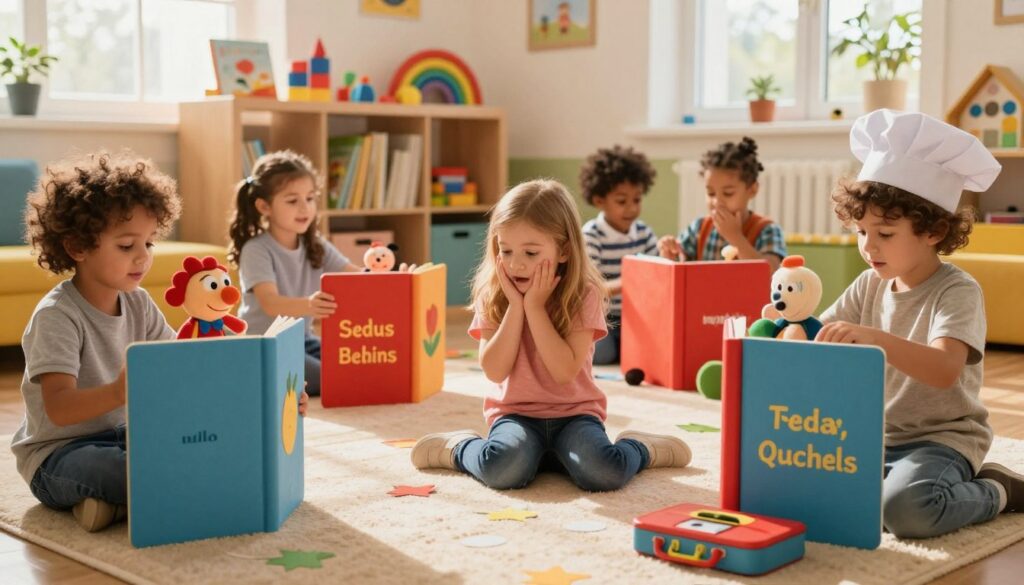
Children learn best when new words are tied to real-world experiences. By setting up a pretend grocery store or a mock doctor’s office, parents provide a meaningful context for language acquisition.
In these scenarios, children naturally adopt specific roles and vocabulary associated with those settings. They might practice words like “transaction,” “prescription,” or “inventory” while playing, which builds a more robust lexicon than rote memorization ever could.
“Play is the highest form of research.”
Encouraging Creativity and Expression
The benefits of imaginative play for language skills extend beyond just learning new nouns. When children are free to invent their own stories, they are encouraged to express themselves with greater nuance and confidence.
This creative freedom allows them to experiment with sentence structures and descriptive adjectives. As they narrate their play, they refine their ability to communicate complex ideas, leading to a more varied and sophisticated vocabulary over time.
Ultimately, the joy found in these creative moments drives intrinsic motivation. When learning feels like a game, children are far more likely to retain the language they discover during their adventures.
The Impact of Storytelling in Play
Storytelling acts as a vital bridge between a child’s immediate environment and their expanding internal world. When children weave narratives during their playtime, they move beyond simple mimicry and begin to develop complex intellectual thought patterns. This process highlights the many benefits of imaginative play for language skills, as children must organize their thoughts into coherent sequences.
Storytelling as a Language Tool
Narratives serve as a powerful mechanism for linguistic growth. By creating characters and settings, children practice the specific sentence structures and vocabulary necessary for future academic success. This creative exercise is not just about fun; it is a structured way to build emotional literacy.
Through these stories, children learn to navigate complex feelings. They often explore themes of:
- Resilience when characters face difficult challenges.
- Empathy by stepping into the shoes of different personas.
- Compassion through resolving conflicts between toys or friends.
Enhancing Comprehension and Retention
Engaging in storytelling helps children sharpen their memory and understanding of cause-and-effect relationships. As they repeat and refine their tales, they solidify their grasp of language, which is one of the primary benefits of imaginative play for language skills. This practice ensures that they can recall details and follow logical progressions in their daily lives.
When children narrate their play, they are essentially rehearsing for real-world communication. They learn to listen, respond, and adapt their stories based on the feedback of their playmates. This dynamic interaction fosters long-term cognitive development and prepares them for more advanced literacy tasks in school.
The Connection Between Play and Communication
The connection between pretend play and language development is rooted in how children express themselves without saying a word. While verbal skills are vital, the ability to interpret gestures and physical cues forms the bedrock of effective human interaction. Through imaginative scenarios, children learn to read the room and understand the intentions of their peers.
Nonverbal Communication in Play
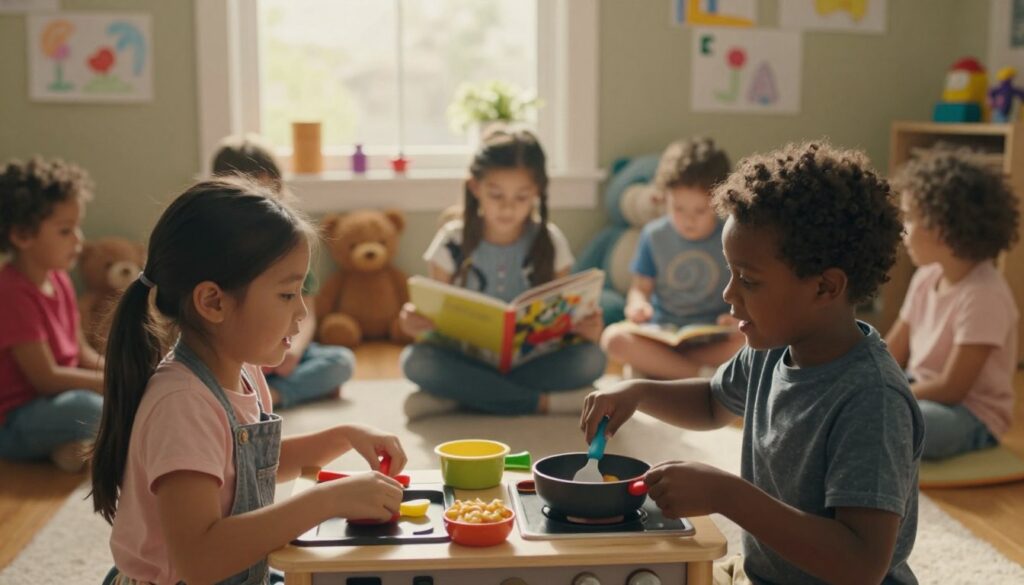
During play, children rely heavily on body language to convey meaning. They use expressive gestures and facial signals to signal a change in the game or to invite others to join. This silent dialogue is a critical precursor to complex social communication.
Spatial awareness also plays a significant role in this developmental stage. As children manipulate toys, they begin to grasp concepts like “above,” “below,” and “under.” Understanding these relationships helps them describe their environment more accurately, which directly strengthens the connection between pretend play and language development.
Encouraging Conversational Skills
Play provides a safe space for children to practice the rhythm of a real conversation. By engaging in back-and-forth interactions, they learn the essential art of taking turns. This practice ensures that they listen as much as they speak, a skill that is vital for building lasting relationships.
When children negotiate roles or decide on the rules of a game, they are actively refining their ability to express ideas clearly. These collaborative moments turn simple playtime into a powerful training ground for social success. By fostering these exchanges, parents and caregivers help children develop the confidence needed to navigate the world around them.
Developing Narrative Skills Through Play
The ability to weave a narrative begins long before a child picks up a pencil. When children engage in make-believe, they are not just having fun; they are actively practicing the connection between pretend play and language development. This process allows them to experiment with complex ideas in a safe, low-pressure environment.
Structure of a Narrative
To tell a good story, a child must learn how to organize events in a logical order. During play, they naturally practice the fundamental components of storytelling, such as establishing a scene, introducing a conflict, and reaching a resolution.
By acting out these sequences, children internalize the following narrative building blocks:
- The Beginning: Setting the stage and introducing the main players.
- The Middle: Navigating challenges or unexpected plot twists.
- The End: Bringing the story to a satisfying conclusion.
Role of Characters and Settings
Assigning roles to characters and creating imaginary settings requires a high level of cognitive flexibility. This type of “out of context” thinking is a powerful predictor of future writing achievement because it demands strong visual imagery.
When a child pretends to be a doctor in a hospital or an astronaut on a distant planet, they are practicing abstract thought. This connection between pretend play and language development helps them articulate hypothetical scenarios that exist outside their immediate reality. By consistently practicing these skills, children build a solid foundation for advanced reading comprehension and creative writing abilities later in their academic journey.
Imaginative Play and Early Literacy
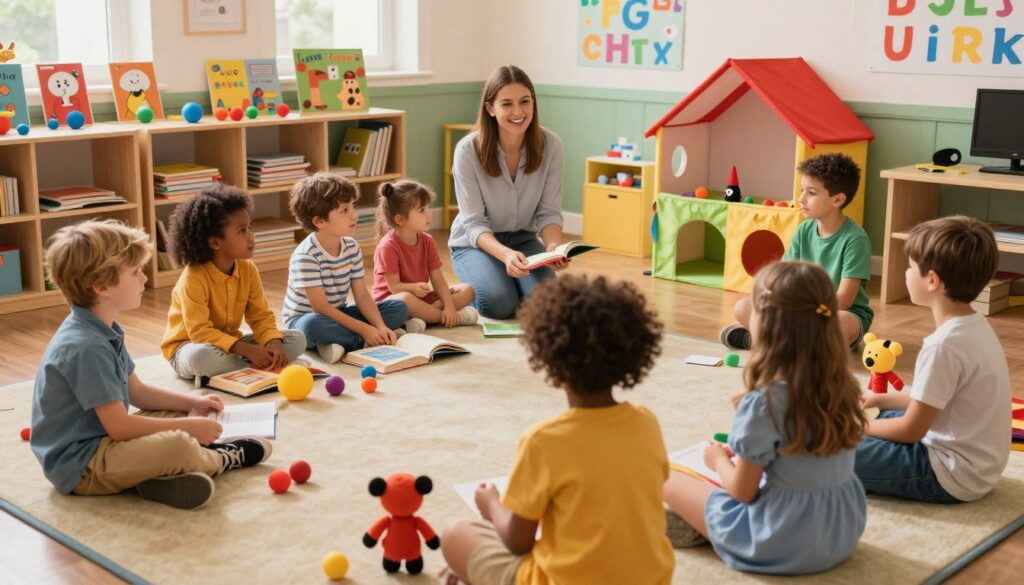
Imaginative play serves as a vital bridge between childhood wonder and the foundational skills required for early literacy. By creating scenarios that mirror the real world, children naturally begin to understand that symbols and words carry specific meanings. This process demonstrates how imaginative play enhances language skills by providing children with authentic reasons to engage with text in a low-pressure environment.
Play-Based Learning Approaches
Integrating literacy into daily routines transforms ordinary playtime into a rich educational experience. For example, when children set up a pretend shop, they often feel motivated to create signs, price tags, or menus. This spontaneous writing allows them to practice letter formation and phonics without the stress of formal instruction.
Parents and educators can support this by providing simple materials like paper, markers, and clipboards. When adults participate in the play, they can model how to write a grocery list or read a “store hours” sign. These small interactions turn play into a powerful tool for cognitive growth.
Linking Play to Early Reading Skills
Connecting creative activities to reading readiness creates a natural and joyful path toward academic success. When children act out stories, they learn about narrative structure, character development, and sequence. These elements are the exact same building blocks required for reading comprehension later in life.
Understanding how imaginative play enhances language skills allows us to see that a child playing “doctor” or “librarian” is actually practicing complex communication. By valuing these moments, we foster a lifelong love for literacy. The following table highlights how specific play activities translate into essential reading and writing milestones.
| Play Activity | Literacy Skill Developed | Academic Benefit |
|---|---|---|
| Pretend Restaurant | Writing menus and orders | Letter-sound correspondence |
| Acting out stories | Narrative sequencing | Reading comprehension |
| Building a post office | Writing letters and labels | Vocabulary expansion |
| Playing librarian | Sorting and categorizing | Phonological awareness |
Cultural Influences on Imaginative Play
The way children play is deeply rooted in the traditions and values of their specific cultural environment. While play is a universal childhood activity, the specific themes and social dynamics often reflect the community in which a child grows up. Interestingly, historical data shows a significant shift in these habits; in 1982, pretend play accounted for 41 percent of preschoolers’ free play, but it dropped to just 9 percent by 2002. This decline highlights the need to understand how imaginative play enhances language skills in an increasingly structured world.
The Role of Culture in Play Styles
Cultural backgrounds dictate the scripts and roles children adopt during their pretend sessions. In some societies, play is highly collaborative and focused on communal tasks, while in others, it may emphasize individual exploration and fantasy. These differences are not merely stylistic; they shape the social vocabulary children acquire.
By observing these variations, we gain insight into how imaginative play enhances language skills through social interaction. Children learn to negotiate roles and express complex ideas based on the cultural expectations they observe at home. This social scaffolding is a vital component of their overall development.
Multilingual Play and Language Exposure
For children growing up in multilingual households, imaginative play serves as a unique laboratory for linguistic growth. When children switch between languages during play, they practice cognitive flexibility and expand their vocabulary in both tongues. This process is a powerful example of how imaginative play enhances language skills by providing a low-pressure environment for experimentation.
Parents and educators can support this by providing diverse props and stories that reflect multiple cultural perspectives. Encouraging children to tell stories in their home language while playing helps bridge the gap between their cultural identity and their academic environment. Ultimately, embracing these diverse influences ensures that every child has the tools to communicate effectively in a globalized world.
Supporting Imaginative Play at Home
Parents hold the key to unlocking a child’s potential through the power of imaginative play. By creating a nurturing environment, you help your little one build a strong foundation for future success. Understanding the importance of imaginative play in language development allows you to turn everyday moments into rich learning opportunities.
Tips for Parents to Encourage Imaginative Play
The most effective way to support your child is to become a sensitive co-player. Instead of directing the action, try to follow your child’s lead during their make-believe scenarios. This approach shows that you value their ideas and encourages them to express themselves more freely.
You can model effective language by tuning in and listening carefully to what your child says. When you observe their actions, narrate what you see using descriptive words. This simple habit significantly boosts their communication confidence and vocabulary growth.
Resources for Imaginative Play Activities
You do not need expensive gadgets to foster creativity at home. Simple, open-ended items like cardboard boxes, fabric scraps, and kitchen utensils often spark the most vibrant stories. These items allow children to invent their own worlds without limitations.
Local libraries and community centers are also excellent resources for finding inspiration. Many offer storytime sessions or playgroups that emphasize the importance of imaginative play in language development. Engaging with these community tools can provide fresh ideas for your home play sessions.
Consider keeping a small bin of “dress-up” clothes or props in a corner of the living room. Having these items easily accessible encourages spontaneous play throughout the day. By providing these resources, you demonstrate that you prioritize the joy of discovery in your child’s daily life.
Recognizing Signs of Language Delays
Watching your child grow is a journey filled with joy, but it also brings questions about whether they are meeting key milestones. While every child develops at their own unique pace, there are times when a little extra attention is needed. Fostering language development through imaginative play is a wonderful way to support your child, but it is also helpful to know when to seek professional guidance.
Indicators of Language Development Issues
Parents often wonder what constitutes a typical delay versus a natural variation in growth. Early warning signs might include a lack of response to their name by twelve months or a limited range of sounds during infancy. It is important to stay observant without feeling overwhelmed by every minor fluctuation in progress.
If a toddler is not using gestures like pointing or waving by fifteen months, it may be worth a conversation with a pediatrician. Additionally, a lack of interest in social interaction or difficulty following simple instructions can be indicators that a child needs extra support. Early intervention is highly effective and can make a significant difference in a child’s long-term communication success.
The Role of Play in Identifying Delays
Play is often the most natural setting to observe a child’s communication skills in action. Certain language milestones frequently emerge alongside specific play behaviors, providing a clear roadmap for development. For instance, the ability to use two-word combinations typically appears around 19 to 22 months, which often coincides with the start of more complex pretend play.
When you engage in fostering language development through imaginative play, you gain a front-row seat to your child’s cognitive growth. If a child struggles to engage in simple symbolic play, such as pretending a block is a phone, it might signal a need for further evaluation. By paying attention to these play-based cues, you can ensure your child receives the right resources to thrive.
Conclusion: The Vital Connection
Children transform simple moments into complex worlds when they engage in pretend play. This natural behavior acts as the rocket fuel for cognitive growth and linguistic mastery. According to the American Academy of Pediatrics, imaginative play supports healthy cognitive and language development in young children.
Recognizing the link between imaginative play and language development empowers caregivers to nurture brighter futures.
Core Takeaways for Growth
Every interaction during playtime builds a stronger foundation for communication. The impact of play on language development remains clear when observing how children negotiate roles and describe their surroundings. These activities provide a safe space for testing new words and complex sentence structures.
Shaping Future Educational Paths
Schools must protect time for unstructured exploration to ensure academic success. Integrating play-based learning into modern curricula supports the diverse needs of students. Educators who prioritize these experiences help children gain the confidence required for lifelong literacy. By valuing these moments today, we prepare the next generation for the challenges of tomorrow.