
Did you know your child’s brain makes millions of new connections every second? The first five years are a critical window for growth that won’t happen again. You can shape this foundation with simple, everyday activities.
Many parents wonder if they’re doing enough for their child’s brain. Science proves that construction play boosts both mental and physical growth. Playing building games is a hands-on way to prepare your child for school.
For a broader science-based overview, read Building Games and Child Growth: What Science Actually Says.
When your toddler builds with blocks or connects pieces, they solve complex problems. These moments are not just fun; they’re essential exercises for a growing mind. Let’s see how these play habits help your child’s future learning.
The Science Behind Building Games Brain Development
By the time your child is five, their brain is almost fully grown. This is a critical window for learning. Playing building games helps their brain grow by giving it the right challenges.
To explore this topic in more detail, visit our complete guide to Building Games and Brain Development.
Neuroplasticity and Early Childhood Play
The brain can change and adapt throughout life. In early childhood, it changes fast. Playing learning through play games helps it grow strong.
Playing with different things helps the brain make new connections. These brain training activities make the mind strong. They help during the brain’s fastest growth time. Here are some key benefits of early play:
- Increased synaptic density in the prefrontal cortex.
- Enhanced ability to process complex visual information.
- Improved focus and sustained attention spans.
How Spatial Reasoning Forms in the Toddler Brain
Spatial reasoning lets us understand how things are arranged. Toddlers learn this by playing with blocks. They see how shapes fit and how gravity works.
Every time they stack blocks, they do complex mental calculations. They test ideas about balance and shape. Playing learning through play games every day helps them understand these ideas. It turns abstract ideas into real ones.
Foundational Cognitive Benefits of Construction Play
Construction play is a key part of your child’s learning journey. It lets them explore cause and effect with real objects. This hands-on learning is great for building games brain development because it gets them involved, not just watching.
Developing Problem-Solving Skills Through Trial and Error
When your child tries to balance a block, they’re testing a theory. If it falls, they figure out why and try again. This trial and error builds lasting skills in problem-solving and thinking.
Watching your child deal with frustration is enlightening. They don’t give up; they keep trying different ways. This shows they’re learning to be smart and flexible.
Enhancing Executive Function and Working Memory
Executive function is like the brain’s traffic controller. Through cognitive development games, your child gets better at keeping information in mind. This boosts their working memory and self-control.
These games need focus, planning, and quick thinking. By enhancing cognitive skills through games, you help your child succeed in school. Here’s how different play activities help with these skills.
| Play Activity | Cognitive Benefit | Skill Outcome |
|---|---|---|
| Stacking Blocks | Spatial Awareness | Improved Logic |
| Sorting Shapes | Pattern Recognition | Working Memory |
| Building Bridges | Structural Planning | Problem Solving |
| Collaborative Play | Social Regulation | Executive Control |
The Role of Fine Motor Skills in Brain Growth
When your child reaches for a block, they’re doing more than playing. This simple action is a vital catalyst for neural growth. It helps the motor cortex form stronger connections in the brain.
Playing cognitive development games every day gives your child the sensory input they need. As they play, they map their physical world. This is key for building a strong foundation for learning.
Hand-Eye Coordination and Neural Pathways
The brain needs feedback loops to improve movement. When a toddler tries to put a block on a tower, they use their eyes and hands. This precise coordination strengthens the neural pathways between the visual system and the motor cortex.
These fun brain-building games help kids learn about weight, gravity, and balance. Every successful move makes the brain reinforce the neural circuit. This repetition helps young minds learn complex spatial information.
Precision and Control: From Stacking Blocks to Complex Structures
Development starts with simple grasping and moves to refined control. At first, a child might knock over a stack. But soon, they learn to place blocks with purpose. This is a big step in early childhood.
As kids go from stacking simple cubes to building complex structures, they get better at using their hands. Playing cognitive development games that challenge them helps. It prepares their hands for holding a pencil and writing. By picking fun brain-building games that match their skill level, you help their physical and mental growth.
Mathematical Concepts Learned Through Building
When your child stacks blocks, they are learning through educational games for brain development. These games turn abstract math into real, hands-on experiences. By playing with blocks, your child starts to understand the world around them.
Understanding Geometry and Symmetry
Construction play introduces kids to geometry. They learn to sort blocks by shape or size. This helps them see patterns and how shapes fit together.
When building, symmetry becomes important. Your child learns to balance structures. This spatial reasoning is key for early math skills.
Early Exposure to Physics and Structural Integrity
Beyond shapes, building games teach physics. Kids learn about gravity when towers fall. They see the need for a strong base and balance.
These educational games for brain development let kids test their creations. They learn about structure and weight. This lays the groundwork for STEM learning.
| Concept | Learning Outcome | Practical Application |
|---|---|---|
| Geometry | Shape recognition | Sorting blocks by form |
| Symmetry | Balance and order | Creating mirrored designs |
| Physics | Gravity awareness | Building stable foundations |
| Measurement | Size comparison | Stacking by height |
Language Acquisition and Social Interaction During Play
When kids play with blocks, they’re not just building towers. They’re also improving their communication skills. This activity is a powerful vehicle for language acquisition and social development. It helps them learn how to connect with others.
Collaborative Building and Communication Skills
Building together requires kids to share their ideas and listen to others. They must negotiate roles and solve problems. This teaches them to work together and find common ground.
These interactions help kids understand social cues and develop empathy. They see how their actions affect the group. This turns block play into a lesson in teamwork.
Expanding Vocabulary Through Descriptive Play
Construction play is a chance for kids to use descriptive language. They talk about shapes, sizes, and designs. This intentional communication sharpens their language skills.
Doll play also helps kids use internal state language. They talk about their characters’ thoughts and feelings. Interactive games offer a fun way for kids to practice these important skills.
Age-Appropriate Building Activities for Children Under 5
Choosing the right play for your child’s age is key to their growth. By matching activities to their skills, construction play stays fun and brain-stimulating. Studies show that even short play times can improve classroom focus in young kids.
Sensory Exploration for Infants and Young Toddlers
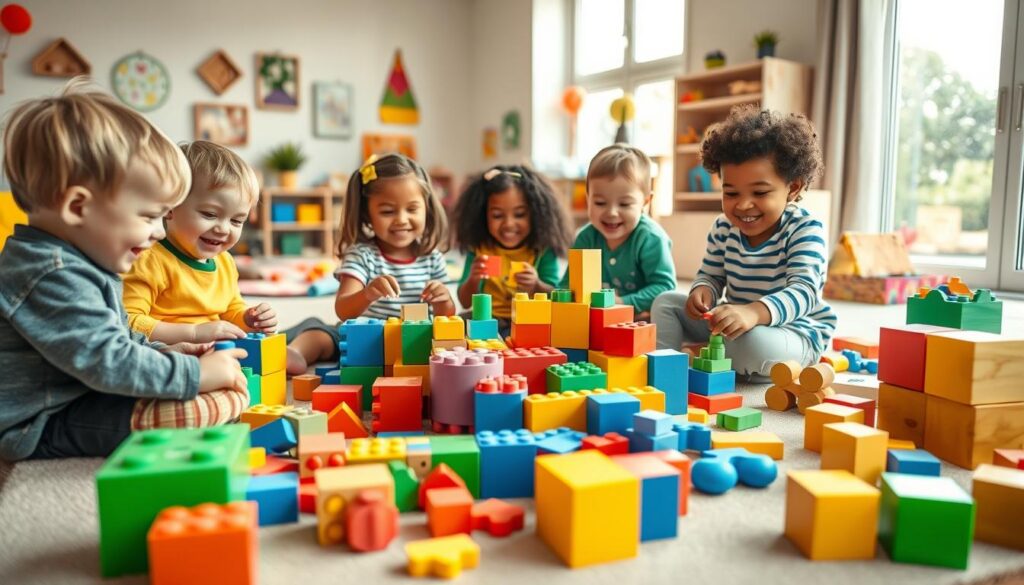
For the youngest builders, the goal is to engage the senses and introduce basic concepts. Provide soft, textured blocks that are easy to hold and safe. These interactive brain-building games help infants learn about weight, balance, and space through touch and movement.
Encourage your toddler to stack blocks to see them fall. This simple act helps build the brain’s logical thinking pathways. For more ideas, check out brain-boosting with building play to keep your little one engaged.
Complex Engineering Challenges for Preschoolers
As preschoolers grow, their ability to design and build complex structures increases. Introduce educational games for brain development that challenge them to build bridges, towers, or enclosures. These tasks push their thinking and encourage them to consider structure and symmetry.
When a structure collapses, see it as a chance to learn, not fail. Ask your child why it fell and how to make it stronger. This helps build resilience and critical thinking skills for their future.
| Developmental Stage | Primary Focus | Recommended Activity |
|---|---|---|
| Infants (0-18 months) | Sensory Input | Stacking soft, textured blocks |
| Toddlers (18-36 months) | Cause and Effect | Building simple towers and knocking them down |
| Preschoolers (3-5 years) | Problem Solving | Creating complex structures with specific goals |
The Impact of Parental Involvement on Cognitive Outcomes
Being involved in your child’s construction play is key. It gives them the support they need to hit new cognitive heights. Your presence builds a secure emotional foundation for them to explore and try new things.
By enhancing cognitive skills through games, you turn playtime into a learning space. This space boosts both their smarts and confidence.
Scaffolding Techniques for Parents
Scaffolding is a way to help your child learn by giving them just enough help. You offer gentle prompts or physical assistance to help them get the task done. This way, they stay in charge of their play.
As they get better, you slowly step back to let them do it on their own. This dynamic interaction helps build their problem-solving skills. By enhancing cognitive skills through games, you help them move from simple tasks to more complex ones.
Asking Open-Ended Questions to Stimulate Critical Thinking
Don’t ask simple “yes” or “no” questions. Instead, ask ones that make them think deeply. For example, “What do you think will happen if we add another block to this side?” makes them think like a scientist.
These questions help them analyze and test their ideas. When you focus on enhancing cognitive skills through games, you teach them to think critically. This thoughtful engagement makes every building session a lesson in logic and structure.
Overcoming Common Challenges in Construction Play
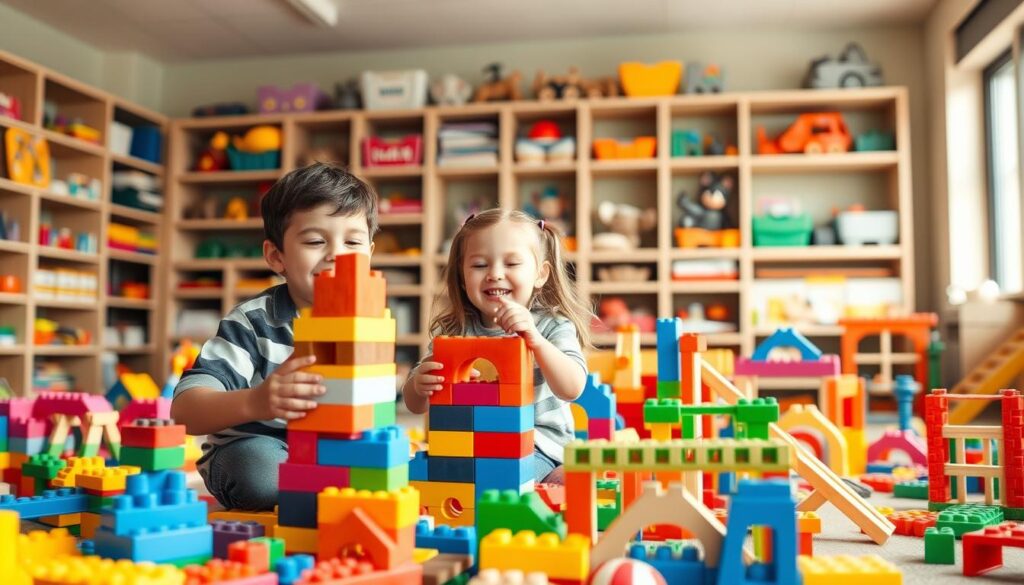
When a tower falls, it might seem like a failure. But it’s really a chance to learn. Your child might get upset when their creation crumbles. Yet, these moments help them grow emotionally.
Playing games that teach through fun is key. It lets kids deal with their feelings in a safe place.
Managing Frustration When Structures Collapse
It’s normal for toddlers to feel sad when their blocks fall. Instead of fixing it, validate their feelings and encourage them to try again. This helps them learn to keep going, which is good for their brain and self-control.
Being calm when they’re upset shows them how to handle disappointment. You can turn these moments into fun brain-building games. Ask them, “What do you think made it fall?” This makes them excited to solve a new problem.
Balancing Structured Instructions Versus Free Play
It’s important to mix structured play with free play. Structured play teaches kids to follow steps, while free play boosts creativity and innovation. Both are essential for growth.
The table below shows how different play styles help your child grow:
| Play Style | Primary Benefit | Parental Role |
|---|---|---|
| Structured | Focus and Logic | Guiding the steps |
| Free Play | Imagination | Observing quietly |
| Combined | Problem Solving | Asking open questions |
The goal is to keep it fun. Whether they’re following a guide or using their imagination, these fun brain-building games lay the groundwork for lifelong learning. Remember, the journey of building is more important than the end result.
Integrating Educational Brain Games into Daily Routines
Turn daily playtime into a tool for brain growth. By adding educational brain games to your routine, you help your child improve their thinking skills. These habits turn everyday moments into chances for brain training activities that help them grow.
Creating a Dedicated Building Environment
Having a special area for building play helps your child focus. A quiet, clean space encourages deep thinking and creative exploration. It tells your child it’s time for serious play.
Use a low table or a soft rug to mark the building area. Keep blocks and toys in easy-to-reach bins. This setup lets your child start brain training activities whenever they want.
Consistency and the Power of Repetitive Play
Consistency is key to mastering the mind. Repeating building tasks sharpens motor skills and deepens understanding. This repetitive play lets them try new things and solve problems with more confidence.
Don’t forget, sleep is essential for brain growth. Enough rest gives your child the energy to play these educational brain games well. A rested brain learns and remembers better.
| Environment Type | Focus Level | Cognitive Benefit |
|---|---|---|
| Dedicated Building Zone | High | Improved Problem Solving |
| General Play Area | Moderate | Creative Exploration |
| Shared Living Space | Low | Social Interaction |
Conclusion
Your child has a huge chance to grow in these early years. Every block they stack and every structure they balance is key to their growing mind.
You can shape their mind by choosing hands-on activities. Adding educational brain games to your day makes playtime a learning adventure.
These moments of discovery help make strong neural connections. This supports their future in school. Brands like LEGO Duplo or Magna-Tiles are great for sparking curiosity.
Being there and involved is the best way to help them grow. Your active role turns simple building into a lesson in logic and creativity.
Stick with these brain games to help your child feel confident in learning. Small steps today lead to big gains in their future.