
Can a simple stack of blocks change how a child sees the world? I ask this because I have watched curious kids turn play into discovery, and I want to know what science confirms about that process.
I trust hands-on play. Trusted by over 10 million parents, Keiki provides resources that help youngsters develop key skills through interactive, creative play. When a child stacks objects, they explore balance, cause and effect, and spatial thinking.
I have seen how a child build activity boosts confidence and problem solving. These play moments bridge abstract ideas and the tangible world, helping kids learn to manipulate objects toward a goal.
Key Takeaways
- Hands-on play supports early cognitive and motor skills.
- Simple stacking and construction teach spatial reasoning.
- Platforms like Keiki are trusted by millions of parents.
- Playful making boosts confidence and goal-focused thinking.
- Every child’s build process is unique and worth nurturing.
The Science Behind Building Games for Children
When kids assemble pieces, their minds map out problems and solutions in real time.
I find that building games act as practical training for the brain. They push a child to plan, test ideas, and fix mistakes.
When a young maker tackles construction, they learn balance, weight, and shape by doing. This hands-on work strengthens spatial thinking and patience.
Research links these activities to better planning, teamwork, and logical thought. Children learn to predict outcomes and to adapt when a structure falls.
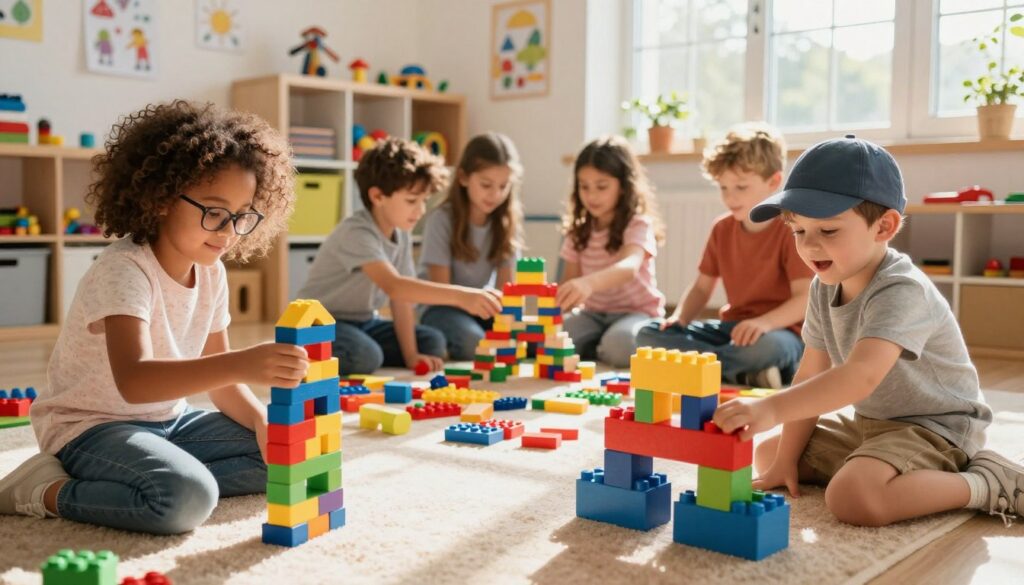
- Real-time problem solving
- Practice with physical principles
- Social skills and patience
| Skill Developed | Example Activity | The Benefits |
|---|---|---|
| Spatial reasoning | Stacking blocks to fit a shape | Improves mental rotation and planning |
| Problem solving | Adjusting a leaning tower | Builds prediction and correction skills |
| Patience & teamwork | Collaborative model making | Enhances focus and social coordination |
| Fine motor control | Placing small connectors | Refines hand-eye coordination |
I encourage parents to watch how their child approaches each task. Observing strategies reveals growing problem-solving habits and budding creativity.
Cognitive Benefits of Construction Play
Simple block play reveals how a young mind forms hypotheses and checks results through action.
Logic and Critical Thinking
I have observed that play with blocks helps kids develop logic and critical thinking by making them solve balance and weight puzzles.
Each tower and failed attempt becomes a small experiment. When a structure falls, the child tests a new approach and refines planning skills.
Spatial Awareness
When a child learns to judge size and distance, they master spatial awareness, a base for later math and engineering learning.
I also see how filling a box with different shapes teaches how parts fit in three-dimensional space and boosts problem-solving.
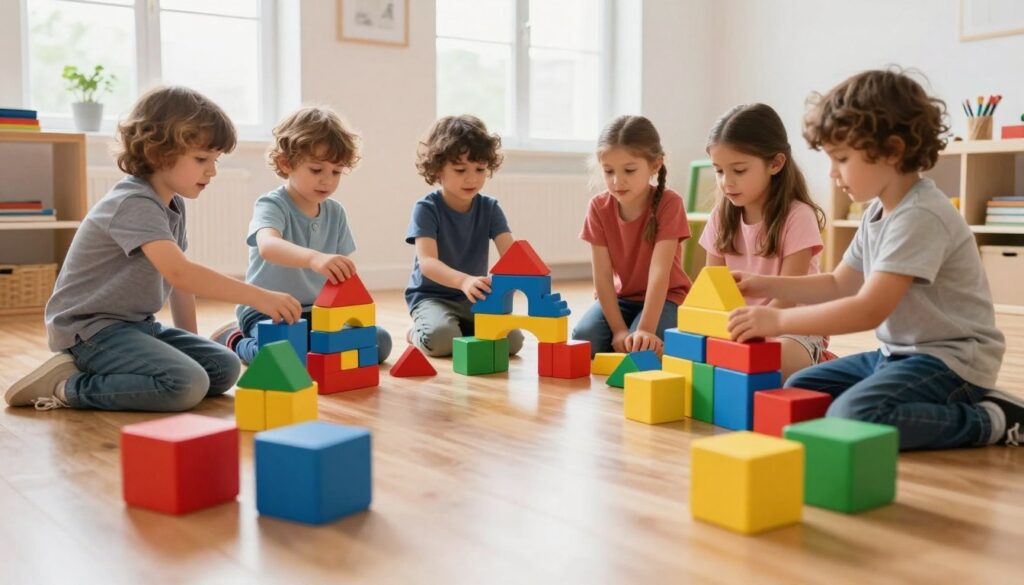
Fine and Gross Motor Skills
Manipulating tiny blocks trains fine motor skills and hand-eye coordination.
Moving larger pieces or stacking a tall tower strengthens gross motor control and perseverance.
Using plastic or wooden building blocks lights imagination and supports steady cognitive development.
- Improves focused thinking and trial-and-error learning
- Builds spatial reasoning and planning
- Develops both fine and gross motor skills
How Building Skills Evolve Through the Years
Watching small hands sort and stack over time reveals a clear path of skill growth.
Logic and Critical Thinking
I see a steady rise in planning and testing as kids grow. Between 1 and 2 years a child tries to stack blocks mainly to feel weight and texture.
From about 3 to 5 years they plan a simple house or road and test stability. By 6+ years they begin to think like young engineers and design supports.
Spatial Awareness
Early play is sensory; the child learns how objects fit and move.
Preschool time brings purposeful layouts and scale thinking. Older kids imagine maps and layered structures.
Fine and Gross Motor Skills
Small pieces train fine control. Larger pieces build strength and coordination.
I often tell parents that the time spent in these years sets a strong foundation for later learning.
“Every stage shows new challenges — celebrate each small triumph.”
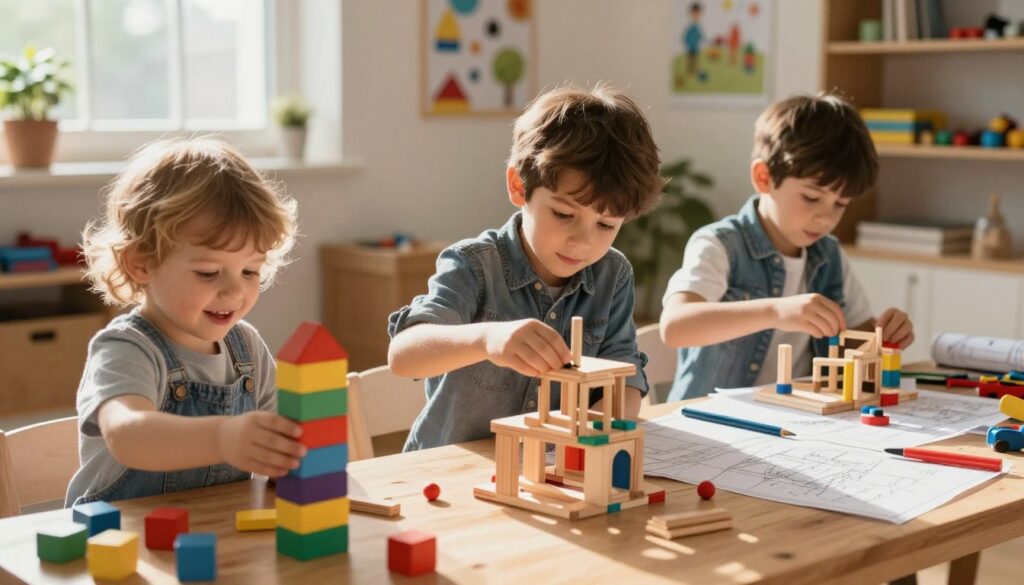
| Age Range | Typical Focus | Key Outcome |
|---|---|---|
| 1–2 years | Sensory play, stack blocks, mouth and touch | Object properties and hand control |
| 3–5 years | Purposeful play: toy house, roads | Planning, scale, cooperation |
| 6+ years | Complex models and supports | Engineering thinking and persistence |
Practical tip: Choose age-appropriate materials and follow a child’s lead. For additional activities to support early executive skills, see executive function activities for preschoolers.
Essential Materials for Creative Construction
I recommend a mix of simple and durable supplies to spark long-lasting creative play.
Wooden blocks are a classic I suggest first. They teach weight, balance, and spatial thinking while feeling solid in small hands.
LEGO building blocks help a child follow steps and create detailed models. I like them for sequential thinking and fine motor practice.
Cardboard boxes are the most accessible material. A plain box can become a castle, a car, or a tiny city that feeds imagination.
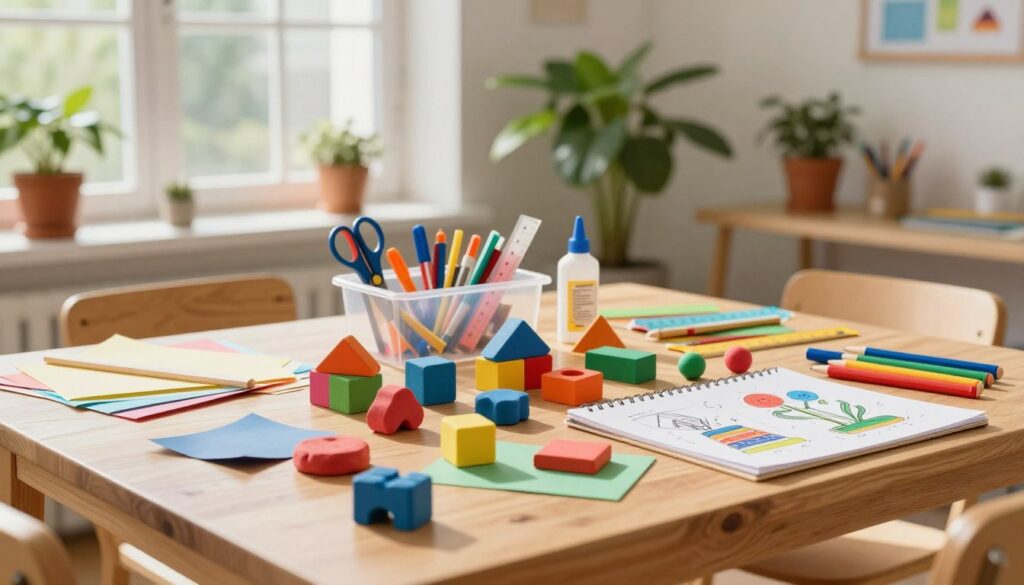
- Magnetic sets introduce basic physics and spark scientific curiosity.
- Mix plastics, wood, and natural items to keep play fresh and varied.
- Create a dedicated corner where all materials live so kids build daily.
- Offer boxes of different sizes to prompt new ideas and scale experiments.
My core belief: the best toys let a child fully engage creativity and practical skills. Keep materials safe, labeled, and easy to reach.
Classic Indoor Building Activities
A stack of pillows and a few blankets can spark hours of focused play and discovery. These low-cost activities use everyday materials to teach balance, planning, and creativity.
Fortress of Pillows and Blankets
I love the classic fortress of pillows and blankets because it shows how a child can use household items to construct a cozy hideout.
Turn chairs into supports, drape sheets, and add soft toys as props. A chair tunnel with blankets also helps gross motor skills as kids crawl and explore.
Box Castle Projects
My research shows that a box castle made from cardboard of different sizes is a top activity kids enjoy.
Suggest turning one box into a house and another into a robot. Use tape, markers, and safe scissors to add doors and windows.
- Quick challenge: set a 3–5 minute timer to encourage fast, playful construction.
- Towers with plastic cups or blocks teach patience and fine control as a child stacks higher.
- These simple projects make ordinary materials into meaningful toys and lasting memories.
For more indoor activity ideas, see indoor activity ideas.
Exploring Nature Through Structural Play
Collecting twigs, stones, and leaves can spark a dozen small experiments in one afternoon.
I often take a child outdoors to search for natural materials. This turns a walk into playful construction and quiet science work.
Flat stones stacked into a small tower teach balance and patience. I watch how each placement changes the whole pile.
Making a tiny bug house from sticks and leaves helps a child notice habitats and textures. It forms a gentle bond with the animal world.
Sandbox castles are another great example that boosts imagination and planning. Building with sand also trains fine motor skills and persistence.
I love when a child weaves twigs and feathers into a bird’s nest. That activity mixes creativity with careful hand control.
- I encourage parents to collect materials together; it adds purpose to the trip.
- A circle of stones can become a pretend pond and a lively creative game.
- These outdoor projects teach care for the world while they play.
| Activity | Natural Materials | Key Benefit |
|---|---|---|
| Stone tower | Flat stones | Balance and spatial reasoning |
| Bug house | Sticks, leaves | Observation and habitat awareness |
| Sandbox castle | Sand, shells | Fine motor skills and imagination |
| Bird’s nest craft | Twigs, feathers | Dexterity and animal study |
Supporting Your Child During Building Sessions
When I sit nearby, I notice how asking one simple question can change a play session.
My aim is to help parents prompt independent thinking without taking over. Small nudges and open questions let a child lead while you observe progress in real time.
Tips for Encouraging Independent Thinking
- I often tell parents to ask child questions like, “What do you think will happen if you put this block here?” This sparks prediction and planning.
- If you help child by steadying a piece of a tower, keep them the main architect. Let them decide placement and test adjustments.
- Praise effort and problem solving rather than the final model. Saying “I like how you tried a new idea” builds resilience.
- Create a small building corner with pillows, a box, and easy-to-reach objects so kids can play any time they want.
- When a child try a new design and it collapses, frame the moment as data. A fallen tower is a lesson, not failure.
- Offer varied materials and ask open-ended prompts to grow creativity and thinking during each session.
These simple moves help a child build confidence, useful skills, and a lasting love of creative play.
Digital Tools and Apps for Modern Builders
Digital tools can turn a simple idea into an interactive lesson that a young mind loves to explore. I recommend the Keiki app as a gentle bridge between hands-on play and screen-based learning.
Well-designed games in that app focus on pattern, balance, and spatial thinking. They use short levels that reward trial and quick fixes. This helps a child practice planning without frustration.
I also value a single, clear game session that ends with a small success. Those moments build confidence and invite another try later.
When paired with blocks or boxes, the digital prompts add an extra layer of explanation. Parents should look for ad-free options and age-appropriate controls to keep sessions safe.
“An app that complements hands-on play turns abstract ideas into playful puzzles.”
Used in moderation, these tools enhance creativity and problem solving. I often suggest they be one part of a mixed play routine at home.
Popular Virtual Construction Games
Many virtual sandboxes let a young player shape entire landscapes with a few keystrokes.
I recommend treating digital titles as another creative tool. They let a child build ideas fast and test designs without lost pieces or long cleanup. Used well, these apps train spatial thinking and planning across years of play.
Minecraft: Creative Exploration
Minecraft, released in 2011, is a top 3D title for kids age 10 and up. Its open world encourages large-scale projects, from a simple house to a massive tower.
Toca Builders: Play for Younger Players
Toca Builders suits younger ages with six characters—Jum-Jum, Vex, Cooper, Stretch, Connie, and Blox—that guide play. The hands-on tools simplify block placement and reward bright ideas.
- Block Craft has over 100 million downloads and lets kids create jetfighters and houses.
- I note that Blocksworld offers drag-and-drop building and that Block Story mixes role-play with 3D construction.
- Growtopia and Lego Creator Island show how collecting and earning bricks turns play into long-term development of creativity and planning.
- When you ask child to try these titles, you help them grow spatial skills and problem-solving.
“Digital sandboxes extend real-world play by letting kids create without limits.”
Navigating the World of Sandbox Gaming
These freeform virtual spaces let a young mind invent goals and chase them in a safe setting.
I have observed that sandbox play offers an open world where a child can create and explore without the pressure of strict rules.
My experience shows these spaces build a strong sense of achievement. A child shapes their own reality and gains pride in self-directed success.
When a child navigates this space, they learn to make decisions and solve problems in creative ways. I often suggest parents guide play gently and set clear boundaries.
I also recommend parents join a session now and then. Playing alongside helps adults understand the mechanics and share the joy of creation.
“Give guided freedom: it grows independence and confidence.”
To learn more about the design behind these environments, see sandbox game. For parent-focused resources, check The Playful Kids.
Balancing Physical and Digital Play
A healthy mix of tactile play and short digital sessions helps a young mind grow in different ways.
I always recommend that parents help child find a sensible routine that blends hands-on activity with limited screen time. Physical play builds fine and gross motor skills. Digital play can sharpen logic and planning.
Use digital tools as a supplement, not a replacement. Let apps introduce ideas, then invite a child to test them with blocks, boxes, or natural materials. This back-and-forth deepens understanding and boosts practical problem solving.
I suggest clear boundaries: short sessions, predictable limits, and device-free periods for active play. Watch how your child responds and adjust the mix to match their interests and energy.
- Alternate tactile projects and focused screen time.
- Choose apps that reward trial and low frustration.
- Praise effort and creative thinking over perfect outcomes.
| Mode | Main Benefit | Parent Role |
|---|---|---|
| Physical play | Motor control, sensory learning | Provide materials and space |
| Digital app | Logical puzzles, pattern recognition | Pick age-appropriate apps and set limits |
| Mixed sessions | Applied thinking and creativity | Encourage transfer between screens and real objects |
Safety Considerations for Young Architects
Checking age ratings and online features helps keep play safe and age-appropriate.
I always advise parents to check the recommended age on any title before allowing access. Ratings exist to guide maturity and content exposure.
My research shows that titles like Fortnite are rated for players aged 13 and above and may not suit younger users. I suggest adults play a short session themselves to review content and chat with their child about what they saw.
- Monitor online interactions and privacy settings to keep accounts secure.
- When you ask child about a session, you learn how they feel and what they notice.
- Play the game first to judge suitability and set clear boundaries.
- Discuss risks and model respectful behavior in chats and team play.
“Open conversation and simple checks are the best tools to protect a young player’s experience.”
Stay involved, stay curious, and use ratings as a starting point to protect privacy and well-being.
Conclusion
My aim has been to show how playful projects spark logic, creativity, and persistence.
Building games and short play sessions shape problem solving and social skills. These moments turn simple activities into lasting cognitive development.
I encourage you to mix hands-on work with a well-chosen app to help child test ideas and grow new skills. Use varied materials and set small challenges as the years pass.
Construction games and digital tools both support thinking, planning, and creative expression. Celebrate each small success and keep exploring fresh ideas together.
Thank you for reading. I wish you many joyful, curious, and meaningful play sessions ahead.