
Most parents who want to replace screen time with physical play do not need more reasons to reduce device use. Instead, they need to know what can fill the empty space. What can you offer at 4 p.m. when the tablet usually comes out? What can you do when your child responds to an activity suggestion with a groan?
This guide focuses on practical replacements. First, you will find a screen-to-play chart that matches common screen moments with physical activities of a similar length. Next, you will find indoor and outdoor games, a realistic daily routine, useful equipment, and simple ways to make the new habit easier to maintain.
The activities are designed mainly for children ages 3 to 12. However, many can be simplified for younger children or made more challenging for older children.
You do not need to ban devices to make this approach work. In the 2021 Common Sense Census, children ages 8 to 12 averaged about five and a half hours of entertainment media per day, while teens averaged about eight and a half hours. Schoolwork was not included in those figures. Therefore, many families may be able to reclaim one manageable part of the day without trying to eliminate every screen activity at once.
Why Replacing Screen Time Works Better Than Banning It
Removing something a child enjoys can create an immediate conflict. Replacing it with a prepared choice gives the child something specific to do instead.
A replacement also changes the conversation. Rather than repeating, “Turn off the tablet,” you can say, “Would you rather play balloon volleyball or try the hallway obstacle course?”
What Long Screen Sessions Can Displace
Screens are not automatically harmful. They can support communication, entertainment, creativity, and learning. However, long or poorly timed sessions may take the place of movement, outdoor play, face-to-face interaction, family routines, or sleep.
For example, an hour spent sitting with a device is also an hour that is unavailable for climbing, running, balancing, building, talking, or playing with another person. The concern is not only the number of minutes. It is also what those minutes replace.
Evening screen use can be especially difficult when it interferes with a calm bedtime routine. For this reason, many families benefit from ending entertainment screen use before bedtime and charging devices outside children’s bedrooms.
What Children Gain From the Trade
Physical play gives children opportunities to practice skills that are difficult to develop while sitting with a device.
When children invent a game, discuss a rule, wait for a turn, and change the activity so that a younger sibling can participate, they practice planning, communication, cooperation, and flexible thinking.
Movement activities can also support balance, coordination, strength, body awareness, and confidence. For a broader explanation of what active play may support at different ages, see our guide to physical play for kids [INTERNAL LINK TO ADD LATER: Physical Play for Kids: Benefits, Ideas, and How to Encourage It].
Why Swapping Beats Restriction
A rule that only removes an activity may invite negotiation every day. In contrast, a prepared replacement answers the question children are often asking: “What am I supposed to do instead?”
Start with one recurring screen session rather than creating a complete family policy overnight. Once that replacement feels familiar, choose a second moment to change.
Our related guide on why active play works better than limiting screen time [INTERNAL LINK TO ADD LATER: Why Active Play Works Better Than Limiting Screen Time for Kids] explains why gradual replacement may be easier to maintain than sudden restriction.
The Screen-to-Play Swap Chart
Instead of trying to reduce screen time in general, choose one recurring moment from the chart below. Prepare the replacement in advance, then use the same swap for one week before deciding whether it works for your family.
| Screen moment | Physical swap that fits the same period | Time needed | Why it may work |
|---|---|---|---|
| Waiting to leave in the morning | Walk around the block or dance to two songs | 10 minutes | A short activity can add movement without disrupting the entire morning routine |
| Right after school | Outdoor free play before homework | 20 to 30 minutes | Movement gives children a transition between school and home responsibilities |
| While an adult prepares dinner | Hallway obstacle course, balloon keep-up, or setting the table against a timer | 10 to 15 minutes | The child stays nearby and has a clear task |
| Homework break | Animal walks, a tidy-up challenge, stretching, or balloon keep-up | 3 to 5 minutes | A short movement break may help the child return to the task |
| Long car ride | Spotting games during the drive, followed by movement at safe rest stops | Ongoing | Active stops can reduce restlessness during a long journey |
| Restaurant or appointment wait | A short supervised walk or simple standing movement game | 5 to 10 minutes | Movement gives the child something purposeful to do while waiting |
| Rainy weekend morning | Indoor obstacle course, balloon volleyball, dance game, or fort-building challenge | 30 to 45 minutes | A longer empty period usually needs a larger activity |
| Hour before bed | Gentle stretching, simple yoga poses, or a story with actions | 10 to 15 minutes | A calm physical activity can support the transition toward bedtime |
Two details make these swaps easier to use.
First, prepare the activity before the usual screen moment arrives. A child who must wait while you search for a ball, clear the hallway, or find the painter’s tape may return to asking for the device.
Next, offer two acceptable options rather than asking an open-ended question. A choice between two activities moves the decision away from whether the child will participate and toward which activity they prefer.
Games That Actually Replace a Screen Session
The best replacement activities are not necessarily the most creative ones. Usually, they are the activities that can begin quickly, require little preparation, and fit the space available.
Outdoor Activities You Can Encourage
A nature scavenger hunt can turn an ordinary walk into a clear mission. Give children a short list with a definite ending, such as one pinecone, a smooth pebble, something yellow, and a leaf larger than their hand.
Family walks and bike rides often work better when they include a destination. For example, walk to a playground, ride to a picnic area, or stop for a short game of tag at the halfway point.
A backyard obstacle course can be made with cones, cardboard boxes, chalk, ropes, and buckets. Children might run around one cone, crawl under a rope, jump between chalk marks, and carry a ball to the finish line.
Instead of ranking children against one another, let each child repeat the course and try to improve their own time or complete it with greater control.
Indoor Play Ideas for Rainy Days
An indoor obstacle course can use couch cushions, painter’s tape, cardboard boxes, and stable household objects. Keep every station at floor level. In addition, remove hard objects, unstable furniture, and anything children may be tempted to climb.
Balloon volleyball works well in smaller spaces because the balloon moves slowly. Place a line of painter’s tape on the floor and ask children to tap the balloon across it without letting it touch the ground.
Other quick indoor options include:
- freeze dance;
- animal walks;
- follow-the-leader;
- hallway bowling with soft balls;
- sock toss into a laundry basket;
- jumping between tape marks;
- action songs;
- simple yoga poses;
- a movement dice game.
Choose activities that fit the child’s energy level. For example, freeze dance may work well after school, while stretching or slow animal walks may be more appropriate before bedtime.
When a Calmer Screen-Free Swap Is Better
Sometimes a child needs a break from screens but is not ready for active movement. In that case, painting, modeling dough, building, cooking, puzzles, or board games can still provide a useful hands-on alternative.
These activities are not replacements for physical play. However, they can protect quieter parts of the day while still encouraging creativity, hand control, conversation, and problem-solving.
Community Programs and Group Play
Community activities can provide social motivation and a predictable schedule. Check public libraries for movement-based storytimes, municipal recreation departments for drop-in play, and community centers for family swim or open-gym sessions.
Playgrounds also provide opportunities for climbing, balancing, running, and imaginative play. Stay close enough to supervise, then allow children to attempt manageable challenges within the limits of the equipment and their abilities.
Recreational home trampolines should not be treated like ordinary backyard equipment. The American Academy of Pediatrics discourages recreational trampoline use because of the risk of fractures, head injuries, and other serious injuries.
| Activity type | Sample ideas | General age range | Main opportunity |
| Outdoor adventures | Scavenger hunts, bike rides, walking games, tag | 3 to 12 years | Coordination and endurance |
| Backyard challenges | Obstacle courses, jumping games, target throws | 4 to 10 years | Agility and problem-solving |
| Indoor active play | Balloon volleyball, dance, animal walks | 2 to 12 years | Movement in a smaller space |
| Community activities | Storytimes, open gym, swimming, recreation classes | Varies by program | Social play and structured participation |
Age ranges are general recommendations. Always consider the child’s abilities, the equipment, and the level of supervision required.
Creating a Balanced Screen Time Schedule
Clear and realistic routines can reduce daily negotiation. Instead of creating many complicated rules, begin with two or three boundaries that your family can apply consistently.
For example:
- keep meals screen-free;
- avoid entertainment screens during the bedtime routine;
- charge devices outside children’s bedrooms;
- complete important routines before recreational screen use;
- protect at least one active period each day.
Set Screen Boundaries That Fit Your Child and Family
Current American Academy of Pediatrics guidance does not treat screen use as a question of minutes alone. It encourages families to consider the child, the type of content, the context in which media is used, and what the media experience may be replacing.
This means that families should consider questions such as:
- Is the content appropriate for the child?
- Is the screen helping with learning, creativity, communication, or relaxation?
- Is it replacing sleep, movement, school responsibilities, or family interaction?
- Can the child stop without becoming extremely distressed?
- Is an adult available to guide or discuss the content?
- Do the family’s boundaries remain consistent?
The AAP’s 2026 policy also recognizes that digital platforms are designed to hold attention. Therefore, difficulty ending screen use is not always a sign of weak parenting or poor behavior. Autoplay, notifications, recommendations, and reward systems can make stopping difficult for both children and adults.
Rather than relying only on one universal limit, create boundaries that protect sleep, physical activity, schoolwork, relationships, and screen-free routines.
Integrating Play Into Daily Routines
Build the day around predictable active periods instead of discussing screen limits every time a device appears.
For example, a family may use:
- a short movement activity before school;
- outdoor play after school;
- an active break during homework;
- a screen-free dinner;
- calm movement before bedtime.
Visual schedules can help younger children understand what happens next. Timers may also reduce conflict because the signal ends the session instead of making the adult appear to end it unexpectedly.
Give a warning before transitions. For example, say, “Five more minutes, then we are putting the tablet away and choosing a movement card.”
A Sample Daily Schedule
Morning: Offer 10 to 20 minutes of stretching, dancing, walking, or active play when the schedule allows.
After school: Provide a snack, then offer 20 to 30 minutes of outdoor play or another movement activity before homework.
Homework period: Add a three to five minute movement break between longer tasks.
Evening: Keep dinner screen-free, then offer a family activity, independent play, or a limited planned screen session.
Bedtime: End stimulating screen activities before the bedtime routine. Charge devices outside the bedroom when practical.
Some families use physical activity to help children earn screen minutes. Although this may work temporarily, it can also teach children that screens are the prize and movement is the price.
If you use this method, keep it temporary. Gradually move toward a routine in which both screen use and physical play have appropriate places in the day.
Engaging Your Kids in Physical Activities
Small changes that your family can maintain are usually more useful than an ambitious plan that disappears after several days.
Let children make limited choices, keep simple equipment within reach, and protect short windows for movement.
Encouraging Independent Play
Create an activity jar with simple ideas written on slips of paper. When a child asks for a device because they are bored, invite them to choose one or two movement ideas from the jar.
Possible activity cards include:
- dance to one song;
- complete ten animal steps;
- toss socks into a basket;
- build a three-station obstacle course;
- walk backward along a tape line;
- keep a balloon in the air;
- create a new jumping pattern;
- race to collect five toys.
Keep balls, chalk, jump ropes, beanbags, and other frequently used items in an accessible place. However, store equipment that requires direct supervision out of reach.
Rotate a few materials periodically instead of placing everything out at once. A small change in available equipment may renew interest without requiring new purchases.
Involving Friends and Family
Group play may hold a child’s attention longer than solo activity. Plan a family walk, invite a friend for a backyard game, or arrange a regular playground visit with another family.
Adults can join without controlling every decision. For instance, help children begin the game, clarify the safety boundaries, and then allow them to create variations.
For younger children, our guide to simple physical challenges for toddlers [KEEP EXISTING URL] includes activities that work with one adult and one child.
Setting Challenges and Personal Goals
Keep goals short, personal, and easy to understand.
A child might try to:
- keep a balloon in the air five times;
- balance on a tape line;
- complete the course without touching a marker;
- jump between four targets;
- carry a beanbag without dropping it;
- repeat the activity using the opposite side of the body.
Avoid comparing siblings with different ages or abilities. Instead, help each child notice their own progress.
Use specific encouragement. Rather than saying only, “Good job,” you might say, “You slowed down at the turn and kept your balance,” or “You tried a different way after the first one did not work.”
Choosing the Right Equipment and Toys
Equipment matters less than accessibility. Items that are easy to reach and quick to use are more likely to become part of the daily routine.
You do not need a large collection. A few versatile items can support many different games.
Outdoor Basics Worth Owning
Useful outdoor basics may include:
- an age-appropriate ball;
- sidewalk chalk;
- cones or upturned buckets;
- a jump rope;
- a foam flying disc;
- a balance bike or bicycle;
- beanbags;
- a small selection of outdoor loose parts.
A balance bike may be appropriate for many children between approximately 2 and 5 years old. However, the correct size depends on the child’s height and ability to place both feet securely on the ground.
Use a properly fitted helmet for bikes, balance bikes, scooters, skateboards, and other wheeled activities.
Indoor Options That Invite Movement
Indoor materials may include:
- painter’s tape;
- balloons;
- soft balls;
- beanbags;
- stable floor cushions;
- movement cards;
- a soft exercise mat;
- a child-safe indoor climbing structure.
Follow the manufacturer’s age, weight, installation, and supervision instructions for climbing equipment. In addition, use an appropriate surface and keep nearby furniture away from the fall area.
Building sets, art supplies, puzzles, and modeling dough belong in the quieter screen-free category rather than the physical-play category.
Safety Checks Before Play
Before each activity:
- Check the play area for tripping hazards.
- Inspect equipment for broken, loose, or sharp parts.
- Keep small pieces away from children who may place objects in their mouths.
- Make sure wheeled equipment is used away from traffic.
- Use life jackets and direct adult supervision near water.
- Confirm that children have enough space to move without colliding.
- Adjust the challenge to each child’s current ability.
When using stairs, require walking rather than running. Make sure the steps are clear and provide close supervision.
During long trips, allow movement only at a designated rest area or another location safely separated from moving vehicles.
Indoor obstacle courses should remain at floor level. Children should not jump from couches, tables, shelves, or other furniture.
Reasonable challenge is part of active play. However, the goal is to provide manageable risks while reducing hazards that children cannot recognize or control.
For more ideas, see our collection of fun activities to keep kids entertained [KEEP EXISTING URL].
| Item | General age range | Main opportunity | Important safety check |
| Balance bike | Approximately 2 to 5 years | Balance and gross motor control | Use a helmet and check the fit and tires |
| Soccer or playground ball | 3 years and older | Coordination and cooperative play | Clear the area of obstacles |
| Foam flying disc | 4 years and older | Timing and spatial awareness | Play away from roads and windows |
| Jump rope | Approximately 5 years and older | Rhythm and endurance | Use a flat, non-slip surface |
| Painter’s tape and beanbags | 2 years and older | Balance, aim, and indoor movement | Keep the floor clear |
Making Physical Activity Fun and Exciting
Children may lose interest when an activity always looks exactly the same. Fortunately, small changes can renew interest without requiring an entirely new game.
Change one element at a time. For example, add music, introduce a theme, change the route, include a new movement, or allow the child to design one part of the activity.
Themed Play Days and Events
Simple themes can turn familiar movements into imaginative challenges.
Possible themes include:
- superhero training course;
- pirate treasure hunt;
- animal rescue mission;
- space explorer challenge;
- jungle movement trail;
- construction worker relay;
- nature detective walk.
For a superhero course, children might crawl through a tunnel, jump over a tape line, carry a soft object to safety, and balance along a narrow path.
The activity does not need elaborate decorations. A few names, props, and imaginative instructions may be enough.
Incorporating Music and Dance
Music can make movement feel spontaneous and enjoyable.
Try:
- freeze dance;
- action songs;
- follow-the-leader dancing;
- slow and fast movement games;
- marching with simple instruments;
- copying a family member’s dance pattern;
- moving like different animals.
Depending on the child’s age and comfort level, a structured action song may work better than open-ended dancing.
Keep the volume at a comfortable level, especially for children who prefer quieter sensory experiences.
Creating Obstacle Courses
Build a course with objects already available, such as cones, ropes, chalk, cardboard boxes, cushions, and beanbags.
A simple course might ask children to:
- walk along a tape line;
- crawl through a cardboard tunnel;
- step over three low markers;
- toss a beanbag into a basket;
- return to the starting point.
Change one or two stations each week. This keeps the activity familiar while adding enough novelty to maintain interest.
Time trials can be used as personal challenges. For mixed-age groups, children can also complete the course cooperatively and try to beat a shared time.
Establishing Routine and Consistency
Habits become easier when children know when an activity will happen and what comes next.
Two or three predictable rules are generally easier to maintain than a detailed plan that changes every day.
Daily Playtime Scheduling
Choose one realistic active period and protect it.
For example, your family might begin with:
- ten minutes before school;
- twenty minutes after school;
- one short break during homework;
- a family walk after dinner.
Make the routine visible. A wall schedule with simple words or pictures can help children follow the sequence without repeated reminders.
Our guide on adding movement to your child’s daily routine [INTERNAL LINK TO ADD LATER: How to Add Movement and Active Play to Your Child’s Daily Routine] covers this process in more detail.
Weekend Activity Ideas
Weekends may provide more time for larger activities.
Possible options include:
- family hikes;
- bike rides;
- swimming;
- playground visits;
- pickup soccer;
- nature scavenger hunts;
- recreation classes;
- library programs with movement;
- active visits with another family.
Keep the plan affordable and manageable. An ordinary park visit with another family may be easier to repeat than an expensive outing that requires extensive preparation.
Monitoring Progress and Adjusting
Watch how the routine affects:
- bedtime;
- mood;
- willingness to stop using the device;
- requests for screen entertainment;
- participation in family routines;
- interest in active play.
Do not expect a perfectly linear change. Some days will be more difficult because the child is tired, hungry, overstimulated, disappointed, or strongly interested in a specific online activity.
If the routine stops working, simplify it. Return to one reliable screen-to-play swap for several days, then build from there.
| Day | Before school | After school | Evening |
| Monday to Friday | Short stretch, dance, or walk | 20 to 30 minutes of active play | Screen-free meal and calm family activity |
| Saturday | Family walk, hike, or bike ride | Playground or community activity | Game night with movement rounds |
| Sunday | Yard play or neighborhood walk | Library, swimming, or indoor movement | Light activity and an early bedtime routine |
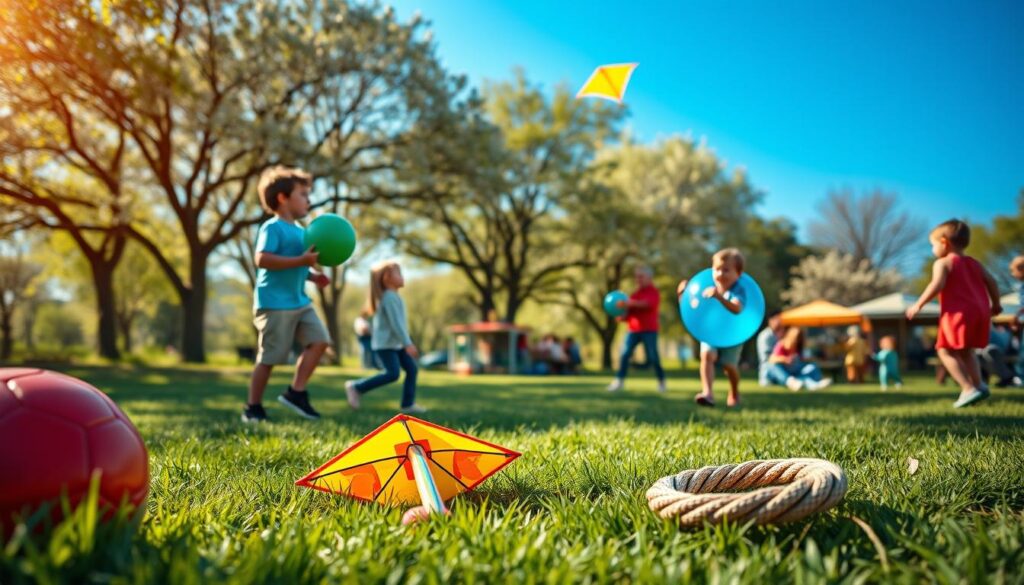
Involving the Community
Activities outside the home can provide structure, social connection, and access to spaces or equipment that families do not have at home.
A scheduled program may also be easier to maintain because it happens at a fixed time.
Finding Programs and Teams
Municipal recreation departments often offer seasonal leagues, swimming lessons, dance classes, open-gym periods, and introductory sports programs.
Schools may have intramural activities or information about nearby organizations. Public libraries may also offer movement storytimes, family events, and activity-based programs.
Before registering, check:
- the recommended age;
- the class size;
- the instructor’s qualifications;
- the level of supervision;
- the required equipment;
- the trial or cancellation policy;
- whether the program matches the child’s interests.
A trial session can help you determine whether the environment is appropriate before making a longer commitment.
Using Parks and Public Spaces
Parks, trails, playgrounds, and open fields provide opportunities for movement without requiring a large collection of equipment.
Vary the type of movement when possible. Children may climb at the playground, balance along a safe border, walk on different surfaces, throw a ball, or invent a chasing game.
Choose challenges that fit the child’s ability. Uneven ground, climbing structures, and wheeled activities require closer supervision and appropriate footwear.
Our guide to physical play ideas that build gross motor skills [KEEP EXISTING URL] includes activity plans that work well in parks and other open spaces.
| Community resource | What it may offer | How to use it |
| Parks and recreation department | Seasonal leagues, classes, and drop-in play | Check registration dates and age groups |
| Public library | Movement storytimes and family events | Attend regularly to build familiarity |
| Community center | Swimming, open gym, and family fitness | Ask about a trial visit |
| School programs | Clubs and intramural activities | Ask the school office about schedules |
Encouraging a Long-Term Love for Active Play
Children pay attention to what adults do, not only to what adults recommend.
Joining a walk, bike ride, dance session, or backyard game shows that movement is a normal part of family life. You do not need to participate in every activity. However, regular involvement can make active play feel more social and valuable.
Recognize specific progress. You might notice that a child balanced for longer, tried again after missing a target, helped a sibling understand a rule, or created a new variation.
Keep rotating a small number of activities. In addition, invite children to help choose the weekly plan. Participation in planning can give them more ownership over the routine.
Short movement breaks also matter on days when a longer screen session is necessary. Our guide on why kids need regular movement breaks from screens [INTERNAL LINK TO ADD LATER: Why Kids Need Regular Movement Breaks From Screens Every Day] explains how to include them without completely reorganizing the day.
Conclusion
The most practical way to replace screen time with physical play is to begin with one recurring moment.
Choose one row from the swap chart, prepare two activity options in advance, and repeat the replacement until it becomes familiar. Afterward, you can decide whether to introduce a second screen-to-play swap.
There is no single routine that works for every child. Adapt the activity to your child’s age, abilities, interests, energy level, and available space. The version your family can repeat is more valuable than an ideal plan that lasts only a few days.
For more indoor, outdoor, and family options, see our guide to screen-free physical activities for kids [INTERNAL LINK TO ADD LATER: Best Screen-Free Physical Activities for Kids: Fun Alternatives to Screen Time].
Reviewed by F.S., early childhood educator.
Frequently Asked Questions
How long does it take for a child to adjust to a screen-to-play swap?
There is no fixed timeline. Some children adjust after several consistent repetitions, while others need more time. Predictability is often more important than choosing a perfect activity. If the swap continues to create strong resistance, try changing the timing, simplifying the activity, or offering two different options.
Should children earn screen time by being physically active?
This method may provide short-term motivation. However, it can also present screen time as the reward and movement as the task children must complete to receive it. If your family uses this system, consider making it temporary and gradually moving toward a balanced routine where both activities have clear boundaries.
What if my child wants the device because friends are online?
Online gaming and communication may be an important part of a child’s social life. Therefore, removing it without considering the social connection may create frustration. Instead, protect reasonable online social time while also making in-person opportunities easier to arrange, such as a regular playdate, a neighborhood walk, or a community activity.
How can I manage screen swaps with children of different ages?
Choose an activity the youngest child can complete, then give the older child a more complex role. For example, the older child can design the course, keep time, explain the rules, or add a challenge. Cooperative games may work better than direct competition when children have a large age or ability difference.
Does educational screen time count the same as entertainment?
Not all screen experiences are equal. Interactive, age-appropriate content used with an adult may offer more value than passive viewing. However, educational content can still replace movement, sleep, conversation, or hands-on learning when sessions become too long. Consider the content, the context, and what the child would otherwise be doing.